Can Ball Valves Be Used for Throttling? Pros and Cons
Image URL: https://notebooklm.google.com/notebook/54d63303-f765-4521-8a20-4adb2031e5d0
Yes, a standard ball valve can reduce flow, but it is usually not the best choice for long throttling duty. This guide explains when it can work, why it often fails, and when a globe valve, V-port valve, or segmented design is a better option.
You will also learn the main pros, the main risks, and the key terms buyers often search for, such as can ball valves be used for throttling and can you use a ball valve to control flow. The goal is simple: help beginners choose the right valve with fewer mistakes.
What Throttling Means in Simple Terms
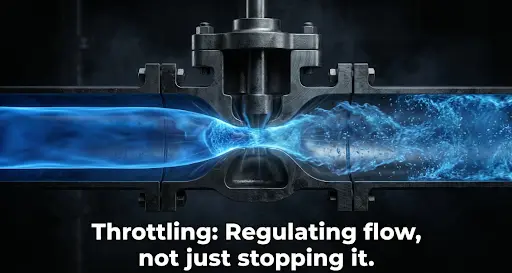
Throttling means using a valve to regulate flow instead of only stopping it. The valve stays partly open, and the opening size changes the pressure drop across the line.
That pressure drop controls how much liquid or gas can pass through. For stable throttling, the valve must stay predictable while partly open. That is where the valve shape becomes very important.
What a Ball Valve Does Best
A ball valve uses a drilled ball that turns a quarter turn. When the hole lines up with the pipe, flow passes through. When the solid side turns across the bore, flow stops.
This design is popular because it is compact, simple, and fast to operate. It also has a low pressure drop when fully open, which makes it useful in water lines, gas lines, HVAC systems, and many industrial services.
Why Standard Ball Valves Struggle During Throttling
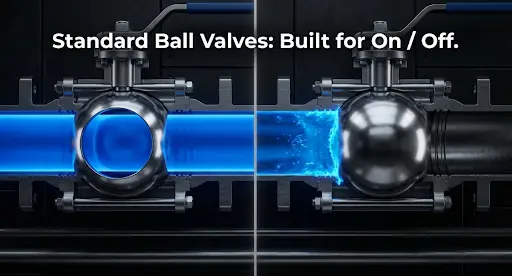
A standard design is built mainly for full-open or full-closed service. When it stays partly open, the round port creates an uneven flow path. Velocity can rise fast, and pressure can drop sharply.
That condition can cause poor flow control, seat wear, vibration, and noise. In liquid service, it can also raise the risk of cavitation, which is the collapse of vapor bubbles inside the flow stream.
This is why a standard ball valve for throttling is often seen as a limited solution. It may work for a short adjustment, but it is not usually the best option for steady regulation.
What Problems Can Appear at Partial Opening
The most common issue is poor control at low flow. A small handle movement can change flow too quickly. That makes fine adjustment harder than many new buyers expect.
Common issues include:
- unstable flow at mid-stroke
- faster wear on seats and seals
- noise and pipe vibration
- cavitation risk in liquid systems
- shorter sealing life after long modulation duty
What Designs Work Better for Flow Control
Not every rotary valve performs the same way. A throttling ball valve usually uses a shaped opening that gives a more gradual flow curve than a standard round port.
Use a V-Port Design for Smoother Control
A V-port valve has a V-shaped notch in the ball or seat. That notch opens in a more gradual way, so the flow rises more smoothly through the stroke.
This helps reduce sudden jumps in flow. It also improves control at lower openings. That is why many people call it a control ball valve or flow control ball valve.
These valves are often used in process control systems, chemical dosing lines, HVAC service, and water treatment plants.
Use a Segmented Design for Heavier Service
A segmented ball valve uses a cut section of the ball to shape the opening. It is often selected for larger lines or difficult media.
In some plants, it is used for slurry, pulp, and fiber-heavy flow. It can offer better control than a plain round-port valve while still giving shut-off when needed.
Compare Ball Valves and Globe Valves Clearly
If the job requires regular and accurate throttling, a globe valve is usually the safer option. Its linear motion and conical disc design are better suited to steady flow reduction.
That is why PANS recommends its globe valve as the preferred throttling option when stable adjustment matters more than quarter-turn shut-off. A standard ball valve is stronger at on-off duty. A globe valve is stronger at controlled regulation.
Use This Simple Selection Rule
Use a standard ball valve for isolation. Use a V-port or segmented type when shut-off and control must share one body. Use a globe valve when frequent throttling is the main task.
Quick guide:
- Standard ball valve: best for on-off service
- V-port or segmented valve: better for mixed shut-off and control duty
- Globe valve: better for regular throttling and finer adjustment
Weigh the Main Pros and Cons
A ball valve can still make sense in the right service. It offers clear strengths, but those strengths do not remove its control limits.
See the Main Pros
The first benefit is compact design. The second is a fast quarter-turn operation. The third is a low pressure drop when the valve is fully open.
A shaped rotary design can also combine shut-off and limited flow control in one body. That can simplify piping in some systems.
See the Main Cons
The biggest drawback is weaker control at partial opening. Long periods of modulation can also wear the seats faster.
In some liquid systems, rapid pressure changes can add noise, vibration, or cavitation. Fast closure can also increase water hammer risk in the piping system.
So, can you throttle a ball valve? Yes, but only with care and only when the service matches the design.
Choose the Right Valve for the Fluid and Duty
Start with the fluid. Clean water, gas, steam, slurry, and chemical media all create different demands. Next, check how often the valve will stay partly open.
Then review pressure drop, line size, temperature, and shut-off needs. If the valve must regulate flow every day, do not treat it like a simple isolating device.
This also answers another common search question: Are ball valves good for throttling? Standard ones are usually not. Special designs can help, but globe valves are often the better long-term answer.
Conclusion
A standard ball valve can reduce flow, but it is usually not the strongest option for continuous throttling. For steady regulation, a globe valve is often the better choice. If you are comparing shut-off and control options for your next project, explore the collection of ball valves and globe valves from PANS VALVE and choose a design that fits the job from the start.
FAQ
Can a ball valve be used for throttling?
Yes, but a standard type is not the best for long-term control. V-port and segmented designs are better suited to this duty.
Can you use a ball valve to control flow?
Yes, to a limited extent. For repeated adjustment, use a valve designed for modulation instead of basic shut-off service.
Can ball valves be used for throttling in every system?
No. Dirty fluids, frequent modulation, and high control accuracy usually call for a better-matched valve design.
What is a flow control ball valve?
It is a rotary valve with a shaped opening, such as a V-port or segmented trim, made to improve control at partial opening.
Why is a globe valve often preferred?
Its conical disc and linear motion make flow adjustment smoother and more stable during regular throttling duty.
SEO Title: Can Ball Valves Be Used for Throttling? Pros and Cons Explained
SEO Description: Can ball valves be used for throttling? Learn the pros, limits, risks, and better options for flow control, including V-port, segmented, and globe valves.
Slug: can-ball-valves-be-used-for-throttling-pros-and-cons
Search
Categories
Tags
Product
- Ball Valve
- Floating Ball Valve
- Fully Welded Ball Valve
- Trunnion Ball Valve
- Butterfly Valve
- Full Metal-Seated Bi-Directional Butterfly Valve
- High Performance Butterfly Valve
- Three-Eccentric Metal Hard Seal Butterfly Valve
- Check Valve
- Cast Lift Check Valve
- Cast Swing Check Valve
- Wafer Type Check Valve
- DIN Valve
- DIN Bellow Sealed Globe Valve
- DIN Globe Valve
- DIN Rising Stem Gate Valve
- DIN Swing Check Valve
- Forge Valve
- Forged Check Valve
- Forged Floating Ball Valve
- Forged Gate Valve
- Forged Globe Valve
- Gate Valve
- Bellow Sealed Gate Valve
- Flat Gate Valve
- Wedge Gate Valve
- Globe Valve
- Cast Globe Valve
- Plug Valve
- Eccentricity Plug Valve
- Inverted Pressure Balance Lubricated Plug Valve
- Orbit Plug Valve
- Sleeve Type Plug Valve
- Slurry Valve
- Slurry Valve
- Strainer


