Choosing an Electric Actuator for Gate Valves: What Actually Matters
An electric gate valve actuator is not a universal fit. The same model that works on a 4-inch gate valve in water treatment will fail on an 8-inch gate valve in a high-pressure gas line. Torque, valve size, operating pressure, power supply, and fail-safety all interact. Get any one wrong and the failure shows up in the field, not during installation checks.
Why Gate Valves Have Specific Actuator Requirements
Gate valves move a wedge or gate element linearly through the flow path. That movement requires significantly more torque to start than to sustain. Especially after the valve has been seated under pressure for a long time. The breakaway torque needed to unseat a gate valve is typically 1.5 to 2.5 times the running torque.
An actuated gate valve undersized on torque will struggle to open after extended closure under pressure. It may meet the running torque spec on paper but fail at the moment it is actually needed. Breakaway torque margin is the specification most commonly missed in gate valve actuator selection. It is also the one most likely to cause field failures.
Valve size makes it worse. Larger bore gate valves move more mass and seal against larger pressure differentials. A DN200 gate valve at 150 PSI needs substantially more actuator torque than a DN50 gate valve at the same pressure. Start with torque tables from the valve manufacturer. Not generic actuator specs.
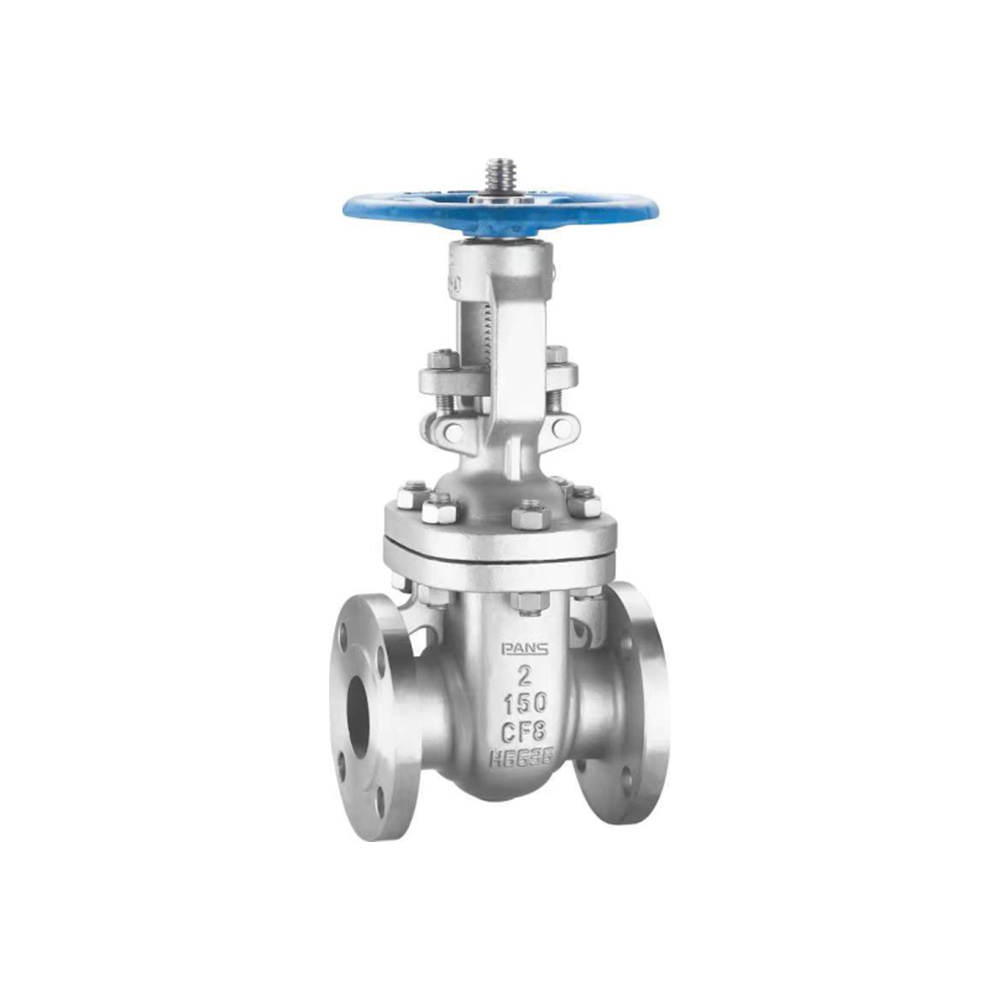
Wedge Gate Valve
Design & Manufacture Standard: API 600
Face to Face: ASME B16.10
The Five Selection Factors That Actually Matter
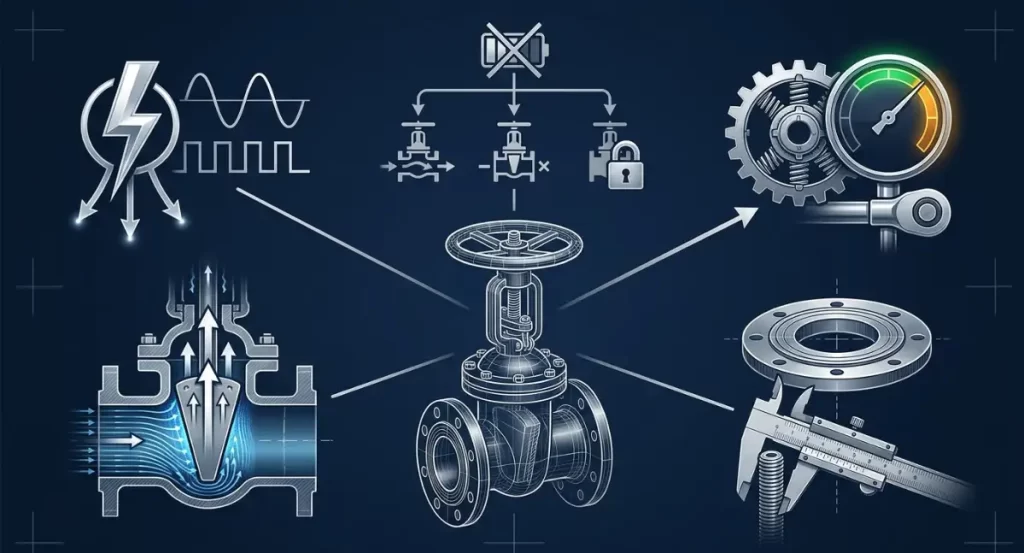
Torque Rating With Safety Margin
Actuator torque rating must exceed the valve’s maximum required torque across its full operating range. Standard practice is selecting an actuator rated 25 to 50 percent above the valve manufacturer’s stated torque requirement. That margin covers wear, temperature effects on sealing, and pressure variation across operating cycles.
Valve Size and Stem Configuration
A gate valve with electric actuator needs a mounting interface that matches the valve’s stem travel length and stem diameter exactly. ISO 5210 and ISO 5211 define the standard flange and drive configurations. Confirming the correct ISO interface before ordering eliminates one of the most common installation errors. The actuator mounts fine. The drive coupling does not engage the stem correctly. Nobody notices until operation.
Operating Pressure and Differential Pressure
Differential pressure across the gate valve at the moment of actuation determines the actual torque load. A valve operating against high differential pressure needs more torque than the same valve at low differential pressure. Differential pressure torque correction is applied by multiplying base torque by a correction factor that varies with valve design and pressure rating. Most people skip this step.
Power Supply and Control Signal
Electric valve actuator manufacturers offer products across 24VDC, 110VAC, and 220/380VAC supply configurations. Available power supply at the installation location determines which voltage range is feasible. Control signal compatibility is separate. Actuators receive signals in 4-20mA, 0-10V, or digital on/off formats. Both power supply and signal format must match site infrastructure or the actuator cannot be commissioned regardless of torque spec.
Fail-Safety Requirement
Fail-safe behavior defines what the gate valve with electric actuator does when power is lost. Fail-open, fail-closed, and fail-last-position are the three options. A gate valve on a fuel gas line typically needs fail-closed. A cooling water supply valve may need fail-open. Specifying this wrong creates a process safety risk that is invisible during normal operation and only reveals itself during an emergency.
Electric vs. Pneumatic: When Each Makes More Sense
Gate valve with pneumatic actuator setups are faster-acting and better for applications requiring rapid cycling or hazardous area operation where electrical equipment must be intrinsically safe. Pneumatic actuators need compressed air supply infrastructure. Less practical in remote locations without existing instrument air systems.
The table below summarizes the key differences for gate valve applications.
| Factor | Electric Actuator | Pneumatic Actuator |
| Power source | Electrical supply | Compressed air |
| Speed | Slower, adjustable | Fast, fixed |
| Position control | Precise, programmable | Less precise |
| Remote control | Standard via signal | Requires solenoid valve |
| Hazardous areas | Requires EX-rated model | Inherently safer |
| Infrastructure needed | Power cable | Air supply line |
| Best for | Remote monitoring, modulating control | Fast cycling, hazardous zones |
A remote control valve actuator for pipeline, oil and gas, or petrochemical applications most commonly uses electric actuation when precise position feedback and SCADA or DCS integration is required. Pneumatic suits fast cycling and simplicity when compressed air is already on site.
Common Selection Errors to Avoid
Undersizing torque is the most common mistake. Using running torque without applying a breakaway torque multiplier produces actuators that cannot unseat the valve after extended closure under pressure.
Ignoring stem travel length is the second. Correct torque, wrong travel. The valve never fully opens or closes. Operators may not detect this until a process upset makes it visible.
Wrong fail-safe mode is the third and most consequential. No visible error during commissioning. Unsafe condition during an emergency.
How PANS Valve Supports Actuator Matching
Correct electric gate valve actuator selection starts with accurate valve specifications. Torque tables, stem configuration data, and pressure ratings all come from the valve manufacturer. PANS Valve provides complete technical documentation including torque specifications, ISO interface data, and pressure ratings for all gate valve models. That gives actuator specifiers the correct starting parameters.
For EPC contractors and distributors managing complex piping packages, PANS offers one-stop procurement coordination that aligns valve and actuator specifications before the order is placed rather than discovering mismatches at installation. 36+ years of gate valve manufacturing experience across oil and gas, petrochemical, and power generation. Electric valve actuator manufacturers need accurate valve-side data to complete a correct selection. PANS provides it. Get in touch to discuss your gate valve and actuation requirements.
Frequently Asked Questions
How to choose the right electric actuator?
Match torque rating to valve breakaway torque with 25 to 50 percent margin. Confirm ISO interface compatibility, power supply voltage, control signal format, and fail-safe requirement against your process and site specifications before selecting a model.
How to choose the right actuator for a specific application?
Define valve type, size, operating pressure, and fail-safe requirement first. Then match actuator torque, mounting interface, power supply, and environmental protection rating to those parameters. Torque is the most critical specification to get right.
What are the common problems with electric actuators?
Undersized torque causing failure to open under pressure. Incorrect fail-safe mode creating safety risks during power loss. Stem interface mismatch preventing full valve travel. Inadequate IP rating causing electrical failure in wet or corrosive environments.
What is the difference between 12V and 24V linear actuators?
12V suits low-power battery or solar-powered remote installations. 24V provides higher torque at equivalent current draw and is more common in industrial control systems. Voltage selection depends on available power supply and required torque output.
Search
Categories
Tags
Product
- Ball Valve
- Floating Ball Valve
- Fully Welded Ball Valve
- Trunnion Ball Valve
- Butterfly Valve
- Full Metal-Seated Bi-Directional Butterfly Valve
- High Performance Butterfly Valve
- Three-Eccentric Metal Hard Seal Butterfly Valve
- Check Valve
- Cast Lift Check Valve
- Cast Swing Check Valve
- Wafer Type Check Valve
- DIN Valve
- DIN Bellow Sealed Globe Valve
- DIN Globe Valve
- DIN Rising Stem Gate Valve
- DIN Swing Check Valve
- Forge Valve
- Forged Check Valve
- Forged Floating Ball Valve
- Forged Gate Valve
- Forged Globe Valve
- Gate Valve
- Bellow Sealed Gate Valve
- Flat Gate Valve
- Wedge Gate Valve
- Globe Valve
- Cast Globe Valve
- Plug Valve
- Eccentricity Plug Valve
- Inverted Pressure Balance Lubricated Plug Valve
- Orbit Plug Valve
- Sleeve Type Plug Valve
- Slurry Valve
- Slurry Valve
- Strainer


