What is the Difference Between a Wedge and Parallel Gate Valve?
| Feature | Wedge Gate Valve | Parallel Gate Valve |
|---|---|---|
| Seal Type | Mechanical wedge pressing against seats | Fluid pressure forcing gate against parallel seats |
| Temperature Range | -40°C to +200°C (handles thermal cycling) | 0°C to +120°C (limited high-temp use) |
| Pressure Rating | Up to 5000 PSI (high-pressure capable) | Up to 1000 PSI (low-to-medium pressure) |
| Best For | High-pressure systems, oil/gas, high-temp, thermal cycling | Low-pressure systems, water distribution, frequent cycling |
| Avoid When | Low-pressure systems (seal may not engage properly) | Low-pressure systems, water distribution, and frequent cycling |
What is a Gate Valve?
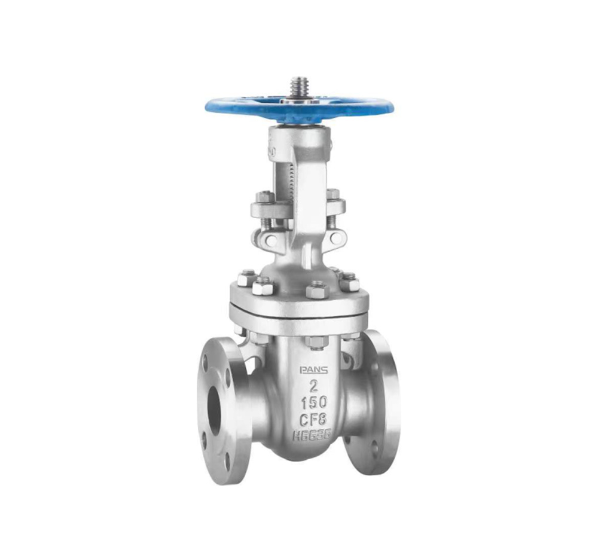
Before diving into the differences, let’s briefly explain what a gate valve is. A gate valve is a type of valve that controls the flow of fluid by raising or lowering a gate, which is a flat or wedge-shaped piece. When the gate is fully lifted, the valve is fully open, allowing fluid to flow through. When the gate is fully lowered, the valve is closed, stopping the flow.
Wedge Gate Valve
A wedge gate valve is one of the most commonly used gate valves. The gate in this valve has a wedge-like shape, which allows it to press tightly against the valve seats. This design creates a strong seal and prevents leaks.
Types of Wedge Gate Valves
1. Solid Wedge Gate Valve
In a solid wedge gate valve, the wedge is one solid piece. This type is durable and works well for many applications, especially where the temperature fluctuates. The solid gate is strong enough to handle thermal expansion and contraction.
2. Flexible Wedge Gate Valve
The flexible wedge gate valve has a cut or groove in the middle of the gate, allowing for some flexibility. This helps the valve adjust to seat misalignment and reduces the chances of sticking when opening or closing the valve.
3. Resilient Wedge Gate Valve
What is a resilient wedge gate valve?
A resilient wedge gate valve features a flexible rubber or elastomer-coated gate that conforms to seat irregularities and improves sealing performance, especially in low-pressure water systems.
Unlike solid or flexible wedge gates, which rely entirely on mechanical pressure for sealing, a resilient wedge gate valve uses a rubber layer bonded to the wedge face, allowing it to create a tighter, more forgiving seal across a wider pressure range. The elastomer material—typically EPDM, Nitrile, or Buna-N rubber—self-adjusts to minor surface imperfections, valve seat wear, and thermal expansion/contraction without requiring high closing force.
What is a resilient wedge gate valve used for?
These valves are industry standard in water distribution networks, where bubble-tight shut-off is required at relatively low pressures (typically under 150 PSI). They excel in potable water, wastewater, and irrigation applications because:
- Tight shutoff: Rubber coating seals even against corroded or worn seats
- Low operating torque: The elastomer reduces friction, making manual or motorized operation easier
- Corrosion resistance: The rubber layer protects the metal wedge from corrosion and mineral deposits common in water systems
- Lower maintenance: Fewer leakage issues mean less maintenance and water loss
Common materials: Resilient wedge gate valves typically use ductile iron or carbon steel bodies with stainless steel stems and renewable elastomer-coated gates. This combination balances durability, cost, and chemical compatibility for municipal and industrial water service.
Advantages of Wedge Gate Valves
- Tight Seal: The wedge design ensures a tight seal, preventing any fluid leakage.
- Durable: The solid wedge design is highly durable, especially in high-pressure and high-temperature environments.
- Versatile: Wedge gate valves can be used in various applications, including oil, gas, and water systems.
Parallel Gate Valve
Unlike the wedge gate valve, the parallel gate valve uses a flat, rectangular gate. The gate slides between two parallel seats, hence the name. The sealing in a parallel gate valve relies on the pressure of the fluid, which forces the gate against the seats to create a seal.
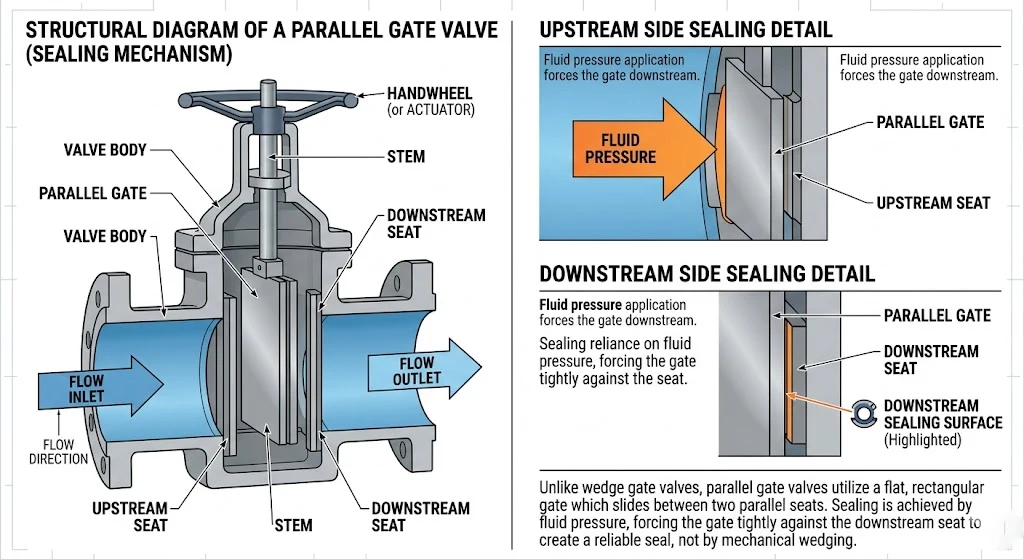
Types of Parallel Gate Valves
1. Single Disc Parallel Gate Valve
This valve has a single gate that slides between the parallel seats. It is simple and less expensive but may not provide as tight a seal as the wedge gate valve.
2. Double Disc Parallel Gate Valve
This valve has two discs, which are pressed against the parallel seats by the fluid pressure. The double disc design ensures a better seal and is often used in high-pressure systems.
Advantages of Parallel Gate Valves
- Lower Operating Torque: Parallel gate valves require less force to open or close. This is easier to operate.
- Suitable for Low-Pressure Systems: These valves are ideal for systems with lower pressures. In these systems, the fluid can help create the necessary seal.
- Less Wear: Since the valve gate moves in a straight path, there is less wear on the valve seats, increasing the valve’s lifespan.
Key Differences Between Wedge and Parallel Gate Valves
Seal Type
- Wedge Gate Valve: The gate wedge valve shape helps create a tight mechanical seal by pressing against the valve seats.
- Parallel Gate Valve: The seal is created by fluid pressure pushing the gate against parallel seats.
Design
- Wedge Gate Valve: Uses a wedge-shaped gate that can be solid or flexible.
- Parallel Gate Valve: Has a flat gate that slides between two parallel seats.
Best Use Case
- Wedge Gate Valve: Ideal for high-pressure and high-temperature systems where a tight seal is required.
- Parallel Gate Valve: Better suited for low-pressure systems or where there is little risk of leakage.
Durability
- Wedge Gate Valve: Typically more durable due to the wedge design. It has the ability to handle temperature fluctuations.
- Parallel Gate Valve: This may not last as long in high-pressure systems. But it works well in lower-pressure environments.
PANS Valve Wedge Gate Valve – Features and Benefits
When it comes to wedge gate valves, PANS Valve offers top-quality products that are designed to meet the demands of various industries. Their gate wedge valve provides reliable performance in both low and high-pressure systems. It is suitable for use in industries such as oil, gas, and water treatment.
Key Features
- Full Port Design: The valve allows unrestricted flow, reducing pressure drop.
- Flexible and Solid Wedge: PANS Valve offers both flexible wedge gate valves and solid wedge gate valves, catering to different application needs. The resilient wedge gate valve option ensures a tighter seal, especially in water distribution systems.
- Rising Stem Design: PANS Valve’s rising stem design ensures easy operation and visual indication of whether the valve is open or closed.
- Durable Materials: These valves are made with high-quality materials, such as forged T-head stems and renewable seat rings. These provide long-lasting durability. The body and bonnet are connected with studs and nuts, ensuring robust assembly.
- Back Seating Design: All PANS Valve wedge gate valves come with a back seating design. This enhances the durability and reliability of the packing seal.
Standards Compliance
- API 600/ISO 10434: The design and manufacture of PANS Valve gate valves meet strict international standards.
- API 598: The valves are rigorously inspected and tested to ensure they meet the highest quality and performance standards.
Why Choose PANS Valve?
For over 36 years, PANS Valve has been at the forefront of manufacturing high-quality valves. Here’s why you should consider PANS Valve for your wedge gate valve needs:
- Wide Range of Products: From resilient wedge gate valves to parallel gate valves, PANS Valve offers a variety of valve options to suit different industries and applications.
- Top-Quality Manufacturing: PANS Valve has five manufacturing bases and workshops that cover 25,000 square meters. This setup ensures high-quality production standards. They produce over 3,000 tons of valves annually.
- Quick Response: Customers can receive quotations and drawings within 24 hours. Most products are delivered within 20 days, thanks to the company’s large stock of rough embryos.
- Trusted for Decades: They have over 30 years of experience. PANS Valve has built a reputation for reliability and innovation in the valve industry.
Your Product Title Here
Your product description goes here. This is where you highlight the key benefits, features, and applications of your product.
Get A Quote
Conclusion
Both wedge gate valves and parallel gate valves have their strengths. Knowing the key differences can help you select the right valve for your system. If you need a valve that can handle high pressure and ensure a tight seal, the wedge gate valve is the best option. On the other hand, for lower-pressure systems, the parallel gate valve might be more suitable.
With PANS Valve, you’re guaranteed high-quality valves that meet international standards. Their wedge gate valves are built to last and perform reliably in a variety of industries. Whether you need a resilient wedge gate valve or a parallel gate valve, PANS Valve has the solution for you.
Search
Categories
Tags
Product
- Ball Valve
- Floating Ball Valve
- Fully Welded Ball Valve
- Trunnion Ball Valve
- Butterfly Valve
- Full Metal-Seated Bi-Directional Butterfly Valve
- High Performance Butterfly Valve
- Three-Eccentric Metal Hard Seal Butterfly Valve
- Check Valve
- Cast Lift Check Valve
- Cast Swing Check Valve
- Wafer Type Check Valve
- DIN Valve
- DIN Bellow Sealed Globe Valve
- DIN Globe Valve
- DIN Rising Stem Gate Valve
- DIN Swing Check Valve
- Forge Valve
- Forged Check Valve
- Forged Floating Ball Valve
- Forged Gate Valve
- Forged Globe Valve
- Gate Valve
- Bellow Sealed Gate Valve
- Flat Gate Valve
- Wedge Gate Valve
- Globe Valve
- Cast Globe Valve
- Plug Valve
- Eccentricity Plug Valve
- Inverted Pressure Balance Lubricated Plug Valve
- Orbit Plug Valve
- Sleeve Type Plug Valve
- Slurry Valve
- Slurry Valve
- Strainer


