Globe Valve Trim Types and Materials: 5 Checks for Severe Service
Quick Answer
Globe valve trim is the set of wetted parts that control flow and shutoff: the disc, seat faces, stem and backseat. For severe service, choose trim by damage mechanism, not by material name alone. Erosion, cavitation, galling and thermal cycling each call for a different answer. A plug disc usually gives more progressive throttling than a ball disc, while hardfacing and a nitrided stem improve wear resistance. PANS supplies cast, forged and DIN globe valves; cast and forged ranges list loose plug or ball discs, metal seats and order-dependent trim. Confirm the exact trim on the quoted drawing.
This guide explains how globe trim differs from control valve trim, which disc and seat materials fit severe duties, and what to put in an RFQ. It separates published PANS features from options needing written confirmation.
What Is Globe Valve Trim, and How Does General-Purpose Trim Differ from Control-Valve Trim?
In a globe valve, trim means the wetted parts that shape flow and make the seal: disc, seat faces, stem, backseat and, in some designs, guiding surfaces. The body contains pressure; the trim decides how the valve throttles, closes and wears.
Globe-pattern valves are widely used as control valves. However, the trim in a general-purpose isolation or throttling globe valve is not automatically designed or qualified to provide a specified flow characteristic, rangeability or severe-service performance. It usually includes a characterized plug, cage or retainer, seat ring and stem, selected for a specified flow characteristic, rangeability and pressure-drop behaviour. A globe valve with a plug or ball disc can regulate flow, but it is not automatically a characterized control valve. If the datasheet requires a Cv curve, anti-cavitation cage or noise trim, say so explicitly.
What PANS currently lists
PANS lists four globe product pages: cast, forged, DIN and DIN bellow sealed. The cast page lists a straight-pattern OS&Y body; the forged page lists an OS&Y body with BB/WB options. Both list rising stems and a choice of loose plug or ball disc; the cast page adds metal seating. Cast uses renewable seat rings; forged uses an integral seat ring. DIN pages list cobalt-alloy hardfacing on the seat and a nitrided stem.
These are published features, not a promise that every combination is stocked. The cast page names BS 1873 and ASME B16.34, while its FAQ also refers to API 600. Put the governing standard on the RFQ.
Which Globe Valve Disc Type Should You Specify?
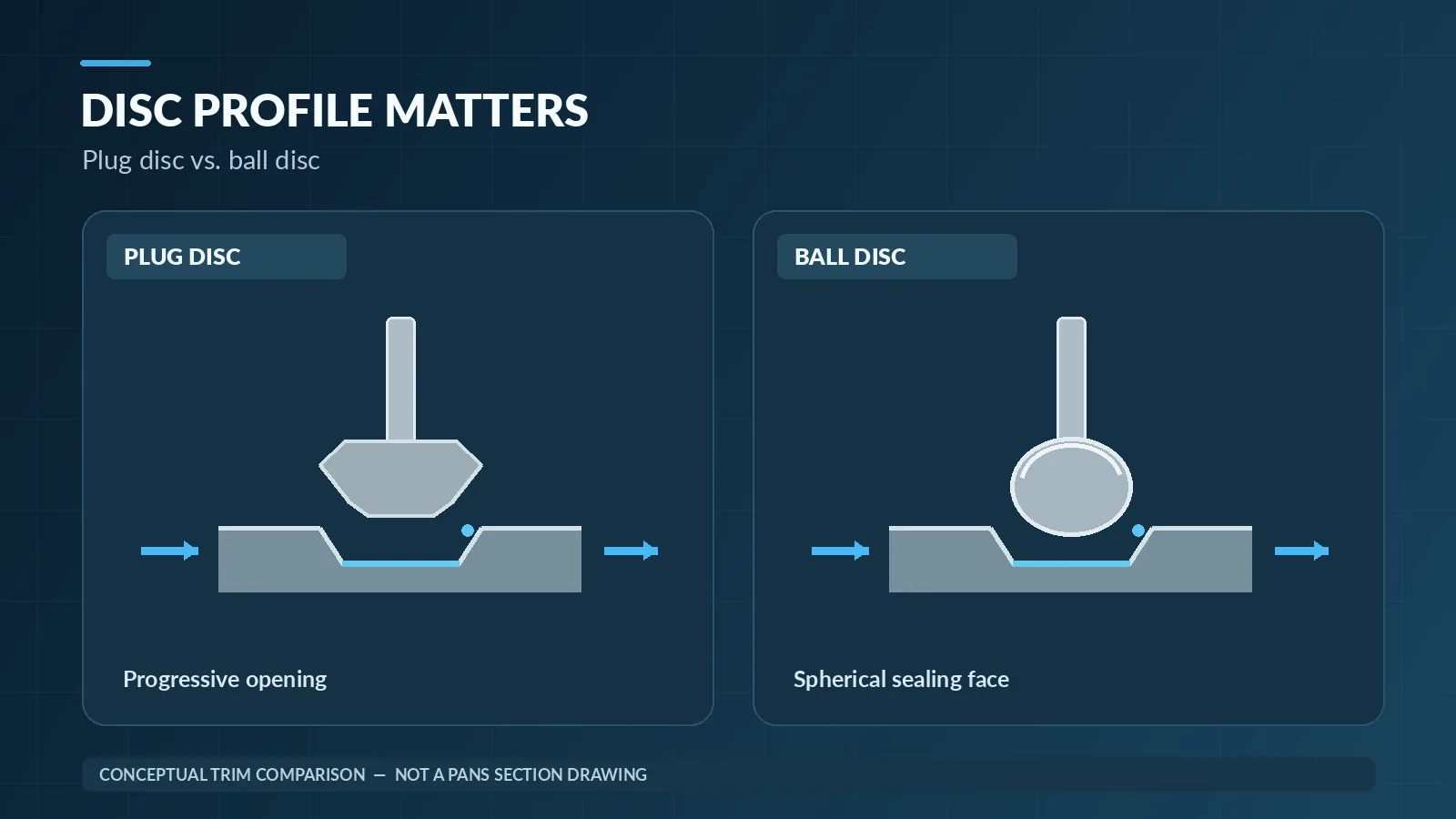
The two common globe valve disc types are plug and ball. Both appear as loose, metal-seated options in the PANS cast and forged ranges.
A plug disc has a conical face and opens progressively, so it is normally the better starting point for throttling. A ball disc has a spherical face that can self-align against the seat and is often used for isolation. Neither shape fixes a flow characteristic by itself; seat angle, guidance and travel still matter.
A plug disc is generally a better starting point for throttling. Either design may provide shutoff; confirm the permitted throttling duty and leakage performance for the selected disc and seat arrangement. If the valve will throttle continuously at a low opening, ask for calculated Cv or Kv, minimum controllable opening and expected velocity. A disc that is fine for occasional throttling may wire-draw quickly in continuous service.
The PANS cast globe valve range lists both loose plug and ball disc options, along with renewable seat rings and a bolted bonnet. For a forged body, the same disc choice has to fit the smaller body and integral seat.
Which Globe Valve Seat and Stem Materials Suit Severe Service?
The globe valve trim material decision starts with the damage mechanism. Clean steam and hot oil often use 13Cr stainless. Corrosive fluid may need 316 stainless or a higher alloy. Erosive service may need cobalt-alloy hardfacing. These are industry starting points; check the offered grade.
Specify globe valve seat material and disc material separately from the body grade. A carbon steel body can carry a stainless or hardfaced trim, and a stainless body can still gall if matching surfaces are not controlled. PANS DIN globe and bellow-sealed pages state that the seal surface is built up with Co hard alloy; the cast page lists hard-alloy spray welding to the customer’s specification.
Hardfacing resists erosion and wire drawing, but it does not remove cavitation energy or correct a poor flow path. For erosive duty, also check velocity, solids and seat geometry.
Does the stem need more than a material grade?
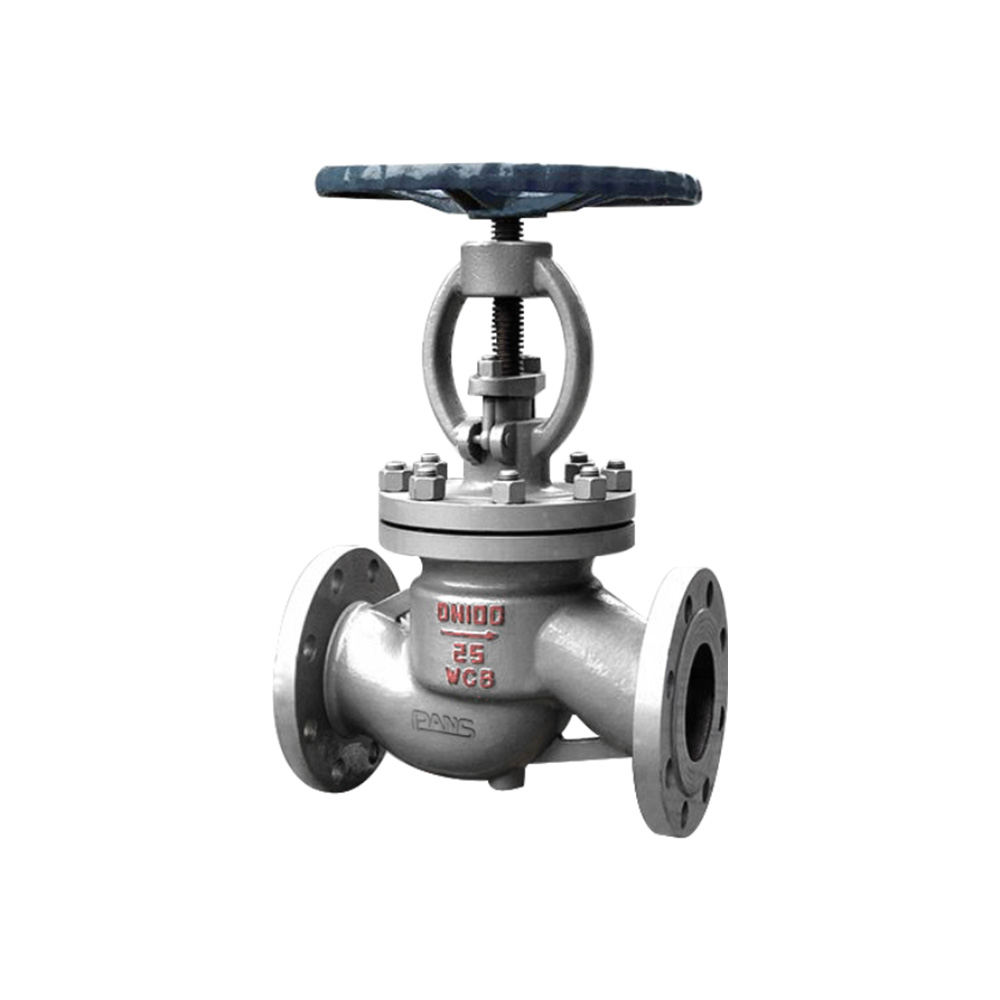
Yes. The stem is a wear part too. PANS cast pages describe an integral forged stem. The DIN globe valve range describes a quenched and tempered stem with a nitrided surface. Nitriding improves surface hardness and friction resistance, but the stem still needs the right packing, surface finish and alignment.
Graphite packing is common for high temperature; PTFE or combined packing may be offered on request. A backseat can limit stem leakage when fully open, but it is not a safe way to change packing under pressure.
For steam-specific selection, our guide to why globe valves suit steam service explains how linear disc movement and tight shutoff work together.
Why Does Severe Service Punish the Wrong Trim?
Severe service is not a single rating. It can mean high differential pressure, flashing or cavitation, abrasive solids, rapid cycling, high temperature or a combination. Each one damages trim differently:
- Erosion removes seat and disc material where velocity is highest.
- Cavitation collapses vapour bubbles and pits hard surfaces.
- Flashing keeps a high-velocity mixture downstream and can erode the body and trim.
- Galling damages matching stainless surfaces under load.
- Thermal cycling changes clearances and seating load.
Harder material helps erosion and galling, but cannot solve a hydraulic problem. If the valve throttles away most of the pressure, a control valve trim with a cage, multistage path or anti-cavitation design may be correct. A standard globe valve can still suit isolation and modest regulation; do not buy it for duty it was never selected for.
Flow direction also changes which surfaces take the punishment. Our globe valve flow direction guide explains why the body arrow and the approved drawing must agree. For high-pressure duties, review the PANS high-pressure globe valve guide before comparing trim options.
How Should You Plan Maintenance and Spare Trim?
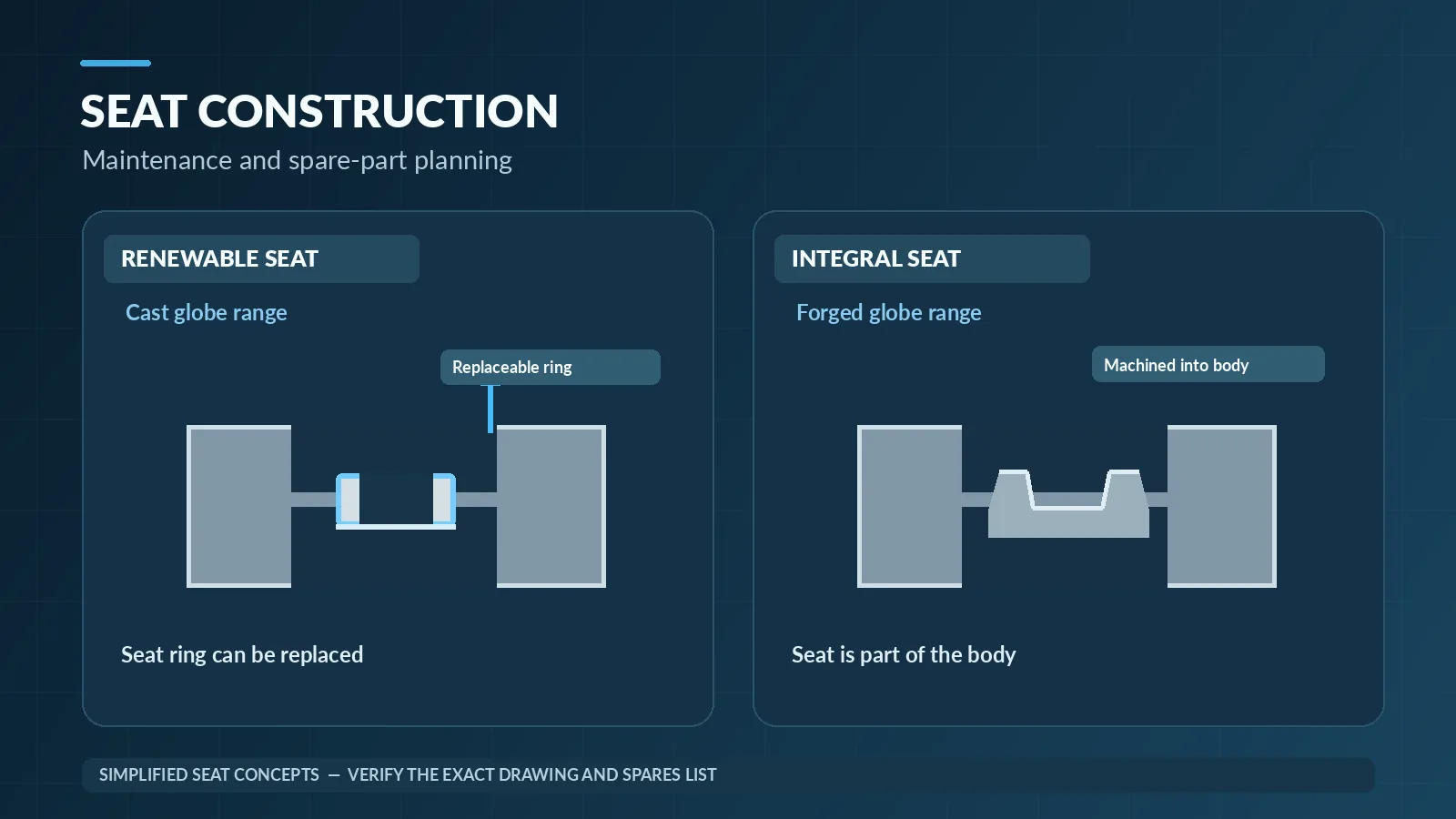
Trim maintenance starts with the seat arrangement. A renewable seat ring can be replaced. An integral seat must be reworked or the affected component replaced. The PANS cast range lists renewable seat rings, while the PANS forged globe valve lists an integral seat ring. The spare-parts plan therefore differs by family.
Loose discs, stems, packing and gaskets are also wear items. Ask for a bill of materials with part numbers, material grades and hardness. For severe duty, request the seat hardness, stem hardness, guiding clearance and operating torque at the specified differential.
If the valve is bellows sealed, remember that the bellows protects the stem seal. It does not replace the seat and disc trim. The DIN bellow sealed globe valve page lists bellows-assisted double sealing, Co hard alloy seat surfacing and a nitrided stem. Confirm the bellows alloy, expected cycle life and replacement method before ordering.
Globe Valve Trim Selection Table
| Duty signal | Trim focus | Confirm before order | PANS range to review |
|---|---|---|---|
| Clean steam, high temperature, throttling | Plug disc, 13Cr or hardfaced seat, nitrided stem | Temperature, differential, Cv or Kv, packing | Cast globe and DIN globe |
| High-pressure small-bore isolation or regulation | Forged body, plug or ball disc, integral seat | API 602, pressure class, end connection | Forged globe |
| Corrosive chemical duty | 316 stainless trim, compatible packing | Media concentration, temperature, chloride risk, body grade | Cast globe, stainless option |
| Erosive or high-velocity duty | Hardfaced seat and disc; verify guidance or use a control valve | Solids, velocity, pressure drop, cycling | Confirm with PANS before selecting |
| Stem-leakage priority | Bellows-sealed globe with hardfaced seat | Bellows alloy, temperature, cycles, test basis | DIN bellow sealed globe |
FAQ
1. Can I change only the trim on an existing globe valve?
Sometimes, but the body, bonnet, stem and seat arrangement must match. Send the tag data and drawing so the replacement scope can be checked against the original construction.
2. Is a hardfaced seat the same as a cavitation-proof trim?
No. Hardfacing raises wear resistance but does not remove the pressure drop that creates cavitation. Correct the hydraulic design first.
3. Does a bellows-sealed globe valve automatically have severe-service trim?
No. The bellows addresses stem leakage; the disc, seat and stem material still need to suit the duty.
Specify the Trim, Not Just the Valve
The right globe valve trim starts with the duty: medium, pressure drop, temperature, cycling and damage mechanism. Match the disc to the operation, specify seat and stem materials separately, and confirm whether the seat is renewable or integral.
Send your duty sheet, line size, pressure and temperature, required trim materials and any existing drawing or tag details to PANS. We will confirm the available globe valve construction and the trim items included in the quotation. Request a quotation from PANS.
Search
Categories
Tags
Product
- Ball Valve
- Floating Ball Valve
- Fully Welded Ball Valve
- Trunnion Ball Valve
- Butterfly Valve
- Full Metal-Seated Bi-Directional Butterfly Valve
- High Performance Butterfly Valve
- Three-Eccentric Metal Hard Seal Butterfly Valve
- Check Valve
- Cast Lift Check Valve
- Cast Swing Check Valve
- Wafer Type Check Valve
- DIN Valve
- DIN Bellow Sealed Globe Valve
- DIN Globe Valve
- DIN Rising Stem Gate Valve
- DIN Swing Check Valve
- Forge Valve
- Forged Check Valve
- Forged Floating Ball Valve
- Forged Gate Valve
- Forged Globe Valve
- Gate Valve
- Bellow Sealed Gate Valve
- Flat Gate Valve
- Wedge Gate Valve
- Globe Valve
- Cast Globe Valve
- Plug Valve
- Eccentricity Plug Valve
- Inverted Pressure Balance Lubricated Plug Valve
- Orbit Plug Valve
- Sleeve Type Plug Valve
- Slurry Valve
- Slurry Valve
- Strainer


