Pressure Seal Valves: Working Principle, Types & High-Pressure Applications
Quick Answer: Pressure Seal Valves for High-Pressure Applications
Pressure seal valves use internal line pressure to strengthen the body-to-bonnet seal, making them ideal for high-temperature, high-pressure applications such as power generation, steam systems, and petrochemical processing. Their self-energizing design provides reliable sealing while reducing valve weight, maintenance requirements, and thermal stress compared with bolted-bonnet designs. PANS Valve Pressure Seal Valves are engineered for demanding applications and undergo mandatory testing to meet American Petroleum Institute standards. Operating since 1985, PANS Valve holds ISO 9001, ISO 14001, and ISO 45001 certifications—request a professional quote today for reliable pressure seal valve solutions tailored to your project.
Understanding the Pressure Seal Gate Valve Working Principle
This revolves around the self-energizing mechanism that converts internal line pressure into a robust sealing force. In the pressure seal valve design, the bonnet is located within the body rather than bolted to an external flange. Inside the unit is the thrust ring, which is usually segmented and fitted into a machined groove, effectively limiting upward travel.
Fluid pressure pushes upward against the underside, firmly forcing the bonnet against the gasket. This component is typically made of steel, stainless steel, or graphite with a tapered profile at a 30° or 45° angle.
The pressure seal gate valve working principle is fundamentally different from that of the bolted-bonnet valve, where sealing relies on mechanical preload created by bolts. The pressure itself contributes to sealing integrity instead of increasing leak potential. For this reason alone, it is suitable for Class 600 and higher (PN 100+) situations.
Comparing Pressure Seal vs Bolted Bonnet for High Pressure
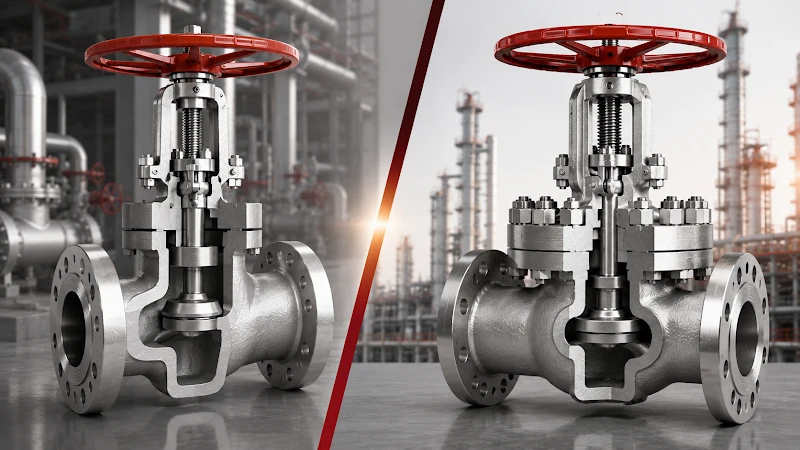
The difference between a pressure seal bonnet valve and a traditional valve becomes more obvious as size, temperature, and pressure rise. Generally speaking, bolted-bonnets (BB) are enough in Class 150 to 300 environments, while pressure seals are necessary for Class 600 and up to Class 2500 applications. Other key advantages of this design over BBs include:
Valve Weights and Sizes
By getting rid of the bulky body-bonnet flanges and bolting, these valves are significantly lighter and more compact. This makes them easier to install, reduces material requirements, and eases thermal insulation procedures.
Valve Thermal Performance
They are optimized for thermal fatigue, meaning they can handle frequent start-ups and shut-downs common in power plants. They don’t need to be replaced as often since they are designed to handle that specific kind of wear and damage.
Valve Maintenance Requirements
They are engineered for minimum maintenance, often requiring only periodic packing. Gasket replacements happen less frequently than the constant re-tightening associated with thermal cycling in BBs. Just make sure the gasket is positioned correctly to avoid accidental damage.
High-Pressure Gate Valve, Globe Valve, and Check Valve Types
Pressure seal valves come in different product specifications to meet a diverse range of flow control configurations in extreme environments.
High-Pressure Seal Gate Valve
This is primarily used for on-off isolation, offering a straight line of unobstructed flow when fully open. It is widely used as a power plant valve for main steam, reheat, and other high-temperature pipeline systems.
Its flexible wedge designs ensure reliable seating, easy operation, and minimal fluid restriction. Its parallel-slide variations employ spring-supported discs to provide a more refined, leak-tight seal for demanding isolation duties.
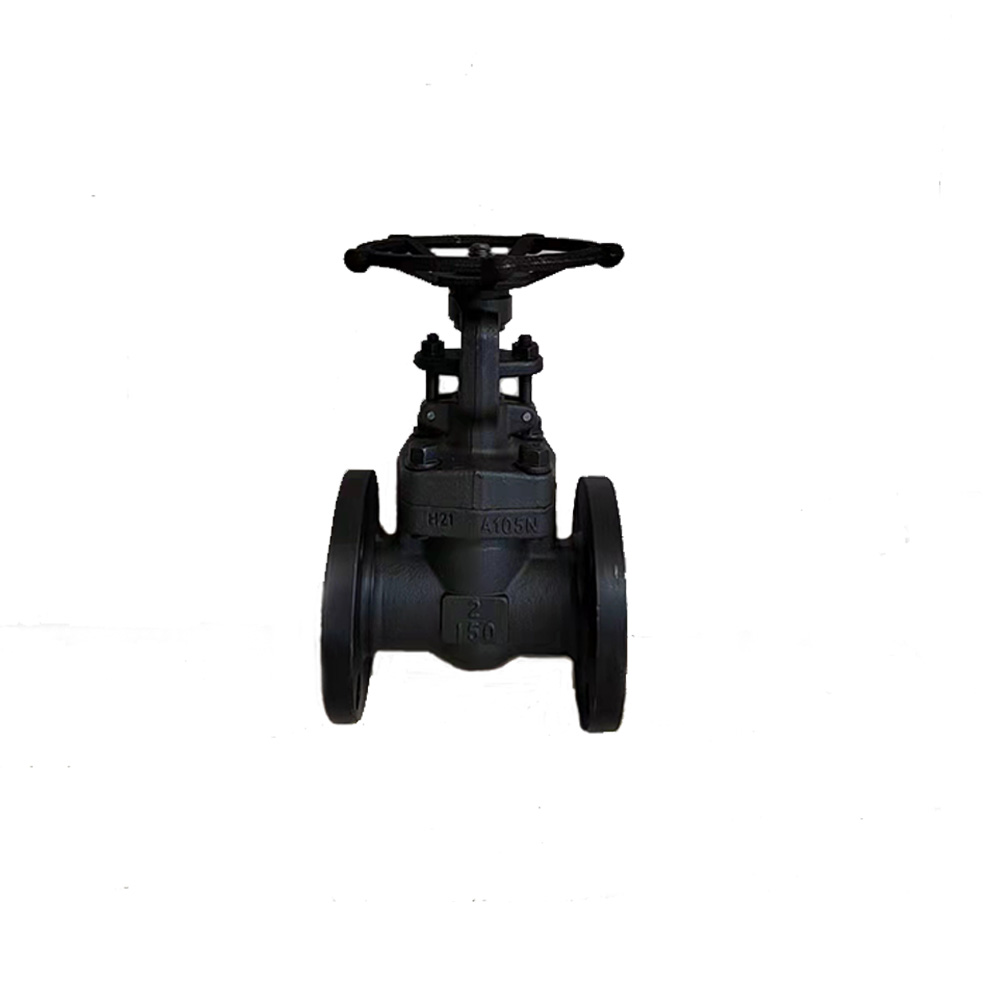
Forged Gate Valve
1. Design and manufacture standard: API602
2. Face to face: manufacture standard
3. Flange ends standard: ASME B16.5
4. Inspection and test standard: API598
High-Pressure Seal Globe Valve
Rather than for simple isolation, this pressure seal valve design is meant for throttling and flow regulation. Unlike the gate valve, the seat opening in a globe valve varies in direct proportion to the disc travel.
This controlled disc movement permits accurate adjustments, making this valve recommended for applications such as feedwater or other systems where flow control is a must. It is available in ‘T’ or ‘Y’ configurations, while angle-pattern types are effective for piping turns to reduce the number of joints and manage slugging effects in pulsating flows.
Check Valves and Material Sciences
Check valves automatically prevent backflow, protecting pumps, piping, and other equipment without manual operation. Some variations are swing, tilting disc, and piston patterns with the same core working principle.
For these valves to withstand thermal fatigue and superheated steam, they are typically constructed with chrome-moly steels. WC9 and WC6 materials provide greater resistance in demanding steam conditions. Forged alloys like F91 and F22 are strategically used for Class 600-2500 pressure seal bonnets and seat rings for their strength and creep resistance.
The Modern Power Plant Valve and Other Uses
In industrial systems where conventional designs are not enough, the pressure seal bonnet valve fills the gap. Their compact construction and reliable sealing make them particularly valuable in applications where even a tiny fluid leak can be dangerous.
Power Generation and Steam Systems
To generate power more efficiently, plants must turn to technology that can withstand demanding pressure-temperature envelopes. The Class 600-2500 pressure seal range can operate in environments exceeding 800°F and 1,500 psi. This means they can be found in modern boilers and HRSG service.
Petrochemical Processing and Refineries
Refineries use these valves to safely isolate and control highly flammable hydrocarbon streams under intense conditions. Providing fire-safe containment, they are ideal for handling different types of volatile media. Petrochemical facilities utilize them to achieve emission-free sealing of organics, acids, and caustics, ensuring containment during thermal shocks and spikes.
Nuclear and Hazardous Service
Nuclear power generation requires leak-free isolation of radioactive fluids. The scope covers feedwater and containment spray systems with heavy-duty cycles. Advanced manufacturing allows these valves to have leak rates measured in ‘molecules per year’, protecting both personnel and assets in these high-risk applications.
Advantages and Limitations of Pressure Seal Valves

Due to the absence of heavy body-bonnet flanges, a pressure seal gate valve or other pressure seal valve types offer bidirectional flow, weight savings, and minimal fluid resistance. These features make them easier to thermally insulate and maintain compared to the traditional alternative.
However, B2B buyers must pay careful attention when checking limitations, such as greater overall height and potential for high friction. When deciding where to source pressure seal valves, it’s vital to pick a leading manufacturer with years of expertise and dependable after-sales support.
PANS Valve has been operating since 1985, offering over 35 years of excellence in pressure seal valve design and delivery. Our products carry internationally recognized certifications, such as ISO 9001, 14001, and 45001, and undergo mandatory testing to meet American Petroleum Institute standards.
Request a professional quote today or contact the PANS Valve engineering team to acquire additional details about our products. We also provide some assistance with installation, replacement, and maintenance of any pressure seal valve products under our brand.
Search
Categories
Tags
Product
- Ball Valve
- Floating Ball Valve
- Fully Welded Ball Valve
- Trunnion Ball Valve
- Butterfly Valve
- Full Metal-Seated Bi-Directional Butterfly Valve
- High Performance Butterfly Valve
- Three-Eccentric Metal Hard Seal Butterfly Valve
- Check Valve
- Cast Lift Check Valve
- Cast Swing Check Valve
- Wafer Type Check Valve
- DIN Valve
- DIN Bellow Sealed Globe Valve
- DIN Globe Valve
- DIN Rising Stem Gate Valve
- DIN Swing Check Valve
- Forge Valve
- Forged Check Valve
- Forged Floating Ball Valve
- Forged Gate Valve
- Forged Globe Valve
- Gate Valve
- Bellow Sealed Gate Valve
- Flat Gate Valve
- Wedge Gate Valve
- Globe Valve
- Cast Globe Valve
- Plug Valve
- Eccentricity Plug Valve
- Inverted Pressure Balance Lubricated Plug Valve
- Orbit Plug Valve
- Sleeve Type Plug Valve
- Slurry Valve
- Slurry Valve
- Strainer


