How Do 3 Way Ball Valves Work? L-Port vs T-Port Guide
A 3 way ball valve works by turning a drilled ball inside the valve body to connect or block different flow paths. That simple motion lets one valve divert, mix, or split media in one compact unit.
In this guide, you will learn the working principle, the difference between L-port and T-port designs, how each one is used, and what to check before choosing one for chemical or water treatment service. Quarter-turn ball valves are a common design in industry, and the flow path depends on the bore pattern and stop positions.
What Is a Three Way Ball Valve?
A three way ball valve is a quarter-turn valve with three ports and a rotating ball in the center. The ball has an internal passage. When the handle or actuator turns the ball, the passage lines up with different ports. That changes the flow route through the valve. ISA describes ball valves as quarter-turn valves with a bore through the ball.
For beginners, think of it this way: it can send one inlet to two outlets, combine two inlets into one outlet, or switch one line between two flow paths. The result depends on whether the bore is L-shaped or T-shaped.
How Does a 3 Way Ball Valve Work?
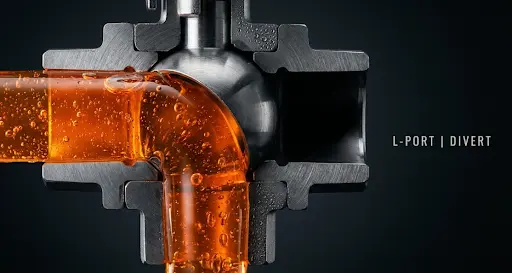
The valve works through a 90-degree turn. In one position, the internal passage connects one set of ports. In the next position, it connects to a different set. Because the ball rotates instead of moving up and down, the mechanism is compact and fast. Quarter-turn operation is a standard feature of ball valves.
Inside the valve, several key components work together. The ball is the rotating sphere that controls flow, while the seats provide sealing around it. The stem connects the handle or actuator to the ball, allowing it to turn. The body contains the pressure and houses the ports, and seals and packing prevent leakage around joints and moving parts.The flow path changes because the drilled opening inside the ball is not always straight. In a multiport design, that opening can be shaped like an L or a T. That is why port pattern matters so much during selection.
How Is an L-Port Ball Valve Different?
An L-port ball valve has an L-shaped passage inside the ball. It is mainly used to divert flow from one common port to one of two side ports.
That means it is a switching valve first. It is usually chosen when the goal is to send media to one line or another, but not both at the same time. Manufacturer data sheets show L-bore switch positions as separate routing positions rather than full mixing positions.
This valve is best used when you need to direct flow from one line to another. It works well for switching between two supply sources, changing pump bypass lines, alternating between filter duty and standby, or selecting between heating and cooling loops. Because it only sends flow to one path at a time, it is ideal for simple switching tasks.
In simple terms, use it when you want A to B or A to C. Do not choose it when you need a steady blending of two streams.
How Is a T-Port Ball Valve Different?
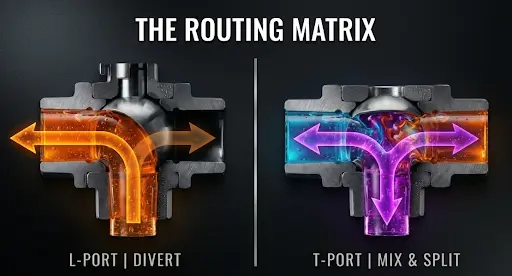
A t-port ball valve has a T-shaped internal passage. It allows more flow combinations than the L-port version.
That extra flexibility makes it useful for mixing, splitting, or straight-through flow, depending on the drilled pattern and stop arrangement. Some T-bore designs can connect all three ports in one position. Others cannot. This is why the flow diagram from the valve maker should always be checked before purchase.
It is best used in systems that require more flexible flow control. It works well for blending hot and cold water, mixing chemical streams, splitting one line into multiple branches, and handling recirculation or bypass loops. Because it can manage more complex flow paths, it is ideal for processes that need more than simple switching.
How Do You Choose Between L-Port and T-Port?
Choosing between an L-port and T-port valve depends on what you need the valve to do. Each design handles flow differently, so understanding their key differences makes selection easier.
The table below provides a quick comparison.
| Selection Factor | L-Port Valve | T-Port Valve |
| Best for | Diverting flow | Mixing or splitting flow |
| Flow pattern | One path at a time | Multiple routing options |
| Typical use | Changeover duty | Mixing / branching |
| When to choose | Switching between lines | Combining or splitting flow |
Valve selection should not be based on port shape alone. Media type, pressure, temperature, body and ball material, seat and seal material, end connection, and whether the valve is manual or actuated should all be checked. Material compatibility is especially important to ensure safe performance in the actual service conditions.
How Are These Valves Used in Chemical and Water Treatment Systems?
This is where multi-channel designs become very useful.
In chemical systems, they are often used for media diversion, chemical blending, sampling lines, tank routing, and bypass duties. A T-port design is often preferred when two streams must be combined or one stream must be split.
Material selection is especially important because chemical attack can damage seats, seals, and metal parts if the wrong combination is used.
In water treatment systems, they can switch between service and backwash lines, direct flow through treatment stages, or support mixing and bypass loops. PANS states that its valves serve water system supply, chemical, petrochemical, and energy applications, which matches the common industrial use of multiport valve designs.
What Should You Check Before Buying?
A good selection process is simple when you follow the flow first.
- Check the flow diagram
Do not assume every T-port or L-port behaves the same way. Stop positions and drilling patterns vary by design.
- Check the materials
Common bodies include carbon steel and stainless steel. PANS lists carbon steel, stainless steel, duplex stainless steel, titanium, nickel, and chromium-based materials in its product range.
- Check the operation method
Manual operation is common for simple plant service. Electric actuation is useful when the valve must be controlled remotely or integrated into automated systems. Emerson describes electric actuators as suitable for quarter-turn valves, including ball valves.
Why Does This Matter for Buyers?
A wrong port pattern can cause flow problems even when the size and pressure class look correct.
That is why this question matters: how does a three-way ball valve work in the exact routing pattern your system needs? Once you answer that, the right design becomes much easier to choose.
For projects that need industrial valve support, PANS VALVE reports more than 36 years of manufacturing experience, 25,000 m² of workshop area, annual output above 3,000 tons, and service across petroleum, chemical, energy, and water-related sectors. It also offers technical analysis, quotation support, manufacturing, and after-sales service.
Conclusion
Now you know the basic answer to how do 3 way ball valves work: the ball turns, the flow path changes, and the port pattern decides what the valve can do. L-port designs are best for switching. T-port designs are better for mixing and splitting.
If you are planning a chemical or water treatment project, choosing the correct valve type will help ensure reliable and efficient system performance. For your next project, explore the PANS VALVE ball valve collection and talk with the team about the right multi-port design for your line.
FAQ
How do 3 way ball valves work?
They rotate a drilled ball inside the body. That ball connects different ports as the handle or actuator turns 90 degrees.
What is the difference between L-port and T-port?
An L-port is mainly for diverting flow. A T-port allows more routing options, including mixing or splitting, depending on design.
Can one valve connect all three ports?
Some T-port designs can. Others cannot. Always check the maker’s flow diagram and stop positions first.
Search
Categories
Tags
Product
- Ball Valve
- Floating Ball Valve
- Fully Welded Ball Valve
- Trunnion Ball Valve
- Butterfly Valve
- Full Metal-Seated Bi-Directional Butterfly Valve
- High Performance Butterfly Valve
- Three-Eccentric Metal Hard Seal Butterfly Valve
- Check Valve
- Cast Lift Check Valve
- Cast Swing Check Valve
- Wafer Type Check Valve
- DIN Valve
- DIN Bellow Sealed Globe Valve
- DIN Globe Valve
- DIN Rising Stem Gate Valve
- DIN Swing Check Valve
- Forge Valve
- Forged Check Valve
- Forged Floating Ball Valve
- Forged Gate Valve
- Forged Globe Valve
- Gate Valve
- Bellow Sealed Gate Valve
- Flat Gate Valve
- Wedge Gate Valve
- Globe Valve
- Cast Globe Valve
- Plug Valve
- Eccentricity Plug Valve
- Inverted Pressure Balance Lubricated Plug Valve
- Orbit Plug Valve
- Sleeve Type Plug Valve
- Slurry Valve
- Slurry Valve
- Strainer


