Butterfly Valve Parts and Functions: A Practical Guide for Inspection and Replacement
Resposta rápida
A butterfly valve has five functional groups: the body and disc, stem and bushings, seat and seals, packing, and actuator mounting interface. Each performs a distinct job and fails in a different way. This guide explains what each part does, how to inspect it, and when to replace it, and why resilient, metal-seated, and high-performance sealing parts are not interchangeable by default.
What Do the Valve Body and Disc Do?
The body is the pressure-containing shell. It connects to the pipeline, houses the seat and stem, and keeps the disc aligned with the bore; wafer, lug, and flanged styles are common. PANS offers carbon steel, austenitic and duplex stainless steel, copper alloy, and titanium on its válvulas borboleta de alto desempenho. Select the material for the medium, not the pipe.
The disc rotates about 90 degrees and meets the seat when closed, so its edge, finish, and stem connection affect shutoff and torque.
Inspection: check the body for corrosion, erosion, cracks, and wall loss, especially at flange faces and joints. On the disc, look for scratches, galling, deposits, and edge deformation, and confirm the disc-to-stem pin is secure.
Replacement: cracking, deep wall loss, or a damaged flange face usually requires replacing the valve. Renew a disc that is badly scored, eroded, distorted, or loose on its stem.
What Do the Stem and Bushings Do?
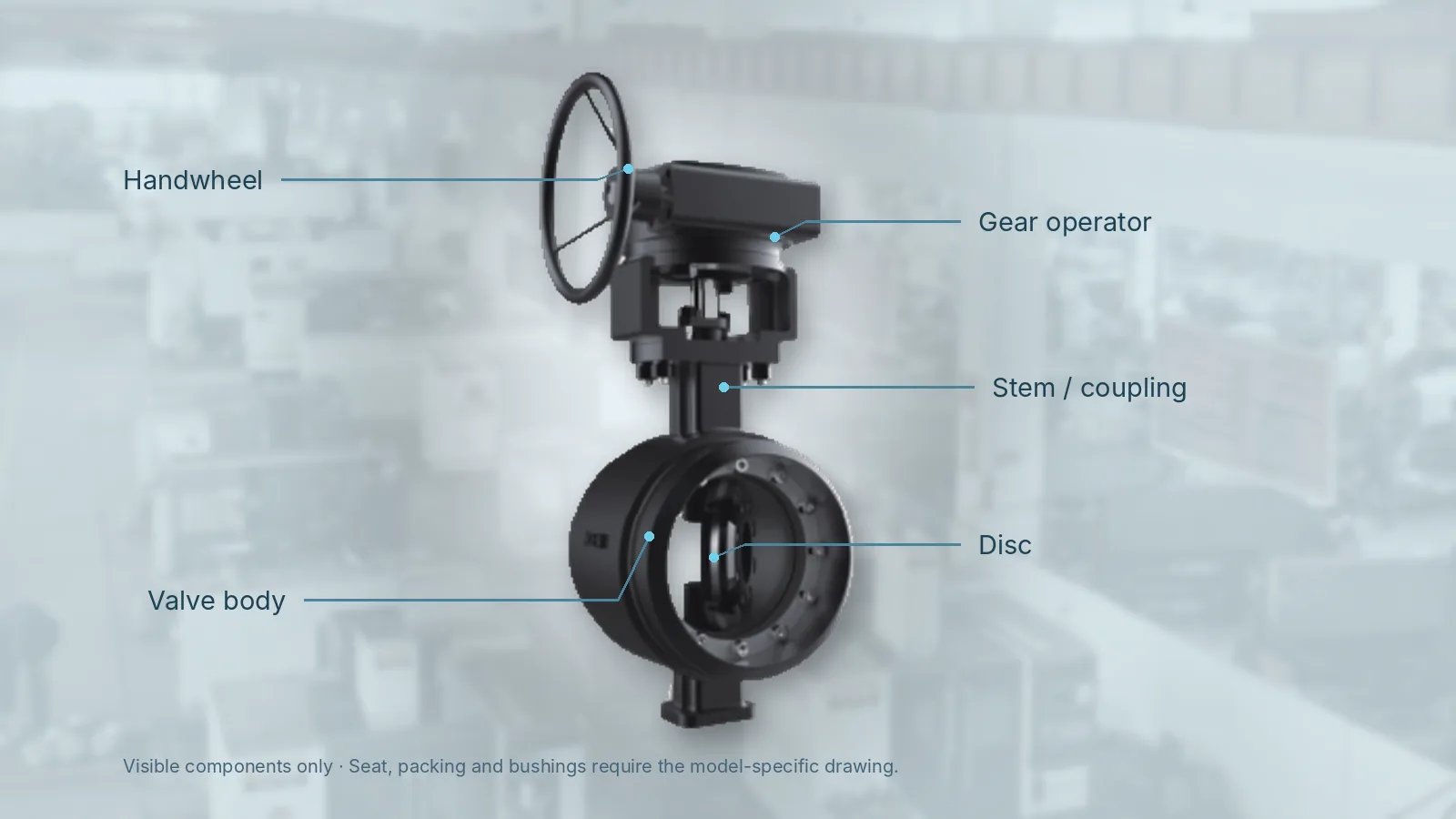
The stem transmits actuator torque to the disc and keeps it aligned. Bushings guide the stem, reduce friction, and protect the body at the stem passage. PANS specifies self-lubricated bushings and an anti-blowout stem on its high-performance model, and an API 609 blow-out stem on its three-eccentric metal-seal model.
Inspection: stroke the valve and check for binding, uneven resistance, or lateral movement. Inspect stem straightness, pitting, thread damage, packing-area wear, bushing clearance, and deposits. Confirm anti-blowout retainers are secure.
Replacement: renew a bent stem, one deeply pitted under the packing, or one damaged at the actuator coupling. Replace bushings when clearance causes side play, vibration, or rising torque; renew bushing and seal sets together when specified.
What Do the Seat and Seals Do?
The seat supports sealing contact; the seal elements close the leakage path between disc, seat, and body. Construction separates the common designs, so each is treated below.
How Does a Resilient Seat Work?
UM resilient-seated butterfly valve relies on elastic deformation to conform to the disc edge. It seals at lower torque and tolerates minor misalignment, but the elastomer limits temperature and chemical compatibility. Inspect for swelling, hardening, cracking, and compression set, and confirm the disc clears the seat during opening. Replace it when cracked, deformed, chemically degraded, or still leaking after correct positioning.
How Does a Metal Seat Work?
A metal seat uses a hardfaced or alloy ring against a hardfaced disc for high-temperature, wear-resistant service. In the PANS three-eccentric metal-seal design, a third eccentric lifts the disc clear of the seat before rotation, reducing friction and wear; the composite seal ring combines stainless steel, graphite, carbon fiber, and PTFE, and both seat and seal ring are replaceable. The full metal-seated bi-directional design adds hardfaced disc and seat rings, thrust rings on both sides, and replaceable rings fixed by evenly distributed bolts. Inspect for galling, chipping, erosion, and heat damage, and match replacement rings to the valve model.
What Changes in a High-Performance Design?
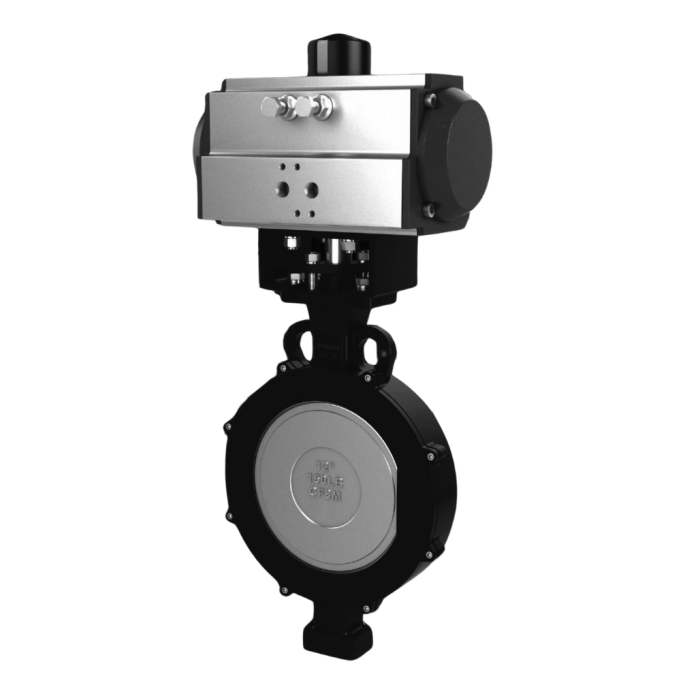
A high-performance valve pairs an eccentric design with a resilient seat. The PANS model can use a triple- or double-eccentric arrangement, an RPTFE floating seat, a tangential pin, and interchangeable parts for on-site replacement, up to a published 150 °C. These features ease maintenance but do not make parts universal across sizes or pressure classes, so follow the model-specific parts list.
What Does the Packing Do?
Packing seals the stem passage, limiting leakage to the atmosphere while allowing rotation. PANS lists packing leakage of no more than 20 ppm for its three-eccentric model and live-loaded packing with the same limit for its full metal-seated design; these figures apply to those constructions only.
Inspection: look for visible leakage, damp packing, crystallized deposits, and corrosion on the stem and gland hardware; check whether the gland follower is near the end of its adjustment range.
Replacement: renew packing when leakage continues after correct adjustment, when it is hardened or extruded, or when the stem is scored; new packing over a damaged stem usually leaks again.
What Is the Actuator Mounting Interface?
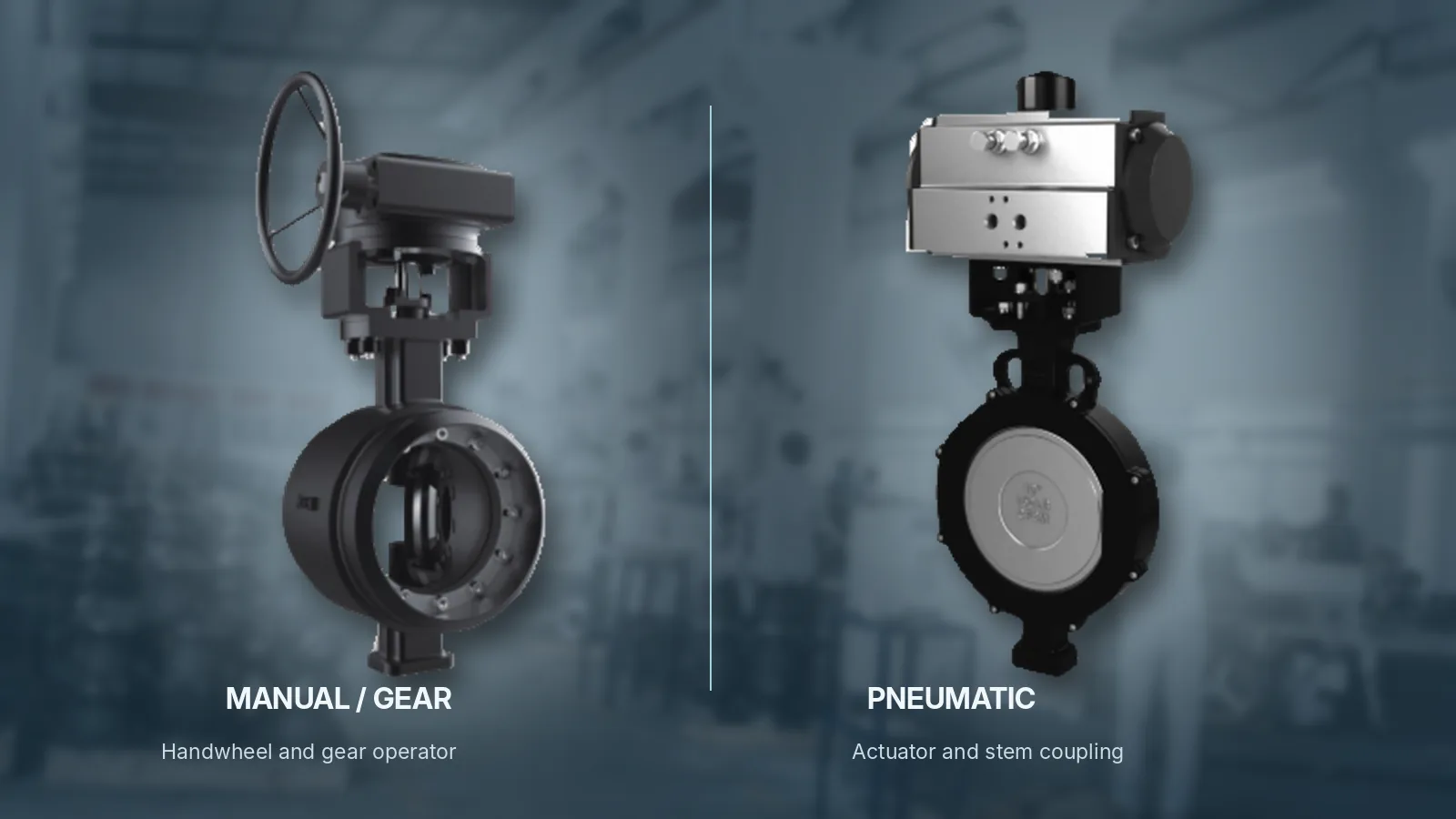
The interface connects the valve to a manual gearbox or pneumatic or electric actuator. It centers the actuator, carries torque through the stem coupling, and resists reaction force; PANS lists ISO 5211 mounting on its high-performance model.
Inspection: check the mounting flange, bolt holes, spigot diameter, and coupling for corrosion and wear; confirm the actuator sits squarely, the coupling engages the stem, and travel stops are correct at both ends.
Replacement: replace damaged hardware or a worn coupling rather than forcing an actuator into alignment. Ask the manufacturer to assess cracked flanges or damaged threads, and do not modify an adapter with the wrong bolt pattern.
Butterfly Valve Inspection Checklist
- Record model, size, pressure class, tag number, medium, and operating conditions.
- Check the body exterior for corrosion, cracks, and leakage.
- Check the disc edge and seat for scoring, deposits, erosion, and deformation.
- Measure stem play and look for bushing wear or binding.
- Inspect packing leakage and gland adjustment.
- Stroke the valve fully and note torque or travel problems.
- Check actuator bolts, coupling fit, and travel stops.
- Photograph the nameplate, damage, and missing parts.
When Should Butterfly Valve Parts Be Replaced?
Base the decision on the sealing surfaces and pressure boundary, not leakage alone; a leak may come from the seat, packing, or a disc that never reaches its closed position. Renew the seat or seal ring when beyond repair, the packing when adjustment no longer controls leakage, and the stem or bushings when wear affects alignment or torque. A cracked, deeply corroded, or flange-damaged body calls for evaluating the complete valve. After reassembly, confirm secure fasteners, free disc travel, and testing for the intended service. For sealing behavior, see how butterfly valve sealing works.
Butterfly Valve Parts RFQ Checklist
- Model, size, pressure class, and drawing or part number.
- Medium and concentration, including solids or abrasives.
- Design, operating, and maximum pressure and temperature.
- Required leakage standard or accepted rate.
- Seat, seal, and body material where known.
- Actuator type and mounting interface, if included.
- Photos of the nameplate, valve, and damaged parts.
- Quantity, and whether a spare part or complete valve is required.
Share your valve specification with PANS to request a quotation. Include the model, medium, pressure and temperature, leakage requirement, and clear photos of the parts so the team can confirm the correct configuration for the installed valve.
Perguntas frequentes
1. Are butterfly valve parts interchangeable between different models?
Not as a general rule. Parts with similar dimensions can differ in material, seat geometry, pressure rating, and stem connection. PANS describes interchangeable parts for its high-performance model, but each part must be confirmed against the specific valve and size.
2. Can the seat be replaced without replacing the whole valve?
On designs with replaceable seat or seal rings, yes, if the body, disc, and stem are serviceable. PANS lists replaceable seat or seal rings on its three-eccentric and full metal-seated designs. Body damage or stem wear can make a seat-only repair ineffective, so inspect the whole valve first.
3. What causes a butterfly valve to become hard to operate?
Bushing wear, stem corrosion, over-tightened packing, and solids or scale in the flow path are common causes. Check actuator alignment and travel-stop settings before applying more torque.
Conclusão
Performance depends on how the body, disc, stem, bushings, seat, seals, packing, and actuator interface work together, so inspect beyond the visible seat. Confirm the construction, measure wear, and order parts against the exact model and service conditions.
For model-specific support, review the PANS range or contact PANS with the valve details and inspection photos.
Procurar
Categorias
Tag
produtos
- Válvula de esfera
- Válvula de esfera flutuante
- Válvula de esfera totalmente soldada
- Válvula de esfera munhão
- Válvula borboleta
- Válvula borboleta bidirecional totalmente metálica
- Válvula borboleta de alto desempenho
- Válvula borboleta de vedação rígida de metal tri-excêntrico
- Válvula de retenção
- Válvula de retenção de elevação fundida
- Válvula de retenção giratória fundida
- Válvula de retenção tipo wafer
- Válvula DIN
- Válvula globo selada com fole DIN
- Válvula globo DIN
- Válvula de gaveta com haste ascendente DIN
- Válvula de retenção oscilante DIN
- Válvula de Forja
- Válvula de retenção forjada
- Válvula de esfera flutuante forjada
- Válvula de gaveta forjada
- Válvula globo forjada
- Válvula de gaveta
- Válvula de gaveta selada por fole
- Válvula de gaveta plana
- Válvula de gaveta em cunha
- Válvula global
- Válvula globo fundida
- Válvula macho
- Válvula macho de excentricidade
- Válvula macho lubrificada com equilíbrio de pressão invertida
- Válvula macho de órbita
- Válvula macho tipo manga
- Válvula de Polpa
- Válvula de Polpa
- Filtro


