Pneumatic Butterfly Valve: Working Principle, Types & Selection
Quarter-turn. Compressed air. 90-degree disc rotation. That is how a pneumatic butterfly valve controls flow. Fast, automated, compact. Key selection factors are actuator type, seat material, body configuration, pressure class, and whether fail-safe is required. PANS Valve manufactures high-performance butterfly valves to ISO 9001, CE, API, and TUV standards for oil and gas, chemical, water treatment, and power generation projects globally. 24-hour quotation. 20-day delivery.
استكشف صمام الفراشة عالي الأداء من PANS
عرض المواصفات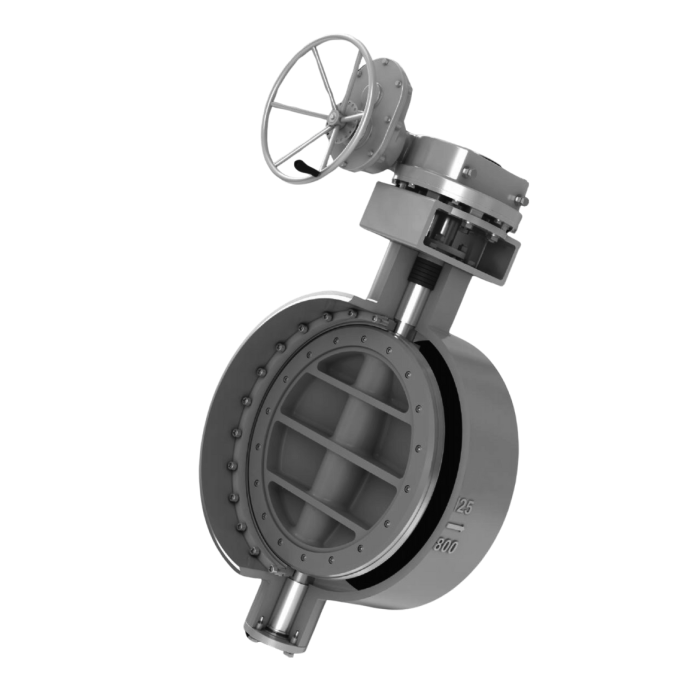
ما هو صمام الفراشة الهوائي؟
Disc inside a pipe bore. Rotate it 90 degrees and you control flow. Align the disc with the flow path and the valve is fully open. Rotate it perpendicular and it is fully closed. That is the core of how a pneumatic butterfly valve works. Simple geometry. Fast operation. Minimal pressure drop compared to gate or صمامات الكرة الأرضية of the same size.
Two components make it function. The valve body holds the disc, stem, seat, and bearings. The pneumatic butterfly valve actuator converts compressed air into the rotary motion that drives the disc. Add a solenoid valve, a limit switch box, and a positioner and you have a complete automated flow control assembly integrated into your process system.
How Does a Pneumatic Butterfly Valve Work?
Compressed air enters the actuator and pushes on internal pistons. That linear piston movement gets converted into 90-degree rotary motion. Two mechanisms do this conversion.
Rack and pinion is the industry standard for smaller sizes. Piston movement turns a central gear. Compact. Cost-effective. Works well up to around 6 inches. Scotch yoke uses a sliding yoke instead. Generates higher torque at the start and end of the stroke. Better choice for larger valves or applications with high friction from powder, slurry, or viscous media. The pneumatic actuator butterfly valve mechanism you choose affects the torque output, cycle life, and how the valve behaves under difficult operating conditions.
What Are the Main Types and Body Configurations?
Double-acting or spring-return. That is the first decision for any pneumatically actuated butterfly valve specification.
Double-acting needs air to open and air to close. If the air supply fails, the valve stays where it is. Last position hold. Spring-return uses air in one direction and springs for the return. If air fails, springs drive the valve to a predetermined safe position. Fail-safe closed or fail-safe open depending on how the springs are configured. For hazardous chemical lines or critical process applications, spring-return is typically the required fail-safe specification.
Body connection type is the second decision. Wafer fits between flanges using through-bolts. Compact. Space-efficient. Lug has threaded inserts in the body, allowing dead-end service without a downstream flange. Flanged bolts directly to mating flanges. More rigid. Better suited to higher-pressure service.
What Specifications Matter Most?
Seat material first. Everything else follows from that.
EPDM for water, weak acids, glycols. Never use EPDM with oil. It absorbs oil and swells, crushing the disc against the seat. PTFE for strong acids, solvents, and corrosive chemicals. Metal seats for anything above 150°C or for abrasive media where soft seats degrade fast. Getting this wrong is the most common cause of premature valve failure in service.
Size range for pneumatically actuated butterfly valves runs from around 2 inches to 48 inches and beyond depending on design. Pressure class depends on body material and disc geometry. Standard resilient-seated designs handle lower pressures. Triple-offset metal-seated designs handle high-pressure, high-temperature, and zero-leakage critical service conditions.
How Do You Select the Right Pneumatic Butterfly Valve?
Five questions. Answer all five before specifying anything.
What is the media?
Water and air take EPDM. Acids and solvents take PTFE. Steam and high-temperature service take metal seats.
What is the temperature?
Determines whether soft seating is even viable.
What is the pressure class?
Determines disc and body material requirements.
What is the cycle rate?
High-cycle applications need actuator sizing at 30% above calculated breakaway torque, not running torque.
Is fail-safe required?
Yes means spring-return. No means double-acting is acceptable.
Where Are Pneumatic Butterfly Valves Used?
HVAC and ventilation systems. Large duct airflow regulation where fast response and low pressure drop matter. Water and wastewater treatment. Large-diameter pipeline flow management where gate valves would be too heavy and too slow.
In Chemical processing, PTFE-seated and metal-seated designs for corrosive media isolation. Power generation cooling water systems. Large-diameter pneumatic actuator butterfly valve designs for rapid flow control across high-volume circuits. Oil and gas pipelines. High-performance double-offset and triple-offset designs where tight shutoff and durability under frequent cycling are the primary requirements.
How Are Pneumatic Butterfly Valves Installed and Maintained?
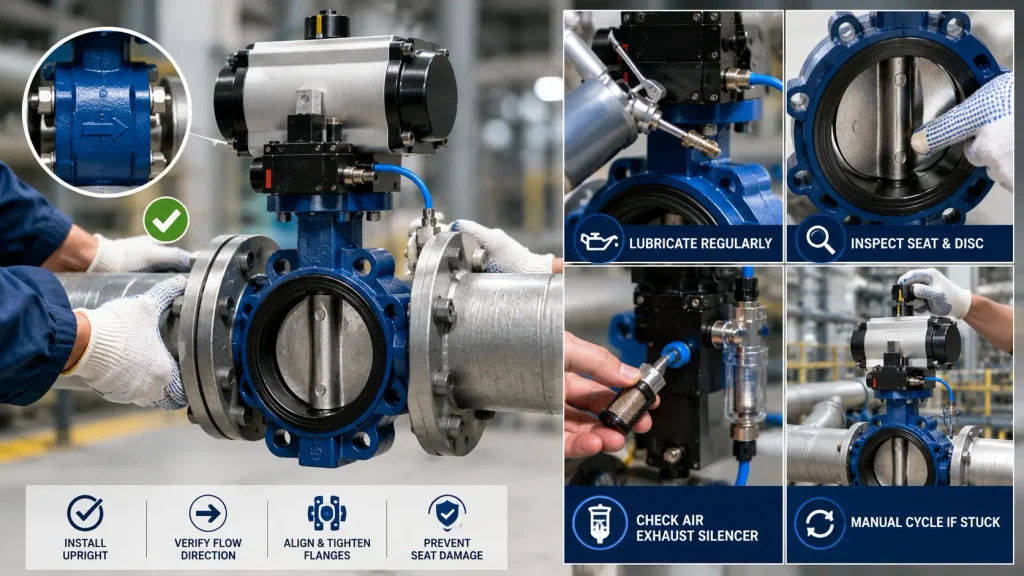
Install upright where possible. Confirm the flow direction arrow on the valve body matches pipeline flow before bolting flanges. For wafer-type bodies, verify the disc has full clearance before closing the flanges around it. One scratch on the seat from a misaligned flange creates a leak path that no amount of torque will fix.
Maintenance is straightforward but needs to happen on schedule. Lubricate bearings and stem interfaces every two months on high-cycle applications. Inspect seat condition for swelling or surface degradation. Swelling signals chemical incompatibility and accelerates failure fast if not caught early. Check the solenoid exhaust silencer for dirt blockage. A blocked silencer is the most common cause of slow actuator response in the field. Valve stuck after long idle? The seat has likely bonded to the disc. Manual cycling breaks the static friction before restoring air pressure.
For high-performance butterfly valve supply across demanding service conditions, contact PANS Valve for a 24-hour quotation. PANS Valve double-offset and triple-offset designs cover high-pressure, high-temperature, and critical service applications where standard resilient-seated designs fall short.
الأسئلة الشائعة
What is a pneumatic butterfly valve?
A quarter-turn automated valve that uses compressed air to rotate a disc 90 degrees inside a pipe bore. Combines a butterfly valve body with a pneumatic actuator for fast, reliable automated isolation or flow regulation across industrial pipeline systems.
What are the three main types of butterfly valves?
Concentric resilient-seated for general low-pressure water and HVAC service. Double-offset high-performance for tighter shutoff at moderate pressure and temperature. Triple-offset metal-seated for high-temperature, high-pressure, and zero-leakage critical service applications requiring maximum durability.
What is the working principle of a pneumatic butterfly valve?
Compressed air acts on pistons inside the actuator. Piston movement is converted to 90-degree rotary motion through rack and pinion or scotch yoke mechanism. This rotates the disc between fully open and fully closed positions to control pipeline flow.
What are the disadvantages of a pneumatic butterfly valve?
Not suited for precise throttling at very high pressure drops. Resilient seats have temperature and chemical compatibility limits. Requires a clean, dry compressed air supply. Spring-return actuators add cost but are necessary for fail-safe operation in hazardous or critical service applications.
يبحث
فئات
العلامات
منتج
- صمام الكرة
- صمام الكرة العائمة
- صمام الكرة الملحومة بالكامل
- صمام الكرة مرتكز الدوران
- صمام الفراشة
- صمام الفراشة ثنائي الاتجاه ذو المقعد المعدني بالكامل
- صمام الفراشة عالي الأداء
- صمام الفراشة ذو الختم الصلب المعدني ثلاثي المركز
- فحص الصمام
- صمام فحص الرفع المصبوب
- صمام فحص التأرجح المصبوب
- صمام فحص نوع الرقاقة
- صمام الدين
- DIN صمام الكرة الأرضية المختوم
- صمام الكرة الأرضية DIN
- DIN ارتفاع صمام البوابة الجذعية
- صمام فحص التأرجح DIN
- صمام صياغة
- صمام الاختيار مزورة
- صمام الكرة العائمة مزورة
- صمام البوابة مزورة
- صمام الكرة الأرضية مزورة
- صمام البوابة
- صمام بوابة مغلق من الأسفل
- صمام البوابة المسطحة
- صمام بوابة إسفين
- صمام العالم
- صمام الكرة الأرضية المصبوب
- صمام التوصيل
- صمام التوصيل غريب الأطوار
- صمام توصيل مشحم لتوازن الضغط المقلوب
- صمام التوصيل المدار
- كم نوع صمام التوصيل
- صمام الطين
- صمام الطين
- مصفاة


