Butterfly Valve Types: How to Choose the Right Design
Resposta rápida
Butterfly valve types are usually grouped by body geometry: concentric, double-offset, and triple-offset. That describes how the disc moves and meets the seat, not how the valve performs. Seat material, pressure and temperature, differential pressure, closure tightness, cycle frequency, and end connection decide the specification. Start with the service, then choose the geometry.
Why Are Butterfly Valve Types So Often Confused?
The same valve can be described several ways, and the terms overlap. “High-performance” is a commercial family label, not a geometry. “Metal-seated” describes the sealing interface, not the offset. “Triple-offset” describes disc and seat geometry, yet a triple-offset valve may use a composite seal rather than an all-metal seat.
That matters when quoting: a request for a “triple-offset metal-seated valve” may return a composite-seal design that meets the geometry but not the sealing duty. Define the service first — medium, size and connection, pressure and temperature, differential pressure, closure tightness — then body and seat geometry. Actuation follows once torque is known.
What Are the Main Butterfly Valve Types?
Industrial butterfly valves fall into three structural families. Each moves the disc differently relative to the seat, which sets friction, sealing behaviour, and maintenance.
When should you choose a concentric, resilient-seated valve?
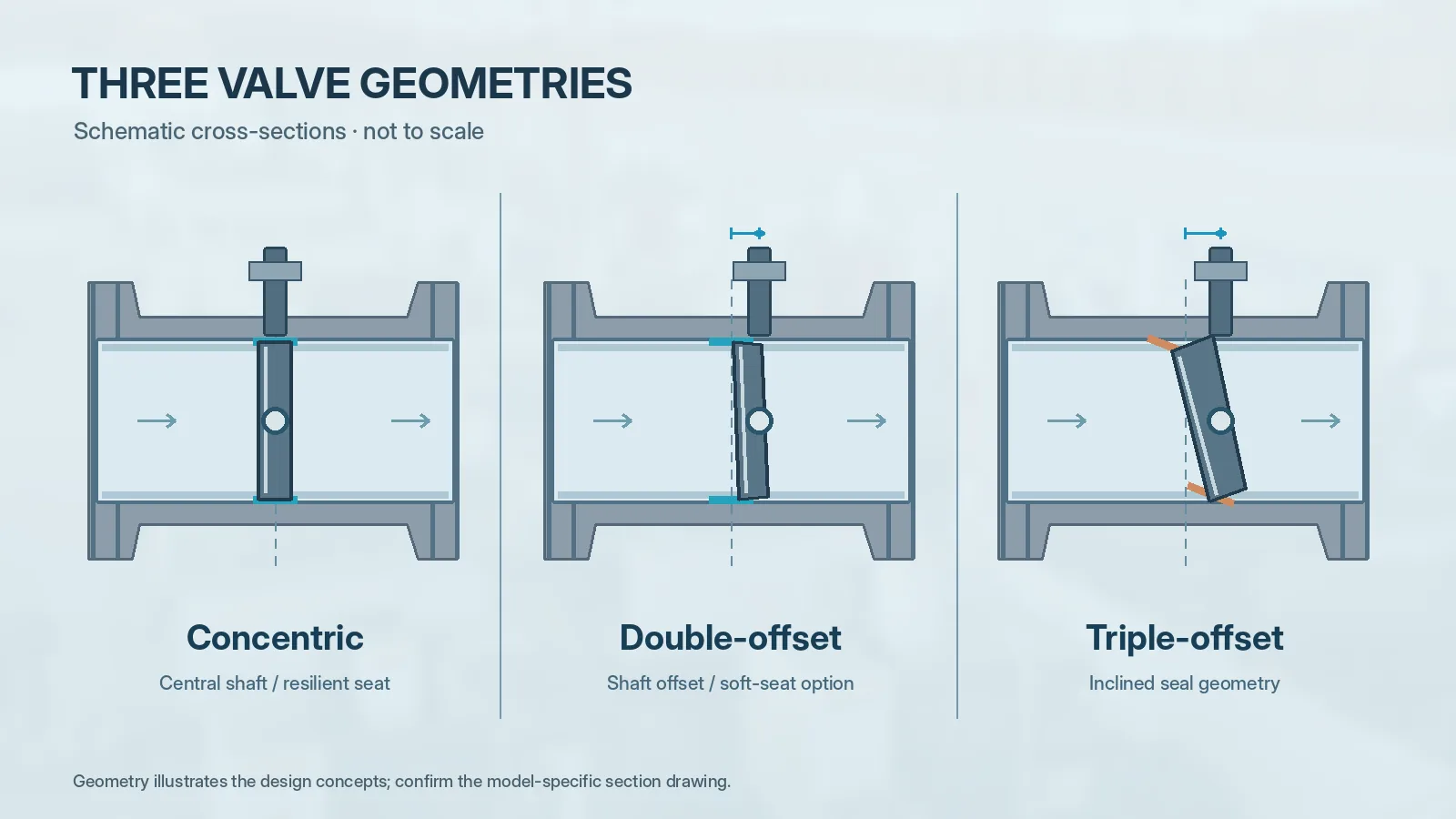
In a concentric design, the stem passes through the disc centre and the disc sits centrally in the body. When closed, the disc presses into an elastomer liner or seat around the full circumference, so the valve seals in either direction.
This is the general-purpose type for water, HVAC, cooling circuits, and utilities: compact, light, and usually the lowest-cost option. The resilient seat closes tightly at modest differential pressure, which suits isolation rather than severe throttling.
Its limits come from the seat material. Elastomers have a narrower temperature range than PTFE or metal and can swell or harden in aggressive media; abrasive solids can damage the seat edge. For clean water at moderate temperature those limits rarely matter. For steam, solvents, or hot oil, they usually do.
When is a double-offset, high-performance valve the better fit?
A double-offset valve moves the stem away from the disc centre and away from the seat plane. The first offset puts the shaft behind the disc centre; the second tilts the seat cone relative to the shaft. As the disc opens, it lifts off the seat within the first few degrees, so the sealing surfaces separate before the disc rotates across them.
That reduces rubbing and extends seat life in services that cycle often. It also allows a PTFE or RPTFE seat instead of an elastomer, widening the temperature and chemical range while keeping a soft-seat closure.
PANS describes its high-performance butterfly valve range with double or triple eccentric geometry, an RPTFE seat, and wafer, lug, or flanged connections. The data sheet, not the family name, should be the reference.
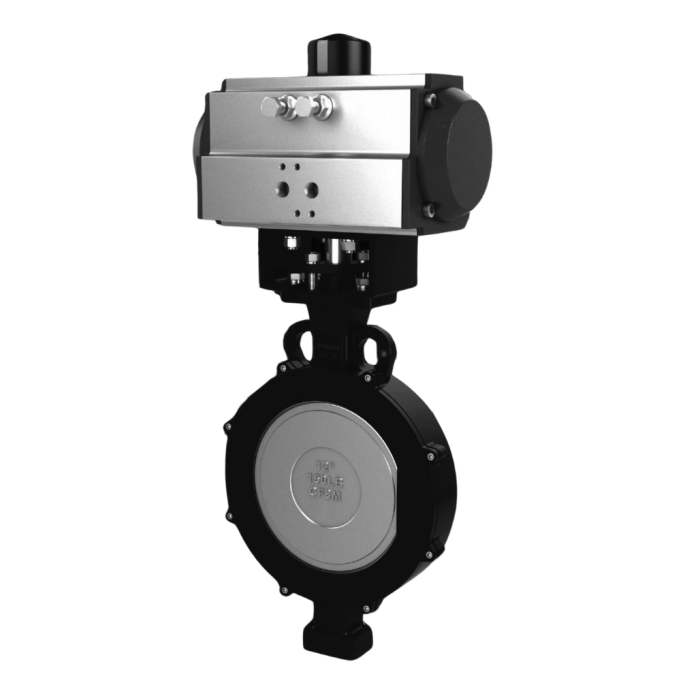
This type suits moderate pressure and temperature where a soft seat is acceptable: process water, some hydrocarbons, steam condensate, and utility isolation. It fits when a concentric valve lacks temperature headroom but a full metal seat is not justified. Check the polymer seat against the actual medium.
When does a triple-offset, metal-seated valve justify the cost?
A triple-offset valve adds a third offset: the seat cone axis is inclined relative to the flow axis. The disc swings into the seat only at the end of the closing stroke, so there is almost no sliding contact during travel. Closure comes from geometry and seating force, not an elastomer compressed against the disc. It is used for higher temperature, higher pressure, and more demanding isolation: steam, heat-transfer oil, refinery, petrochemical, and power applications where a polymer seat would fail.
PANS lists a three-eccentric metal hard-seal design with replaceable seat and seal rings. Its seal ring is described as a composite of stainless steel, graphite, carbon fibre, and PTFE — a composite seal, not a homogeneous metal seat. PANS also lists a separate full metal-seated bidirectional butterfly valve with hardfaced metal-to-metal disc and seat rings.
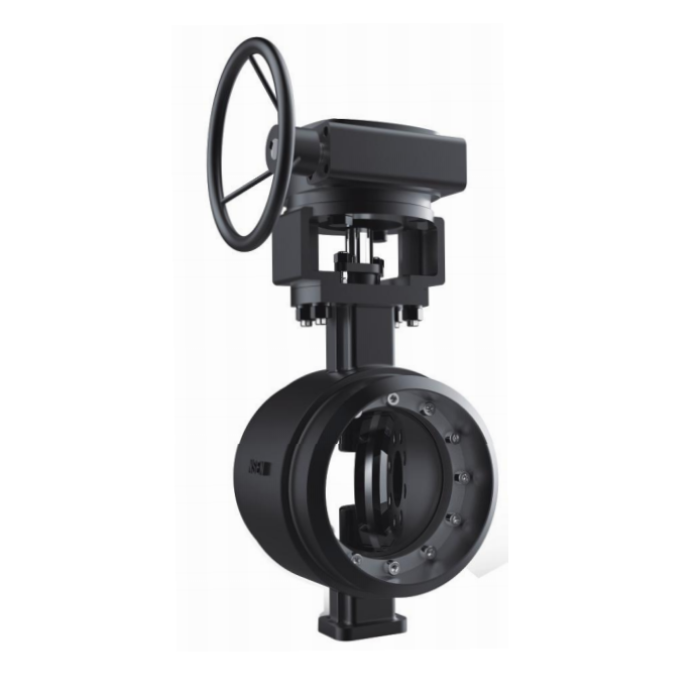
Triple offset is therefore a geometry that can carry either a composite or a fully metal sealing system. If the service requires metal-to-metal seating, say so and confirm the seat construction in the quotation.
These valves cost more and demand careful installation. The seat is sensitive to misalignment and debris at closure, and the body is heavier. They earn that cost when temperature, pressure, or isolation duty rules out a polymer seat.
How Do Butterfly Valve Seat Types Change the Decision?
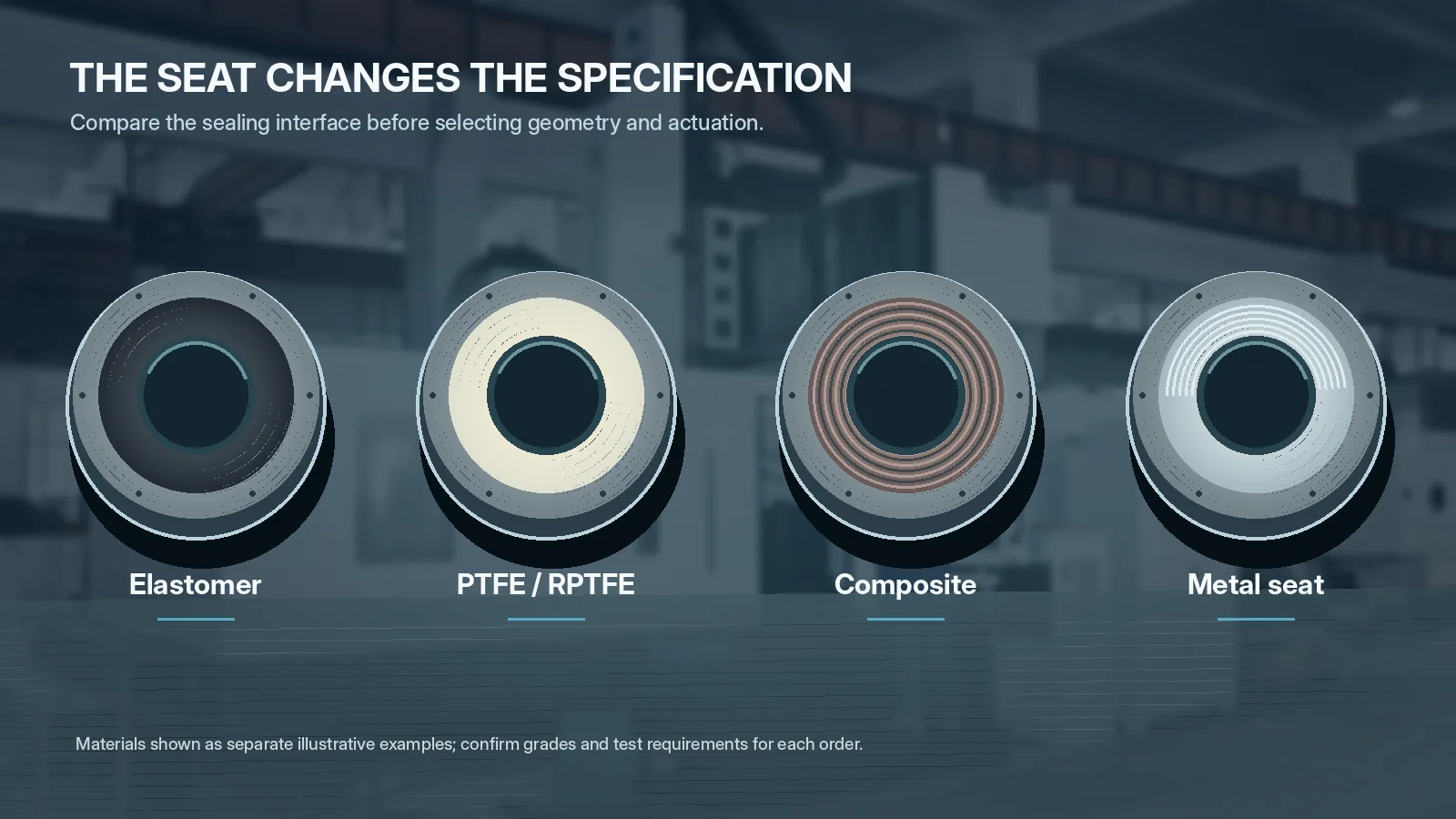
The seat is the most consequential choice after geometry. Four families cover most industrial enquiries.
Elastomer seats (EPDM, nitrile, and similar) seal at low differential pressure and tolerate slight misalignment. They are standard for water and HVAC, but their temperature ceiling and chemical resistance are limited, and abrasive solids can damage them.
PTFE and RPTFE seats widen the chemical and temperature range while keeping a soft sealing interface. They need lower seating friction than metal, but PTFE can creep under sustained load and has its own temperature limit.
Composite seats balance elasticity, temperature resistance, and strength. PANS describes a seal ring built from stainless steel, graphite, carbon fibre, and PTFE. The combination suits services between a polymer seat and a full metal seat, but the medium and temperature still need confirmation.
Metal seats use hardfaced or alloy rings and rely on precision geometry and seating force. They tolerate higher temperature and pressure and resist many aggressive media, but need higher actuation torque and are less forgiving of debris.
Seat choice changes torque, and torque changes the actuator. A metal-seated valve that looks like a direct replacement for a soft-seated valve may need a larger operator and a stronger bracket.
O butterfly valve manufacturing overview covers design, machining, assembly, and testing; the quality-control and testing approach covers material identification and mechanical testing.
Which Butterfly Valve Type Fits Your Application?
Use the matrix as a starting point, then confirm every value against the quoted data sheet.
| Projeto | Sealing interface | Typical fit | Main checks |
|---|---|---|---|
| Concentric, resilient-seated | Elastomer liner or seat | Water, HVAC, utilities, low differential pressure isolation | Temperature limit, chemical compatibility, abrasion |
| Double-offset, high-performance | PTFE or RPTFE seat | Moderate pressure and temperature, frequent cycling, process isolation | Seat temperature ceiling, differential pressure, torque |
| Triple-offset, composite seal | Composite seal ring | Steam, hot oil, higher pressure, demanding isolation | Medium compatibility, cycle duty, alignment |
| Triple-offset, full metal seat | Hardfaced metal-to-metal | High temperature, aggressive media, metal seat required | Actuation torque, debris, seat repair access |
Read the table by column, not by row. A high-temperature service does not automatically require a triple offset if the pressure and medium allow another design; a metal seat does not automatically require a triple offset for simple isolation.
Butterfly valves can throttle, but the flow curve is steep near closure and the disc and seat see high velocity at small openings. State expected cycles per day and stroke time, because a valve that moves twice a day and one that modulates continuously are different applications.
What Should Every Butterfly Valve RFQ Include?
A clear RFQ reduces the risk of a quote that meets the headline size but not the duty. Include:
- Medium, concentration, and whether solids or entrained gas are present.
- Nominal size, connection type, and face-to-face standard.
- Pressure rating and maximum differential pressure across the closed disc.
- Operating and design temperature, including upset conditions.
- Required closure tightness and the acceptance test the project will use.
- Flow duty: isolation, occasional throttling, or continuous control.
- Expected cycles per day and required stroke time.
- Actuation preference, power supply, control signal, and fail-safe position.
- Body, disc, stem, and seat materials, plus coating or lining.
- Documentation, inspection, and test requirements.
Perguntas frequentes
1. Is a triple-offset butterfly valve always metal-seated?
No. Triple offset describes geometry. PANS lists a triple-offset design with a composite seal ring and a separate full metal-seated series. If the duty requires metal-to-metal sealing, specify it separately and confirm the seat construction before ordering.
2. Can a butterfly valve be used for throttling?
Yes, within limits. The disc holds intermediate positions, but flow changes quickly near closure and the seat sees higher velocity at small openings. Continuous control duty should be stated in the RFQ.
3. How should I compare quotations for different butterfly valve types?
Compare the same size, pressure rating, seat and body material, connection, actuation, and test requirement. A lower price often reflects a different seat or a narrower temperature range. Ask for the data sheet and seat construction with every quote.
4. Are butterfly valve seats replaceable?
It depends on the design. PANS lists replaceable seat and seal rings for its three-eccentric and full metal-seated ranges. For other designs, confirm whether the seat is replaceable or a bonded liner before planning maintenance.
Conclusão
Butterfly valve selection is a sequence, not a choice between three names on a catalogue page: define the service, choose the sealing interface, select the geometry that supports it, then size the actuation and confirm the connection. Concentric valves remain the efficient default for clean, moderate-duty water service. Double-offset valves extend the range where a polymer seat still works. Triple-offset valves earn their cost when temperature, pressure, or isolation duty rules out a softer seat.
Where a PANS page describes a family in broad terms, treat the data sheet for the quoted model as the controlling document. Exact configuration, seat construction, and test criteria should be confirmed before purchase.
To confirm the seat construction and quotation details, contact PANS with your valve specification.
Share your valve specification with PANS to request a quotation.
Procurar
Categorias
Tag
produtos
- Válvula de esfera
- Válvula de esfera flutuante
- Válvula de esfera totalmente soldada
- Válvula de esfera munhão
- Válvula borboleta
- Válvula borboleta bidirecional totalmente metálica
- Válvula borboleta de alto desempenho
- Válvula borboleta de vedação rígida de metal tri-excêntrico
- Válvula de retenção
- Válvula de retenção de elevação fundida
- Válvula de retenção giratória fundida
- Válvula de retenção tipo wafer
- Válvula DIN
- Válvula globo selada com fole DIN
- Válvula globo DIN
- Válvula de gaveta com haste ascendente DIN
- Válvula de retenção oscilante DIN
- Válvula de Forja
- Válvula de retenção forjada
- Válvula de esfera flutuante forjada
- Válvula de gaveta forjada
- Válvula globo forjada
- Válvula de gaveta
- Válvula de gaveta selada por fole
- Válvula de gaveta plana
- Válvula de gaveta em cunha
- Válvula global
- Válvula globo fundida
- Válvula macho
- Válvula macho de excentricidade
- Válvula macho lubrificada com equilíbrio de pressão invertida
- Válvula macho de órbita
- Válvula macho tipo manga
- Válvula de Polpa
- Válvula de Polpa
- Filtro


