Why Is Your Check Valve Chattering? Sizing, Minimum Flow and Fixes
Réponse rapide
Check valve chattering is the rapid, repeated opening and closing of the disc, usually caused by unstable flow forces rather than one defective part. The most common causes are an oversized valve running below its minimum stable flow, pulsating flow, poor installation or worn internals. Confirm the noise pattern first, then compare actual flow with the valve’s stable operating range. PANS supplies cast swing, cast lift, wafer and forged check valves and can quote a configuration against the duty data you provide.
This guide shows how to separate chatter from other noise, trace the cause, and choose a fix that matches the duty.
Is It Really Check Valve Chattering?
Chatter is rapid, repeated movement of the disc, plate or piston. It lifts, loses the flow force holding it open, drops toward the seat and repeats, producing a fast metallic tick or knock at low flow or pump start-up.
Not every check valve noise is chatter. The fix depends on the mechanism.
| Noise pattern | Typical clue | Likely mechanism |
|---|---|---|
| Rapid metallic ticking or knocking | Follows low flow or pump start/stop; repeats continuously | Valve disc instability, low flow or worn guide |
| One loud bang at shutdown | Pressure spike; happens once per closure | Water hammer or surge |
| Continuous hiss or crackle | Often downstream of a restriction; damage may follow | Cavitation or flashing |
| Irregular rattle | Can occur at any flow; may change with pressure | Loose trim, debris or worn hinge |
| Rhythmic noise matching pump speed | Repeats with each stroke or revolution | Flow pulsation |
These are clues, not a diagnosis. A recording, vibration reading and operating log are more useful.
What does check valve chatter sound like?
Most buyers describe a fast metallic flutter or hammering inside the valve. If it stops when flow rises, the valve is probably unstable at its present operating point, not simply broken.
Why the difference matters
Water hammer is a pressure surge. Cavitation is a phase-change problem. Chatter is a flow-and-mechanics problem. Treating all three as “a noisy check valve” can lead to the wrong replacement.
Why Does an Oversized Check Valve Chatter at Low Flow?
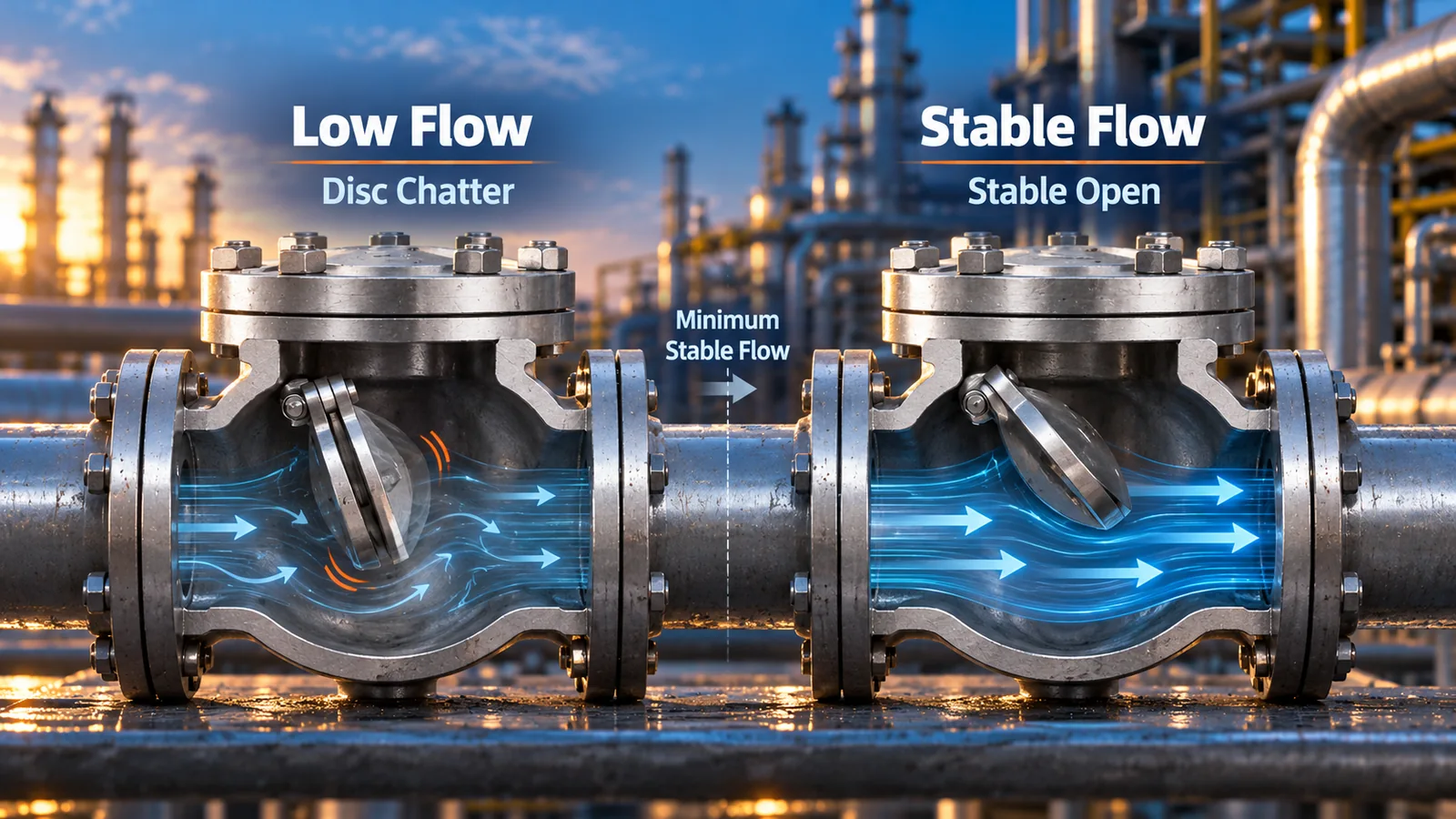
A valve sized by line diameter alone may be much larger than actual flow requires. At low flow, the disc cannot reach a stable open position. It hovers near the seat, where small flow changes produce large changes in opening force. The result is check valve chatter and wear on the seat, hinge and guide.
This is the practical meaning of check valve minimum flow: the lowest flow at which the selected valve remains stable. It is not one universal number. It changes with design, size, spring, orientation, medium and pressure.
Ask for two values:
- Minimum flow to fully open: when the disc or plates reach the intended open position.
- Minimum stable flow: the lowest flow at which the valve does not flutter or chatter.
Also request the pressure-drop curve. A smaller valve may stop chatter but create excessive pressure loss, cavitation or insufficient capacity. Sizing is a balance.
How does valve design affect stability?
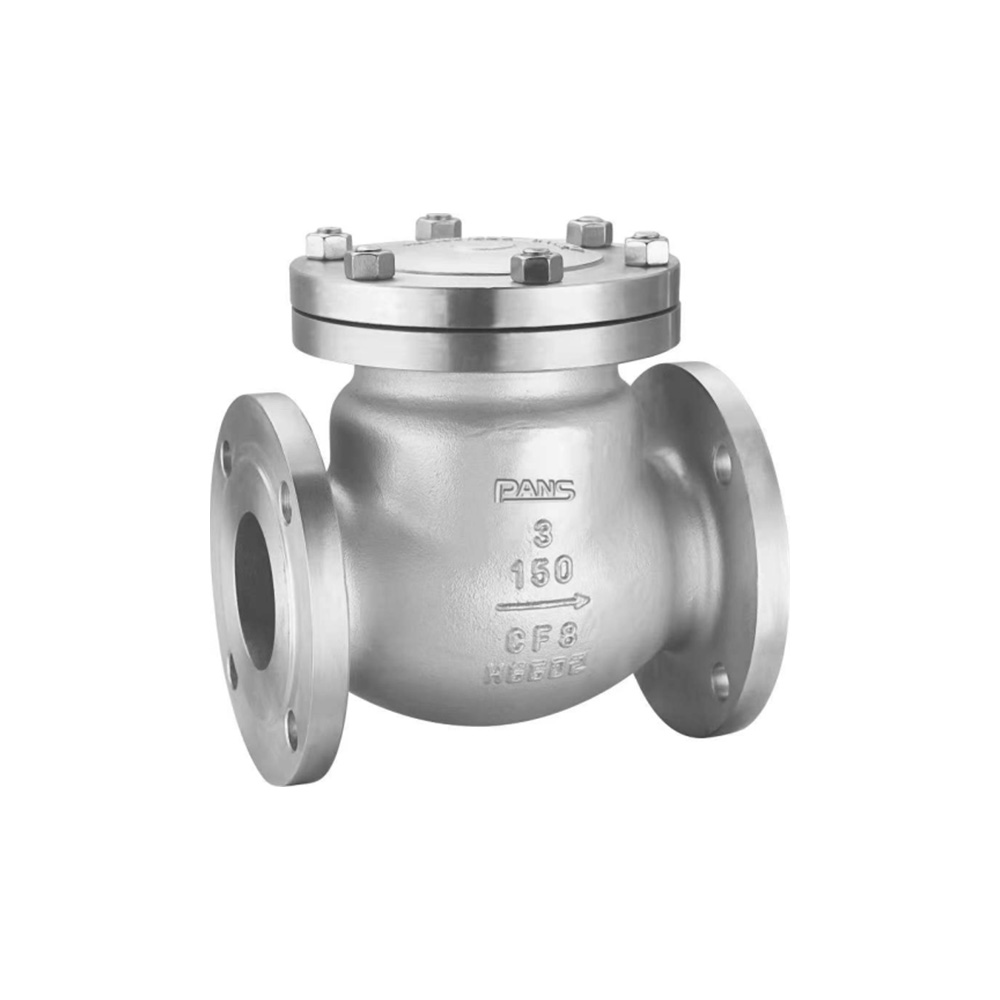
UN clapet anti-retour à battant en fonte uses a hinged disc; disc weight, hinge geometry and orientation set closing force, so low flow and vertical service need attention. A clapet anti-retour à levage en fonte uses a guided disc or piston whose guide and seat affect how steadily it lifts.
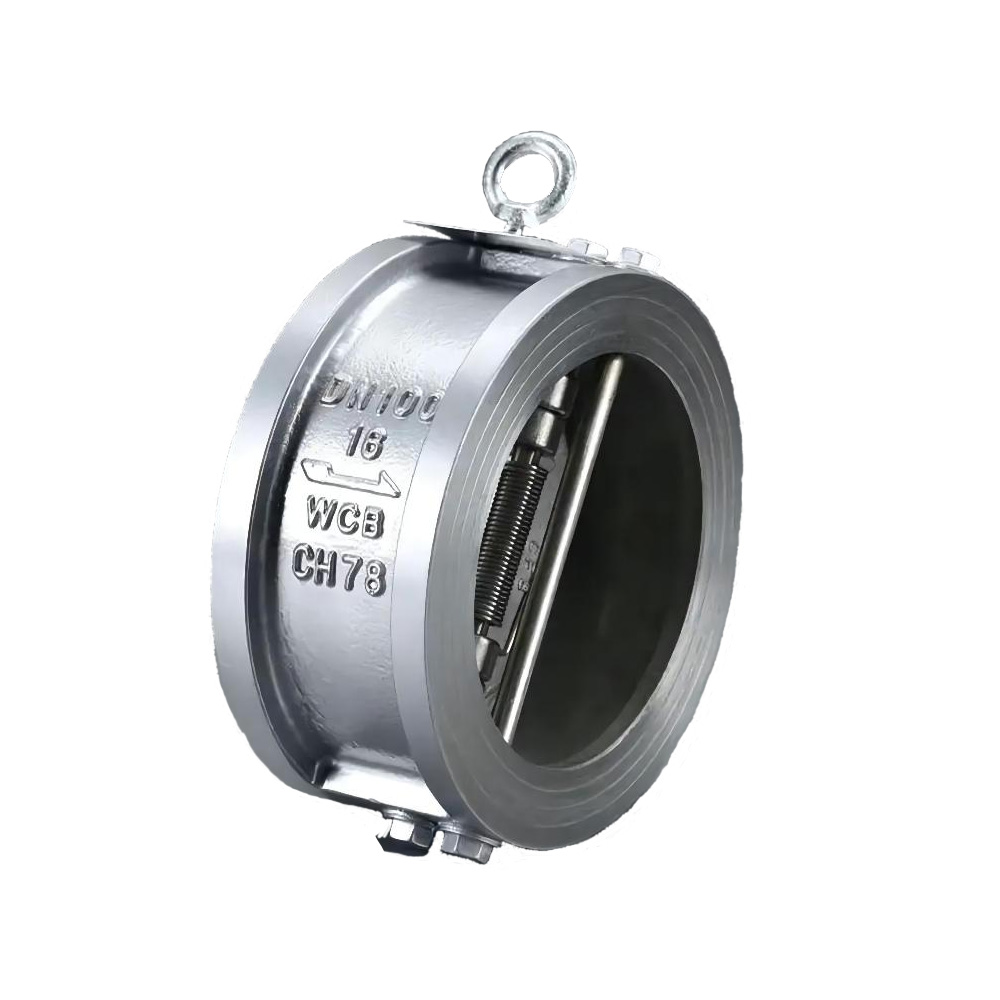
UN wafer-type check valve uses two spring-loaded plates, so spring characteristics and pulsation matter. A clapet anti-retour forgé may use a lift or swing disc; the two are not interchangeable.
Choose the design that stays stable across minimum, normal and maximum flow.
Can Installation Cause Check Valve Chatter?
Yes. A sound valve can chatter when flow reaching it is unstable or misdirected.
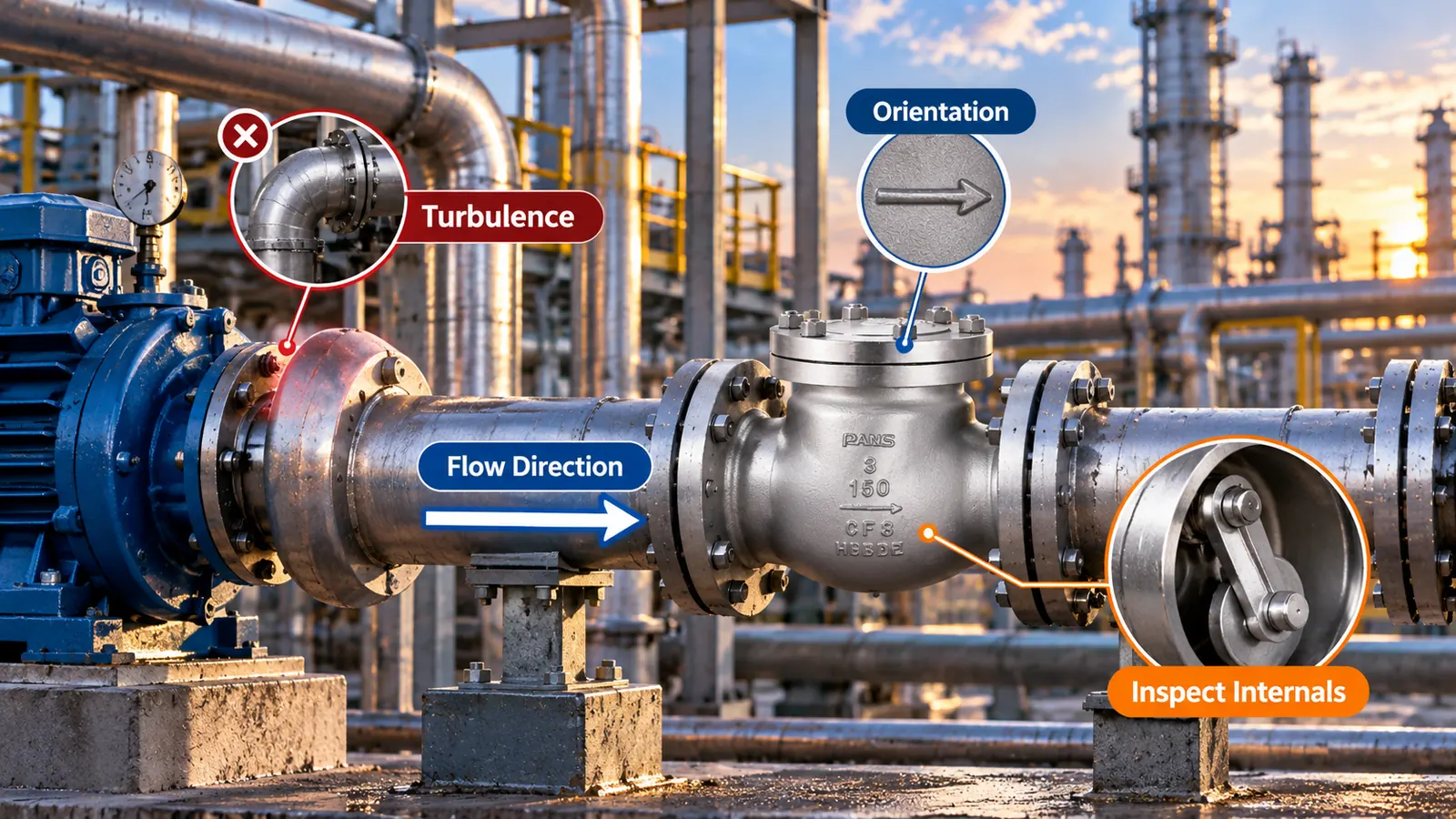
Start with orientation and flow direction. The body arrow must match the line, and the installed position must match the approved drawing. Do not assume every vertical position is acceptable. Some designs have limits, and downward flow through a swing check is a common problem. Our check valve flow direction guide explains how arrows and drawings align.
Then check:
- A valve near a pump, elbow, reducer or tee sees swirl and pulsation.
- Long unsupported pipe can transmit vibration to the disc.
- Air pockets can disturb flow; debris, weld slag or a protruding gasket can restrict disc movement.
- Parallel pumps can leave one check valve at low forward flow.
Straight-length needs vary by size and design. Ask for the supplier’s recommendation for the selected model rather than applying one number.
How Do You Confirm the Cause Before Replacing the Valve?
Use a short, evidence-based check.
- Log the event. Record pressures, flow, temperature, pump speed and when noise starts or stops. Note start-up, low demand or continuous operation.
- Compare flow with the stable range. Ask whether the valve is sized by line or actual flow, and request the minimum stable flow for the quoted model.
- Check installation. Confirm the arrow, orientation, alignment, support and nearby fittings.
- Inspect internals. After isolation and depressurization, check the disc, hinge pin, guide, spring and seat for wear, debris, erosion or gasket intrusion.
- Test a stable point. If safe, raise flow briefly. If noise stops, low-flow instability is likely. If it continues, look for pulsation, worn parts or resonance.
A pressure trace helps. A rapidly needling gauge or a logged signal with a strong periodic component points to pulsation rather than sizing alone.
Which Fix Actually Stops Check Valve Chattering?
Match the fix to the cause. A different-size valve is not always the answer.
| Confirmed cause | Practical correction | What to verify |
|---|---|---|
| Oversizing or sustained low flow | Re-size to actual flow, or select a design with a lower stable-flow threshold | Pressure drop, capacity and cavitation margin |
| Strong flow pulsation | Reduce pulsation at the pump or compressor; review the valve and piping together | Pressure trace and noise at normal flow |
| Wrong orientation or flow direction | Reinstall to the approved drawing | Body arrow, disc movement and seat contact |
| Debris or worn hinge, guide or seat | Clean or replace the affected parts | Free movement and seat condition |
| Water hammer mistaken for chatter | Address closure speed and surge | Peak pressure at closure |
A smaller valve may need reducers; check the revised pressure drop and ensure the reducer does not create a new disturbance. If pulsation is the cause, a new valve may only move the noise.
For a replacement, compare designs at the same duty. Our swing check valve vs spring check valve comparison explains how gravity and spring force change closing behaviour. Spring assistance can improve closure, but it changes cracking pressure and pressure drop. Confirm both for the exact model.
Review common check valve misconceptions before approving a like-for-like replacement. Matching the old size may repeat the old sizing error.
What Should You Include in a Check Valve RFQ?
A clear enquiry lets the supplier check stability, not guess from size.
Process data: fluid, composition and solids; minimum, normal and maximum flow with units; design and operating pressure plus differential; temperature; pump or compressor type and whether flow is steady or pulsating.
Installation data: line size and schedule; flow direction and orientation; end connection and face-to-face; available space and nearby fittings; for replacement, the existing model, drawing and dimensions.
Performance and documents: allowable pressure drop; minimum flow to fully open and minimum stable flow; closing or surge requirement; required standard, test report, material certificate and drawing.
Ask one direct question: “Is this model selected by line size or actual flow, and what is its minimum stable flow?” The answer shows whether the quote is based on your duty.
FAQ
1. What causes check valve chattering?
Unstable disc movement at low flow, often from oversizing. Pulsation, wrong orientation, debris and worn hinge or guide parts can cause the same symptom.
2. Can a check valve be too large?
Yes. A valve selected for line size may be too large for actual flow. The disc runs partly open and may flutter. Check pressure drop before downsizing.
3. What is check valve minimum flow?
The lowest flow at which the selected valve remains stable. Ask for both fully-open flow and minimum stable flow; they are not always the same.
4. Will a spring-loaded design stop chatter?
Not automatically. Spring force can improve closure and stability, but raises cracking pressure and may increase pressure drop. Confirm the spring against the actual flow range.
Stop Guessing and Size for the Real Flow
Check valve chattering is a symptom, not a diagnosis. Separate it from water hammer, cavitation and mechanical rattle, then compare the valve’s stable range with the real operating range. Sizing, installation and maintenance solve different parts of the problem.
PANS supplies cast swing, cast lift, wafer and forged check valves. Share your fluid, minimum and maximum flow, pressure, temperature, line size, orientation and existing valve details to request a quotation for the required configuration.
Recherche
Catégories
Mots clés
Produit
- Robinet à tournant sphérique
- Robinet à tournant sphérique flottant
- Robinet à tournant sphérique entièrement soudé
- Robinet à bille à tourillon
- Vanne papillon
- Vanne papillon bidirectionnelle à siège entièrement métallique
- Vanne papillon haute performance
- Vanne papillon à joint dur en métal à trois excentriques
- Clapet anti-retour
- Clapet anti-retour à levage moulé
- Clapet anti-retour à battant en fonte
- Clapet anti-retour de type plaquette
- Vanne DIN
- Vanne à soupape scellée à soufflet DIN
- Robinet à soupape DIN
- Vanne à vanne à tige montante DIN
- Clapet anti-retour à battant DIN
- Vanne de Forge
- Clapet anti-retour forgé
- Robinet à tournant sphérique flottant forgé
- Vanne à vanne forgée
- Robinet à soupape forgé
- Vanne à vanne
- Vanne à guillotine à soufflet
- Vanne à vanne plate
- Vanne à vanne en coin
- Robinet à soupape
- Robinet à soupape moulé
- Vanne à boisseau
- Vanne à boisseau excentrique
- Vanne à boisseau lubrifiée à pression équilibrée inversée
- Vanne à boisseau orbitale
- Vanne à boisseau à manchon
- Vanne à lisier
- Vanne à lisier
- Passoire


