Check Valve Cracking Pressure: Buyer’s Guide to Selection and Testing
Réponse rapide
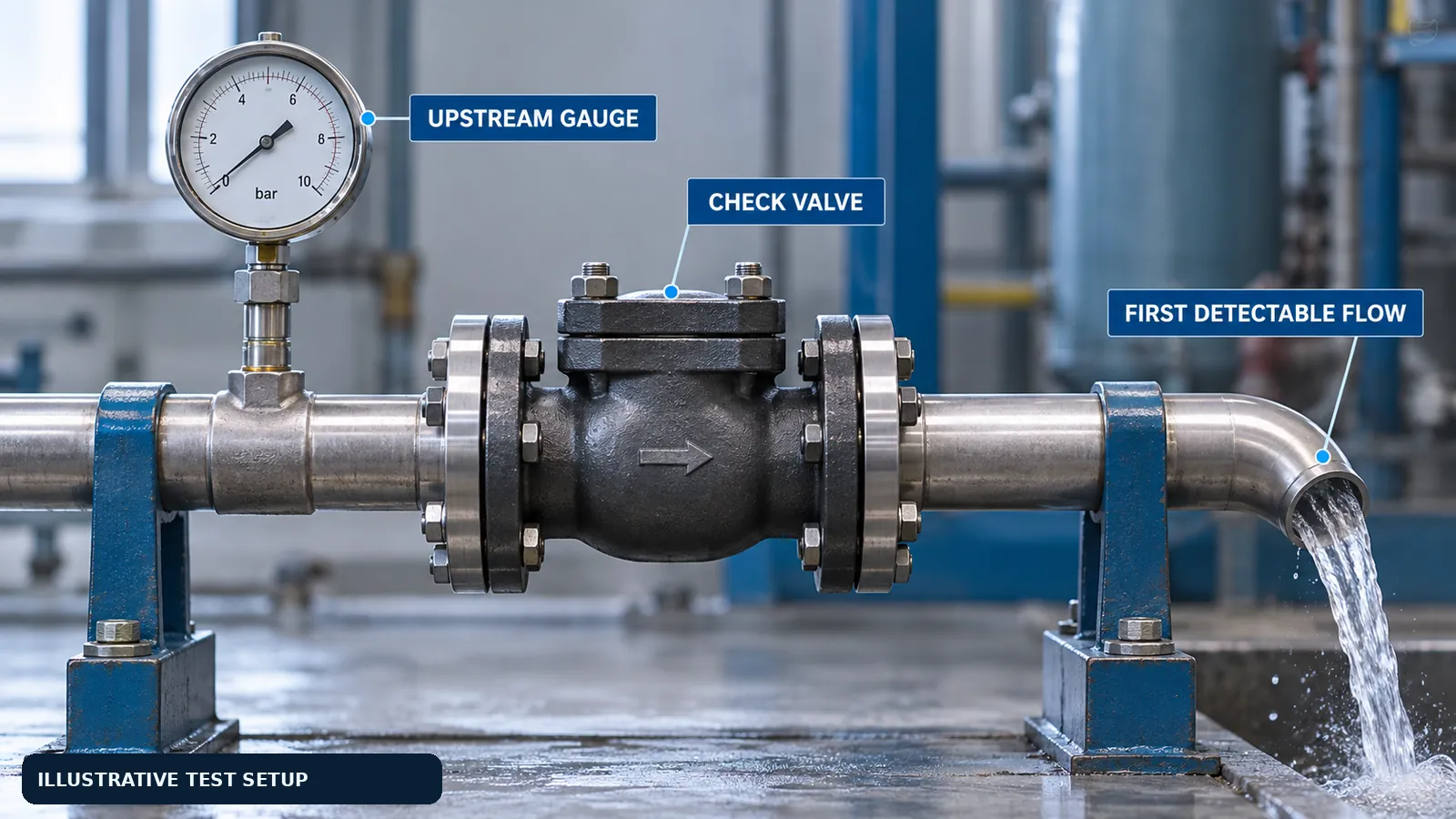
Check valve cracking pressure is the differential pressure across the valve at which the first detectable forward flow occurs under specified test conditions. With the outlet vented to atmosphere, upstream gauge pressure may approximate this differential. It is not the same as full-open pressure drop or reseat pressure, and it changes with valve design, spring force, size, medium and test method. One target cannot be applied across swing, lift, dual-plate and forged designs. Specify the duty, orientation and test method, then request the tested value for the exact model. PANS supplies forged, cast and wafer check valves and quotes each configuration against the required duty.
This guide explains what the number means, how to test it, how designs differ, and what to put in an RFQ so suppliers answer on the same basis.
What Is Check Valve Cracking Pressure—and How Do You Test It?
Cracking pressure—often called check valve opening pressure—is the point where the closure element first moves off the seat. In a closed loop, read it as the difference between upstream and downstream pressure. With the downstream side vented, it is close to the upstream gauge reading.
Three pressures are often confused:
- Cracking pressure: first detectable flow.
- Reseat pressure: the lower pressure at which the disc or plate returns to the seat and stops reverse flow.
- Pressure drop at duty flow: the energy cost once the valve is open.
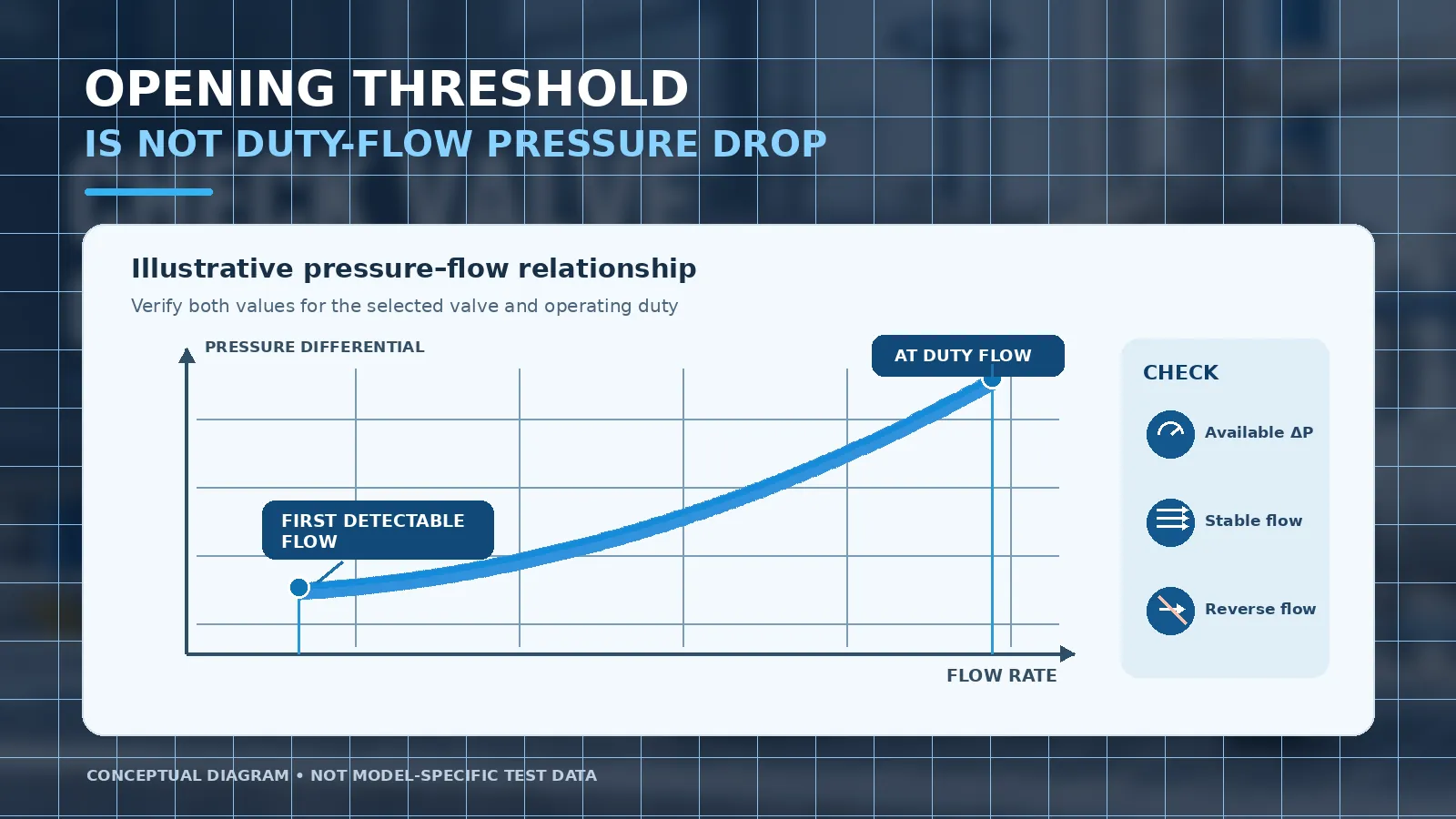
A valve can crack at a low pressure and still have a high pressure drop at full flow. Pressure drop at operating flow depends on valve size, internal geometry, opening position and fluid conditions. Cracking pressure depends on the opening-force balance, including spring preload or disc weight, effective area and orientation.
A practical test sequence
- Record the model, size, trim, spring, orientation and flow direction.
- Use a gauge close to the expected value.
- With the downstream side vented, raise upstream pressure slowly.
- Record the pressure at first steady, detectable flow—not the first gauge flicker.
- Repeat three times and report the average and range.
- State the medium and temperature. A test at 20 °C does not prove behaviour at 120 °C.
API 598 is often named on check valve data sheets. It covers shell and seat leakage tests, not one universal cracking-pressure figure. If the value matters, write the test method into the order. Correct flow orientation during the test is also essential; our check valve flow direction guide explains how body arrows and piping drawings should align.
Why a Lower Cracking Pressure Is Not Always Better
A low cracking pressure lets the valve open early. That helps low-pressure lines, gravity-fed systems and pump discharge lines where every fraction of a bar matters.
The trade-off is stability. If the valve is oversized for the actual flow, the disc may crack open but never reach a stable lift position. It can hover, chatter and wear the seat.
A higher cracking pressure can keep the valve closed against normal line fluctuations. It also raises the pressure the pump must produce before flow starts. If the target is above the available differential, the valve will not open fully—or at all.
The useful selection range therefore comes from three inputs:
- The minimum differential the system can provide.
- The flow needed to hold the disc or plates open.
- The reverse-flow condition the valve must stop.
Ask for the pressure-drop curve as well as the cracking value. The two together show whether the valve will open, stay open and still protect the line. For a design comparison, our swing vs spring check valve comparison explains how gravity and spring force change that behaviour.
Does Cracking Pressure Change With Valve Type?
Yes—and this is where many generic specifications fail. Cracking pressure in a check valve is set by its closure design, so a target written for one type cannot be copied to another.
| Conception | What sets opening behaviour | What to confirm |
|---|---|---|
| Swing check | Disc weight, hinge geometry and orientation; gravity helps closing | Hinge position, flow direction and minimum flow to hold the disc open |
| Lift check | Guided disc or piston, its weight and the available differential | Seat and guide design, installation orientation and pressure drop at duty flow |
| Dual-plate wafer | Spring force on two plates, plus plate and body geometry | Spring rating, size, face-to-face and approved orientation |
| Forged check | The selected disc option—lift or swing—inside the same standards family | Which disc type is quoted and the tested value for that model |
UN clapet anti-retour à battant en fonte relies on a hinged disc. In horizontal service, the hinge pin should sit at the top so gravity can assist closure. In a vertical line, flow must be upward; downward flow can hold the disc open. Our swing check valve installation guidance explains the limits.
UN clapet anti-retour à levage en fonte uses a guided disc or piston. It needs enough differential to lift the disc and keep it in the flow path. The published PANS page specifies horizontal service for its cast lift range, so orientation belongs in the enquiry.
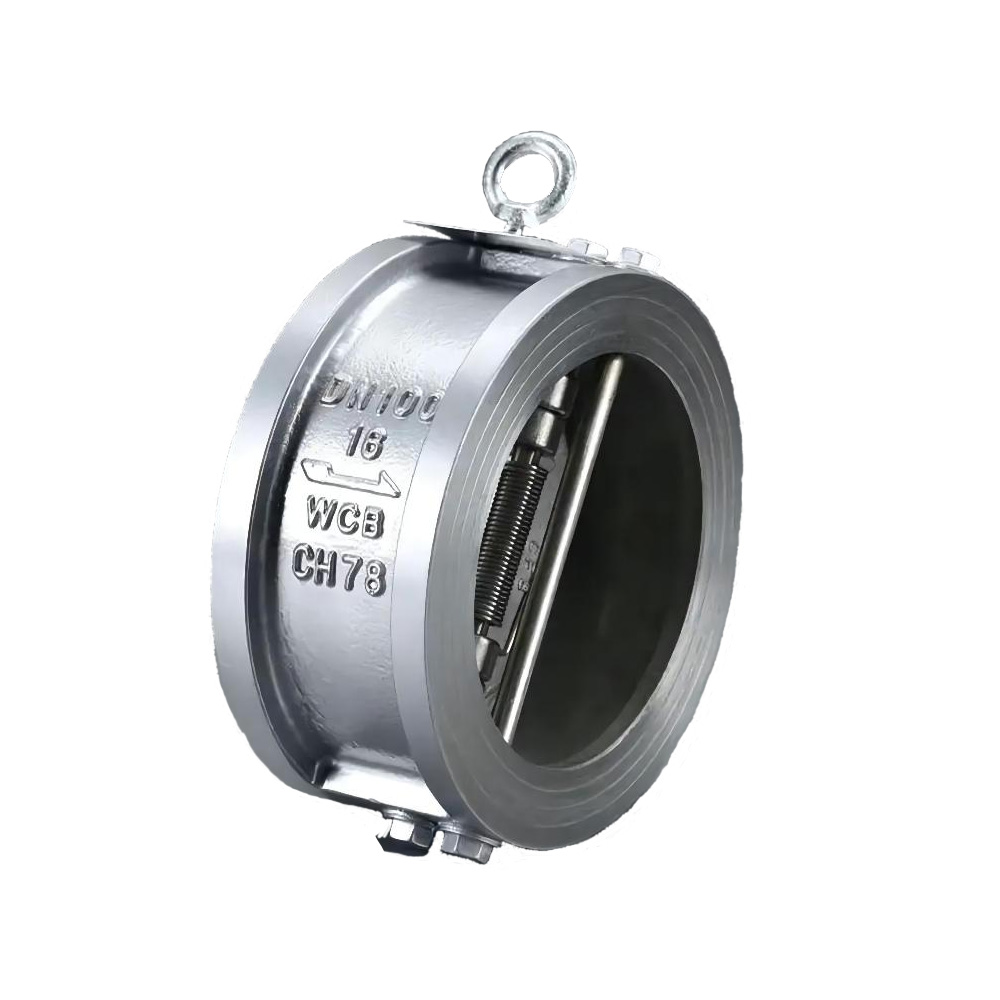
UN wafer-type check valve uses two spring-loaded plates in a compact body. Spring force affects cracking pressure and closing speed. Because the body is short and the plates sit between flanges, confirm the approved orientation and pipe clearance for the exact model.
Forged check valves add another variable: many ranges offer both lift and swing discs. The PANS forged check valve range is built to API 602 with bolted or welded bonnets and SW, SC, BW or RF ends. Two valves with the same size and class can behave differently if one is lift and the other is swing.
What Should a Check Valve Data Sheet Include?
A cracking-pressure figure without context is not procurement data. Ask for these fields on the datasheet or in the quotation:
- Model and disc type: lift, swing or dual plate.
- Size, pressure class and body/trim materials.
- End connections and face-to-face dimensions.
- Flow direction and approved installation orientation.
- Medium, operating temperature and design differential.
- Required cracking pressure, tolerance and test medium.
- Reseat pressure and seat-leakage acceptance.
- Pressure drop at the design flow rate.
- Drawing, material certificate and test report scope.
If a supplier lists one cracking pressure for an entire size range, ask whether it is a catalogue typical or a tested value. Those are different claims. A tested value should identify the unit, test rig, medium, temperature and acceptance rule.
RFQ Example: How to Ask for Cracking Pressure Data
Here is a simple enquiry that gives a supplier enough to answer clearly:
Please quote 40 pieces of 2 in, Class 300 forged check valve to API 602, A105 body with 316 trim, socket-weld ends, horizontal installation, flow left to right. Medium is water at 60 °C, design flow 12 m³/h. Target cracking pressure is 0.3 bar, measured with water at 20 °C, downstream vented, average of three tests. Report the actual value, tolerance, reseat pressure and pressure drop at design flow. Include the general arrangement drawing and API 598 seat test report.
Three things make this useful. The duty is stated, the test method is stated, and the supplier is asked to report a result rather than promise a generic number. If the requested value does not suit the selected model, a good supplier will say so before the order is placed.
For a replacement, add the installed face-to-face length and the existing pipe orientation. Those details often decide whether a suitable valve can actually be fitted.
FAQ
1. Is cracking pressure the same as opening pressure?
In most buyer specifications, yes. Both describe the point where flow first passes the seat. Reseat pressure is separate and usually lower.
2. Can cracking pressure be adjusted after installation?
Usually not. It is set by spring force, disc weight and geometry. A different spring or trim may be needed, and that change must be confirmed for the specific model.
3. Does low cracking pressure mean low pressure drop?
No. Cracking pressure describes opening; pressure drop describes performance once the valve is open. An oversized valve can open early and still run poorly at low flow.
4. Why do two suppliers quote different values for the same size?
They may use different springs, trims, test media or tolerances, or one may be quoting a catalogue typical rather than a measured value. Compare the test method before comparing the number.
Choose the Test, Then the Valve
Cracking pressure is a selection input, not a label value. Define the differential your system can supply, confirm the flow needed to keep the valve stable, and ask for the tested value for the exact model and orientation. Then compare pressure drop, reseat behaviour and documentation on the same basis.
PANS manufactures check valves in forged, cast and wafer designs for industrial buyers who need a clear configuration and an agreed test basis. Send us the line size, medium, temperature, flow direction, orientation and target cracking pressure. We will confirm the available test data for the selected model before you approve the order.
Recherche
Catégories
Mots clés
Produit
- Robinet à tournant sphérique
- Robinet à tournant sphérique flottant
- Robinet à tournant sphérique entièrement soudé
- Robinet à bille à tourillon
- Vanne papillon
- Vanne papillon bidirectionnelle à siège entièrement métallique
- Vanne papillon haute performance
- Vanne papillon à joint dur en métal à trois excentriques
- Clapet anti-retour
- Clapet anti-retour à levage moulé
- Clapet anti-retour à battant en fonte
- Clapet anti-retour de type plaquette
- Vanne DIN
- Vanne à soupape scellée à soufflet DIN
- Robinet à soupape DIN
- Vanne à vanne à tige montante DIN
- Clapet anti-retour à battant DIN
- Vanne de Forge
- Clapet anti-retour forgé
- Robinet à tournant sphérique flottant forgé
- Vanne à vanne forgée
- Robinet à soupape forgé
- Vanne à vanne
- Vanne à guillotine à soufflet
- Vanne à vanne plate
- Vanne à vanne en coin
- Robinet à soupape
- Robinet à soupape moulé
- Vanne à boisseau
- Vanne à boisseau excentrique
- Vanne à boisseau lubrifiée à pression équilibrée inversée
- Vanne à boisseau orbitale
- Vanne à boisseau à manchon
- Vanne à lisier
- Vanne à lisier
- Passoire


