Cryogenic Ball Valve Design: 7 Checks LNG Buyers Must Make
Réponse rapide
A cryogenic ball valve design is suitable for LNG only when the complete valve configuration is qualified for the minimum service temperature. Verify material suitability for the minimum design temperature. Review grades, heat treatment and traceability, together with impact-test results where required, or the documented exemption permitted by the applicable code and project specification. A fully welded body reduces potential leak paths, but it does not make a valve cryogenic by itself. PANS manufactures fully welded, trunnion and floating ball valves and confirms the available configuration against the stated duty before quotation.
This cryogenic ball valve design checklist covers what to verify before approving a quotation, what to request in the RFQ and where a low price can hide a qualification gap.
What Counts as Cryogenic Service in LNG?
LNG is normally handled at about -162 °C (-260 °F). That is the cold end, not the only temperature the valve will see. A valve may sit at ambient before cool-down, pass cold boil-off gas, or warm during maintenance. The design must cover the full range, not one normal operating point.
Record the minimum metal temperature, normal and maximum operating temperatures, pressure, cool-down rate, cycling, insulation, ambient conditions and whether the valve is buried or in a cold box. These inputs set material toughness, seat behaviour, bonnet length and test conditions.
“Cryogenic” is not a universal rating. A valve supplied for -46 °C service is not an LNG valve simply because the same body style is used. Two quotations for the same size and class can also differ in material grade, seat design and test basis. Compare those first. Our guide to fully welded valves in LNG service explains the wider system context.
Which Materials and Seats Work at Low Temperature?
Match the body, ball and stem to the cold end
Austenitic stainless steels are common in cryogenic valve bodies, balls and stems. Do not accept carbon steel as an LNG default. If a low-temperature grade is proposed, request impact results at or below the minimum metal temperature, with test energy and acceptance criteria stated.
Material certificates alone do not prove low-temperature toughness. Verify material suitability for the minimum design temperature. Review grades, heat treatment and traceability, together with impact-test results where required, or the documented exemption permitted by the applicable code and project specification. Thermal contraction also changes clearances, seat load and torque, so the design must be checked as an assembly. Our comparison of forged and cast fully welded bodies covers one part of that decision.
Choose the low temperature seat for shutoff, torque and cycling
Standard PTFE seats need close review for LNG because the material stiffens and loses resilience as it cools. PTFE, PEEK and metal seats are common alternatives, but each changes the trade-off. A soft seat can support tight shutoff at lower pressure, while a metal seat may suit higher cycling or more severe duty. Leakage class, torque and pressure limits can differ.
Ask for the exact seat and seal grades, spring or energizing method, qualified temperature range, pressure limit and expected torque at the cold end. A room-temperature seat test does not prove performance at -162 °C. The ball support also affects seat load and torque; our guide to floating versus trunnion ball valve designs explains the difference. For larger or higher-pressure lines, review the PANS trunnion-mounted ball valve range and confirm the proposed support arrangement.
Why Does an Extended Bonnet Matter?
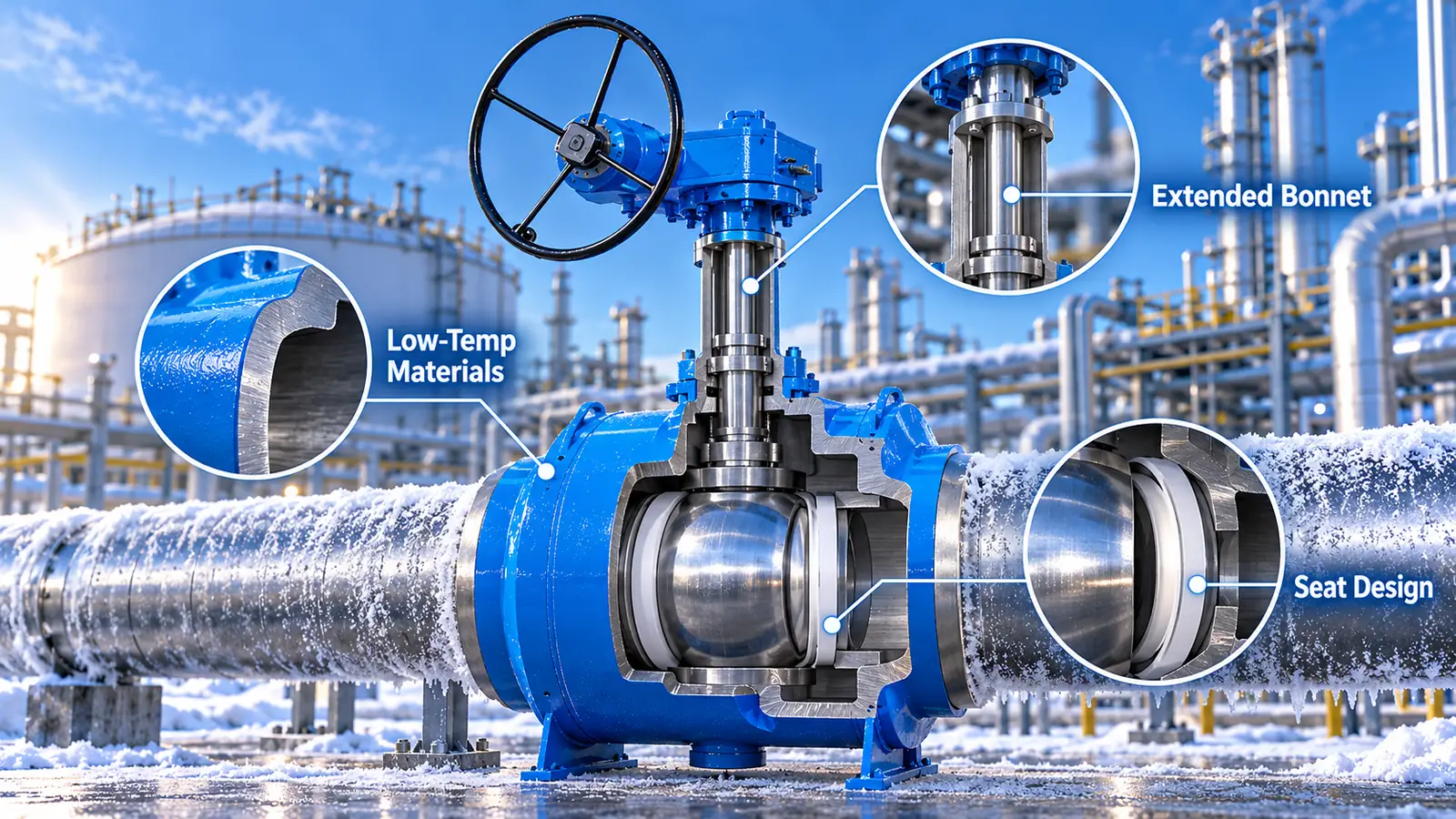
An extended bonnet moves the stem seal and packing away from the cold body. It creates a warmer zone around the packing, reduces heat leak and leaves room for insulation.
Bonnet length should come from the design, not habit. It depends on valve size, stem diameter, insulation thickness, ambient temperature, cold-box conditions and the expected frost line. MSS SP-134 is commonly referenced for cryogenic body and bonnet extensions, but the drawing still has to suit the installation.
A longer bonnet is not automatically better. It adds height, weight, bending load and actuator alignment issues. Check the drawing for extension length, stem material, packing, insulation clearance and actuator mounting. Confirm orientation: a bonnet designed for vertical service may behave differently when installed horizontally. Put the required length and orientation in the RFQ, then compare the approved drawing, not a catalogue image.
How Does a Cryogenic Ball Valve Relieve Cavity Pressure?
When a ball valve closes, liquid can remain trapped in the body cavity. If that liquid warms, it expands and the cavity pressure can rise quickly. A cryogenic ball valve therefore needs a defined relief path: a self-relieving seat, a cavity relief port, an external relief connection, or a combination that suits the duty.
Check relief direction in both seat directions and every operating case. Confirm the relief destination and the cavity-to-line differential required to open each self-relieving seat. Check that an effective relief path remains available under every specified pressure condition, and identify any installation or sealing-direction restrictions introduced by a relief hole. In double block and bleed service, confirm how each cavity is vented and whether the relief path can be isolated.
Do not assume a small drilled hole solves every case. The relief path must suit the trapped volume, expected warm-up, relief rate and allowable body pressure. It must also be clean, unobstructed and compatible with the medium. Ask for the cavity relief arrangement on the drawing and confirm it during design review.
Which Tests and Documents Prove Cryogenic Readiness?
API 6D and ISO 14313 are common for pipeline ball valves. API 598 covers shell and seat leakage testing. BS 6364 and ISO 28921-1 are commonly referenced for cryogenic valve design and production testing. MSS SP-134 addresses body and bonnet extensions. A standard number is not a certificate, and a design standard does not prove that a particular valve passed a low-temperature test.
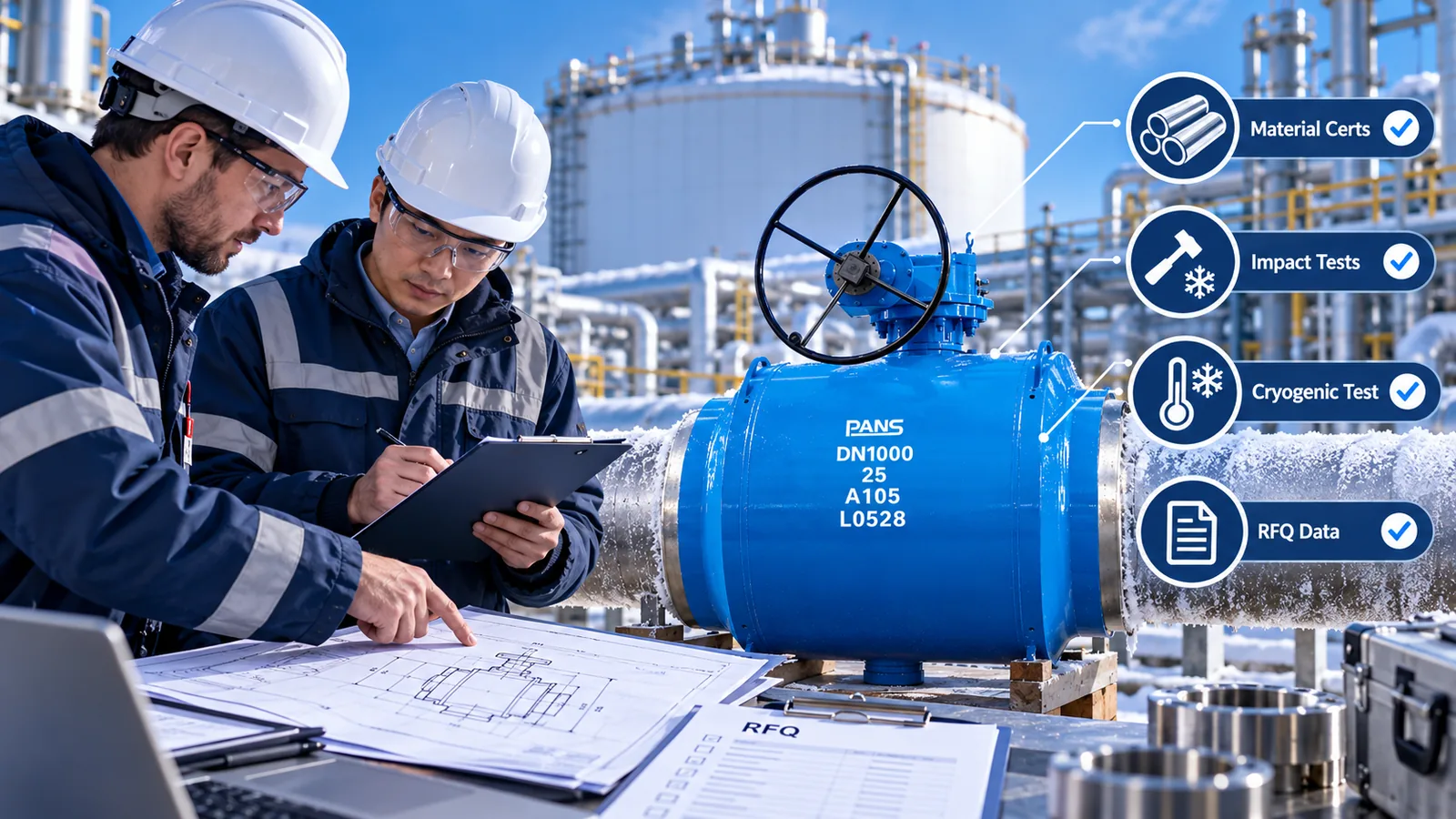
The test report should identify the valve model, serial number, size, class, materials and seat type. It should state the test temperature, medium, duration, cooldown method, acceptance criteria and results. Record functional operation, operating torque, seat leakage and external leakage at the stem/packing and body joints, as required by the selected cryogenic test standard and purchase specification. If the test is a witness or hold point, put that in the order.
For documentation, request the approved drawing and bill of materials, EN 10204 3.1 or 3.2 material certificates, impact test reports, PMI and NDE reports, pressure and seat test reports, cryogenic test report, torque data, cleanliness or degreasing record, nameplate details and packing list. PANS lists PMI, NDE and EN 10204 Type 3.2 among the special tests for its fully welded ball valve range; confirm which items apply to the exact cryogenic configuration before ordering.
What Belongs in a Cryogenic Ball Valve RFQ?
A supplier cannot quote a credible cryogenic valve from size and pressure class alone. Include these fields:
| RFQ field | What to state |
|---|---|
| Service | LNG, boil-off gas, loading line or other duty |
| Size and class | Nominal size, ASME class or PN, design standard |
| Température | Minimum metal temperature, normal and maximum operating temperature |
| Pression | Design pressure, operating pressure and required shutoff differential |
| Moyen | Composition, density, phase and any solids or contaminants |
| Relations | Flange standard, facing, weld end or other connection |
| Space | Face-to-face length, bonnet height, insulation and actuator clearance |
| Opération | Manual, gear, pneumatic or electric; operating frequency |
| Scellage | Required leakage class, test medium and test standard |
| Documentation | Material certificates, impact tests, NDE, PMI, test reports and drawings |
Add the installation location, ambient conditions, insulation details and any project specification. If the valve will be buried, state that clearly. If a fire-safe or fugitive-emission requirement applies, identify the standard and the required evidence rather than assuming it is included.
FAQ
1. Does a fully welded body remove the need for a cryogenic test?
No. Welding reduces body-joint leak paths, but the seat, stem seal and cavity relief still need low-temperature qualification.
2. Can an extended bonnet be shortened on site?
No. Cutting it changes heat transfer, stem alignment and actuator mounting. Any change needs factory review and revised drawings.
3. Which leakage standard should I cite for an LNG valve?
The project specification usually decides. API 598 is a common test method, but the acceptance class, test medium and temperature must be stated.
4. What is the most common RFQ omission?
The minimum metal temperature and test basis. Without both, suppliers may quote different materials and seat designs under the same size and class.
Design the Valve Around the Duty
These seven cryogenic ball valve design checks are simple: define the cold end, qualify every material, specify the low-temperature seat, set the extended bonnet by drawing, prove cavity relief, require cryogenic test evidence and put the full duty in the RFQ. A fully welded body may be part of the answer, but it is not the answer by itself.
PANS supplies ball valves for industrial buyers who need a clear configuration and an agreed test basis. Contact PANS with your valve specification and include the line data, minimum temperature, required documents and installation details so we can confirm the available configuration before you approve the order.
Recherche
Catégories
Mots clés
Produit
- Robinet à tournant sphérique
- Robinet à tournant sphérique flottant
- Robinet à tournant sphérique entièrement soudé
- Robinet à bille à tourillon
- Vanne papillon
- Vanne papillon bidirectionnelle à siège entièrement métallique
- Vanne papillon haute performance
- Vanne papillon à joint dur en métal à trois excentriques
- Clapet anti-retour
- Clapet anti-retour à levage moulé
- Clapet anti-retour à battant en fonte
- Clapet anti-retour de type plaquette
- Vanne DIN
- Vanne à soupape scellée à soufflet DIN
- Robinet à soupape DIN
- Vanne à vanne à tige montante DIN
- Clapet anti-retour à battant DIN
- Vanne de Forge
- Clapet anti-retour forgé
- Robinet à tournant sphérique flottant forgé
- Vanne à vanne forgée
- Robinet à soupape forgé
- Vanne à vanne
- Vanne à guillotine à soufflet
- Vanne à vanne plate
- Vanne à vanne en coin
- Robinet à soupape
- Robinet à soupape moulé
- Vanne à boisseau
- Vanne à boisseau excentrique
- Vanne à boisseau lubrifiée à pression équilibrée inversée
- Vanne à boisseau orbitale
- Vanne à boisseau à manchon
- Vanne à lisier
- Vanne à lisier
- Passoire


