Fire-Safe Valves: API 607 Standard & Oil & Gas Applications
Fire-tested valves are designed to limit external and through-seat leakage to the levels permitted by the applicable standard during and after a specified fire-test sequence. Widely used fire-test standards include API 607 for quarter-turn valves and valves equipped with nonmetallic seats, API 6FA for applicable API 6A and API 6D valves, and API 6FD for check valves. PANS Valve manufactures fire-safe certified ball, butterfly, gate, globe, and check valves to API 607, API 6FA, ISO 9001, CE, and TUV standards for oil and gas, petrochemical, offshore, and pipeline applications globally.
What Is a Fire-Safe Valve?
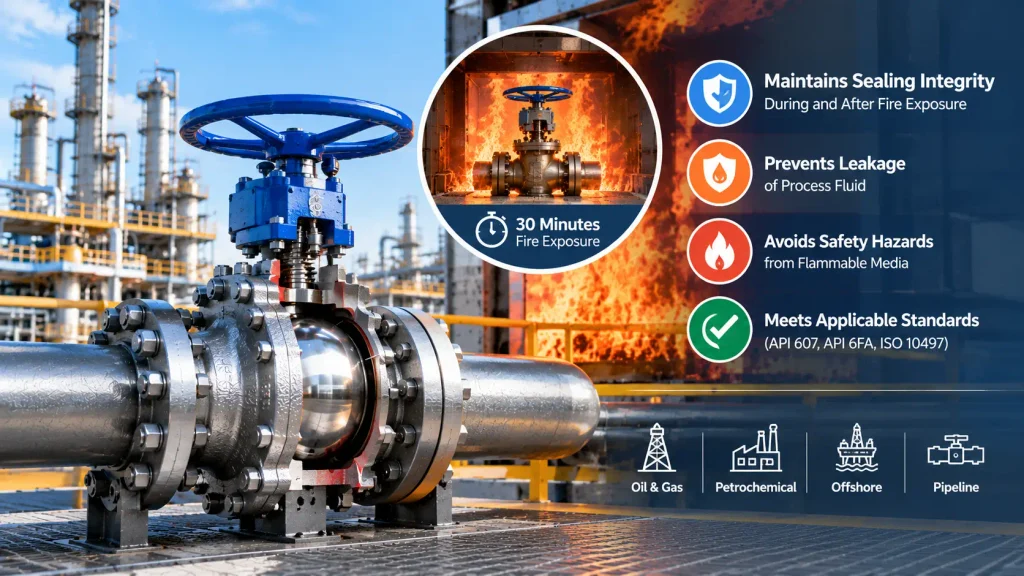
A fire-safe valve is designed and tested to maintain minimum functionality during fire exposure without creating a safety hazard through leakage of process fluid. Fire tests expose the valve to a controlled fire for a minimum of 30 minutes. This is the recognized threshold before structural damage, pipe collapse, or other irreversible consequences occur. A valve passes if it maintains the minimum leakage performance required by the applicable standard during and after that exposure period.
Why Does Fire Safety Matter in Industrial Valve Selection?
A valve that fails during fire exposure can release flammable media, escalating a contained incident into a catastrophic one. Fire-safe valves are the primary defense against this at the valve level.
Several standards address fire type-testing of industrial valves, with API 607, API 6FA, API 6FD, and ISO 10497 among those commonly specified. API 607 covers quarter-turn valves and valves with nonmetallic seats. API 6FA establishes fire-test requirements for evaluating the pressure-containing performance of applicable API 6A and API 6D valves. ISO 10497 is the international equivalent adopted by non-API markets. All three require acceptable leakage performance after 30 minutes of fire exposure and subsequent cooldown.
How Does Fire-Safe Valve Design Work?
Four design features maintain valve function during and after fire exposure.
Secondary metal-to-metal seat. Primary soft seat material like PTFE degrades under fire temperatures. The secondary metal seat provides a backup sealing surface that maintains containment after soft seat failure.
Graphite stem seals. Standard elastomeric stem seals fail under fire temperatures. Graphite-based stem seals maintain integrity at elevated temperatures and are standard in all fire-safe certified designs.
Antistatic device. Prevents static charge buildup between the ball or disc and the body, which could ignite process media.
For actuated valves, the required fail position—closed, open, or fail-in-place—must be determined by the process safety analysis. Actuator fail-safe behavior should be specified separately from the valve’s fire-test qualification.
How Does API 607 Compare to API 6FA?
The table below summarizes key differences between the two primary api 607 fire-safe certification standards.
| Característica | API 607 | API 6FA |
| Valve types covered | Quarter-turn, soft-seated valves | Gate, globe, check per API 6A and API 6D |
| Seat type | Nonmetallic primary seats | Metal seating |
| Test duration | 30 minutes fire exposure | 30 minutes fire exposure |
| Test temperature | 750°C to 1000°C | 750°C to 1000°C |
| Common applications | Ball valves, butterfly valves | Pipeline gate and revisar válvulas |
| International equivalent | ISO 10497 | ISO 10497 |
Both standards require acceptable external leakage and seat leakage performance after the full test sequence. The applicable standard depends on valve type and project specification.
What Are Fire-Safe Ball and Butterfly Valves?
A fire-safe válvula de bola is a quarter-turn ball valve with secondary metal seats, graphite stem seals, and antistatic provisions tested to API 607 or ISO 10497. Under normal operation, it functions as a standard soft-seated ball valve. Under fire conditions, the metal backup seats maintain containment after PTFE seats degrade.
A fire-safe válvula de mariposa applies the same principle to a disc-and-seat design. High-performance double-offset and triple-offset butterfly valves are particularly suited to fire-safe certification because their geometry allows metal-to-metal seating at closure. PANS offers multiple ball- and butterfly-valve categories. Available fire-tested models and their qualified size ranges should be confirmed from product datasheets and fire-test certificates.
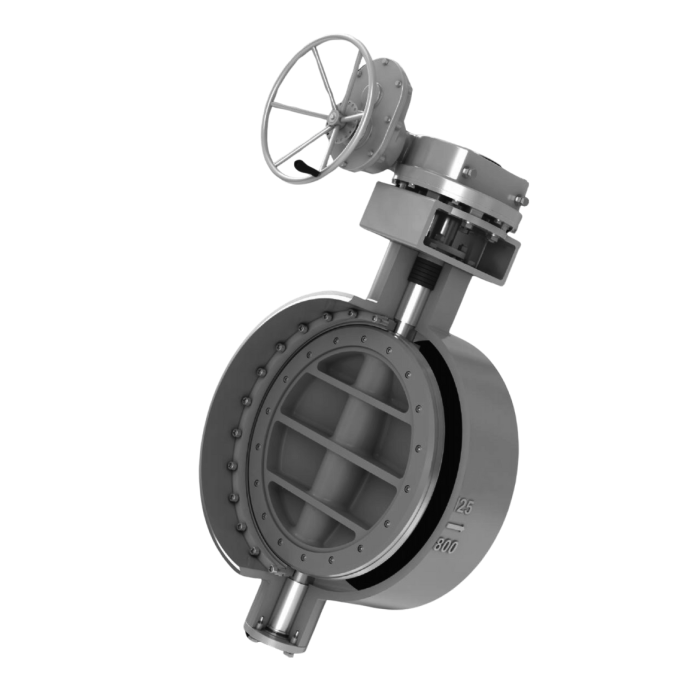
Full Metal-Seated Bi-Directional Butterfly Valve | PANS
Más detallesWhen Are Fire-Safe Valves Required?
When fire-safe valves are required depends on process fluid type, facility classification, and project specification.
Oil and gas production. Any valve handling hydrocarbons at a production platform, gathering station, or processing facility typically requires fire-safe certification. Offshore installations. Fire-safe valves are a standard specification for all isolation valves on offshore platforms due to elevated fire risk and limited evacuation options. Petrochemical and refinery service. Valves on flammable fluid lines are required to be fire-safe certified under most national and international safety regulations. Pipeline systems. Emergency block valves and mainline isolation valves on hydrocarbon pipelines are specified to API 607 or API 6FA depending on valve type.
What Should You Check When Selecting a Fire-Safe Valve?
Six items cover the selection checklist for any fire-safe valve procurement.
Applicable standard. API 607 for quarter-turn and soft-seated valves. Use API 6FA where it applies to the specified API 6A or API 6D valve design, and API 6FD for check-valve fire testing. ISO 10497 for non-API markets.
Valve type. Ball, butterfly, gate, globe, or check depending on application and service conditions.
Material compatibility. Body, seat, and seal materials must suit both the process fluid and the fire test temperature range.
Certificate validity. Request current fire test certificate by valve model and size. Company-level certification is not sufficient for project compliance.
Antistatic compliance. Confirm antistatic provisions are included in the valve design.
Actuator fail-safe position. For automated valves, confirm the spring-return fail-close position suits the process safety requirement.
PANS Valve supplies fire-safe certified valves with full documentation including fire test certificates, material test reports, and API 598 pressure test records. Browse PANS Valve fire-safe valve products or contact PANS Valve for a project-specific quotation.
Preguntas frecuentes
What is a fire-safe valve?
A valve engineered to maintain sealing integrity and minimize leakage during and after fire exposure. Tested to API 607, API 6FA, or ISO 10497 with a minimum 30-minute fire exposure requirement. Used wherever process fluids are flammable or toxic and valve failure during fire is unacceptable.
What are the main types of fire-safe valves?
Ball valves and butterfly valves tested to API 607 are the most common quarter-turn types. API 6FA applies to relevant API 6A and API 6D valve designs, while API 6FD specifically addresses fire testing of check valves. The applicable standard is determined by valve design and project requirements, not simply by seating material.
When are fire-safe valves required?
Required for valves handling flammable or toxic fluids in oil and gas production, offshore platforms, refineries, petrochemical plants, and pipeline systems. Project specifications and national safety regulations define specific valve categories and service conditions requiring fire-safe certification.
What is the difference between API 607 and API 6FA?
API 607 covers quarter-turn and soft-seated valves, including ball and butterfly designs. API 6FA covers gate, globe, and check valves to API 6A and API 6D standards with metal seating. Both require 30-minute fire exposure testing and acceptable leakage performance after cooldown.
Buscar
Categorías
Etiquetas
Producto
- Válvula de bola
- Válvula de bola flotante
- Válvula de bola completamente soldada
- Válvula de bola de muñón
- Válvula de mariposa
- Válvula de mariposa bidireccional con asiento totalmente metálico
- Válvula de mariposa de alto rendimiento
- Válvula de mariposa con sello rígido de metal y tres excéntricas
- La válvula de retención
- Válvula de retención de elevación fundida
- Válvula de retención oscilante fundida
- Válvula de retención tipo oblea
- Válvula DIN
- Válvula de globo sellada con fuelle DIN
- Válvula de globo DIN
- Válvula de compuerta de vástago ascendente DIN
- Válvula de retención oscilante DIN
- Válvula de forja
- Válvula de retención forjada
- Válvula de bola flotante forjada
- Válvula de compuerta forjada
- Válvula de globo forjada
- Válvula de compuerta
- Válvula de compuerta sellada con fuelle
- Válvula de compuerta plana
- Válvula de compuerta de cuña
- Válvula de globo
- Válvula de globo fundida
- Válvula de tapón
- Válvula de tapón de excentricidad
- Válvula de tapón lubricada con equilibrio de presión invertida
- Válvula de tapón orbital
- Válvula de tapón tipo manguito
- Válvula de lodo
- Válvula de lodo
- Colador


