Globe Valve Pressure Drop: Why Cv and Flow Path Decide the Right Size
Быстрый ответ
Globe valve pressure drop is the head loss caused by fluid passing through the body, seat and throttling element at a stated flow. Cv shows how much flow a valve passes at a defined pressure drop, while the flow path, disc position and trim set the actual loss. A low Cv at the required travel can waste pump energy or prevent design flow. PANS supplies cast and forged globe valves and confirms the available configuration against the stated duty before quotation.
A useful globe valve pressure drop check starts with the duty, not the valve label. This guide shows how to size a liquid line, compare flow paths and prepare a comparable RFQ.
Why Does a Globe Valve Create Pressure Drop?
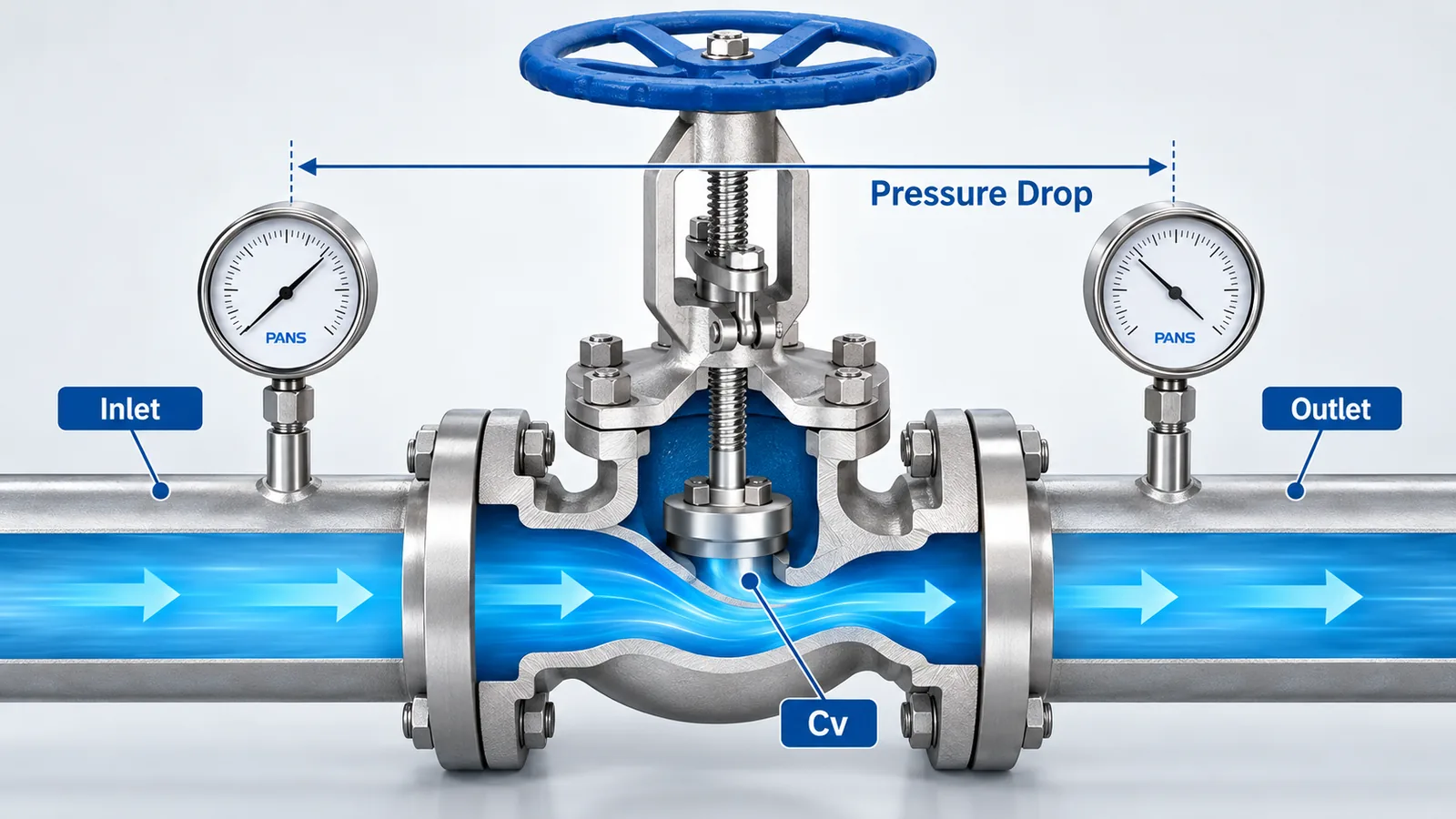
Every valve creates pressure drop, but globe valve pressure drop often exceeds that of a gate or ball valve of similar size because the fluid changes direction and passes a narrower seat opening.
At full open, loss comes from body turns, seat and outlet. At partial open, the disc-to-seat gap becomes the main restriction. Velocity rises, turbulence increases and energy is lost.
Globe valve pressure loss is not pressure class. A Class 300 valve can have a high design pressure and still consume too much head at operating flow.
Check three points:
- Minimum flow: the valve may be near its seat and difficult to control.
- Normal flow: use this point to check pump energy and controllability.
- Maximum flow: use it to check capacity, velocity, noise and cavitation risk.
How Do You Estimate Globe Valve Pressure Drop From Cv?
Cv is a flow coefficient. In US units, it is the number of US gallons per minute of water that passes through a valve at a 1 psi pressure drop, normally at a stated travel. Kv is the metric equivalent: cubic metres per hour of water at a 1 bar drop.
For a turbulent, single-phase liquid, the basic relationship is:
ΔP (psi) = (Q (gpm) ÷ Cv)² × specific gravity
To find the Cv needed for an allowable drop:
Cv = Q (gpm) × √(specific gravity ÷ ΔP (psi))
These checks assume no cavitation, flashing, high viscosity or choked flow. Gas and steam need compressibility factors and different equations, so ask the supplier to run the calculation and state the basis.
Why a single Cv value can mislead
A high Cv means more capacity at a given loss, but the globe valve Cv must match the intended travel. A valve can have a suitable full-open Cv and still control poorly at 30% open. Ask for the Cv curve.
Confirm the basis: full open or rated travel, fluid, units and selected trim. Two same-size valves can have different Cv values.
The globe valve pressure drop at duty flow depends on the Cv at the actual travel, not only the full-open figure. Ask for a curve that covers the normal control range.
Does Globe Valve Flow Path Affect Pressure Loss?
Yes. The globe valve flow path changes how many turns the fluid makes and how directly it reaches the seat.
| Body pattern | Flow path | Pressure-loss effect | What to confirm |
|---|---|---|---|
| Straight or tee pattern | Fluid turns through the seat, then turns again to the outlet | Usually the highest loss of the common patterns | Actual Cv, trim, opening position and orientation |
| Y-pattern | Angled seat and stem create a straighter route | Often lower loss, but not a guarantee | Cv curve, angle, flow direction and support |
| Angle pattern | 90° inlet and outlet remove one piping turn | Can reduce total system loss and fit a corner | Layout, pressure class, faces and actuator clearance |
Internal flow direction also matters. A disc arranged for flow-to-open or flow-to-close changes seating, control and wear. Follow the body arrow and approved drawing rather than reversing a valve to chase a lower gauge reading. Our globe valve flow direction guide explains why orientation affects performance, while the Y-pattern globe valve flow direction article covers the angled design.
Compare quoted globe valve pressure drop and globe valve pressure loss on the same flow basis at normal and maximum flow, using the Cv and opening characteristic rather than a general percentage saving.
What Does a Globe Valve Pressure Drop Calculation Look Like?
Here is an illustrative water example, not a PANS product selection.
- Flow: 20 m³/h, or about 88 gpm
- Specific gravity: 1.0
- Allowable pressure drop: 0.5 bar, or about 7.25 psi
Using the liquid formula:
Cv = 88 × √(1.0 ÷ 7.25) ≈ 33
A valve with a quoted Cv of 40 would calculate to about 0.33 bar at the same flow when fully open. That fits the 0.5 bar allowance, but the check is incomplete. Confirm Cv at the control travel, minimum controllable flow, cavitation margin and fluid properties.
For steam, gas, two-phase, viscous or slurry service, use the relevant sizing method. A liquid Cv calculation can be dangerously optimistic. Our overview of why globe valves suit steam service covers the design reasons; the final size still needs a proper steam calculation.
Which Globe Valve Configuration Should You Buy?
Start with the duty, not the model name. A globe valve suits throttling and shutoff, but it is not automatically the lowest-cost choice for a line that stays fully open.
Use the allowable globe valve pressure drop to test whether the selected size is viable.
Work through these decisions:
- Duty: control, throttling or isolation.
- Flow: minimum, normal and maximum flow.
- Loss: allowable pressure drop at normal and maximum.
- Fluid: phase, density, viscosity, vapour pressure and solids.
- Pattern: straight, Y or angle.
- Materials and trim: body, disc, seat and packing.
- Connections: flange or weld standard, facing and face-to-face.
- Operation: manual or actuated.
- Evidence: Cv curve, drawing, certificates and test plan.
For cast steel service, the PANS cast globe valve range lists a straight-pattern OS&Y design with bolted bonnet, rising stem, renewable seat rings, horizontal service and flanged or butt-weld ends. It cites BS 1873 and ASME B16.34 for design and API 598 for testing. Confirm size, trim, ends and actuation on the quotation.
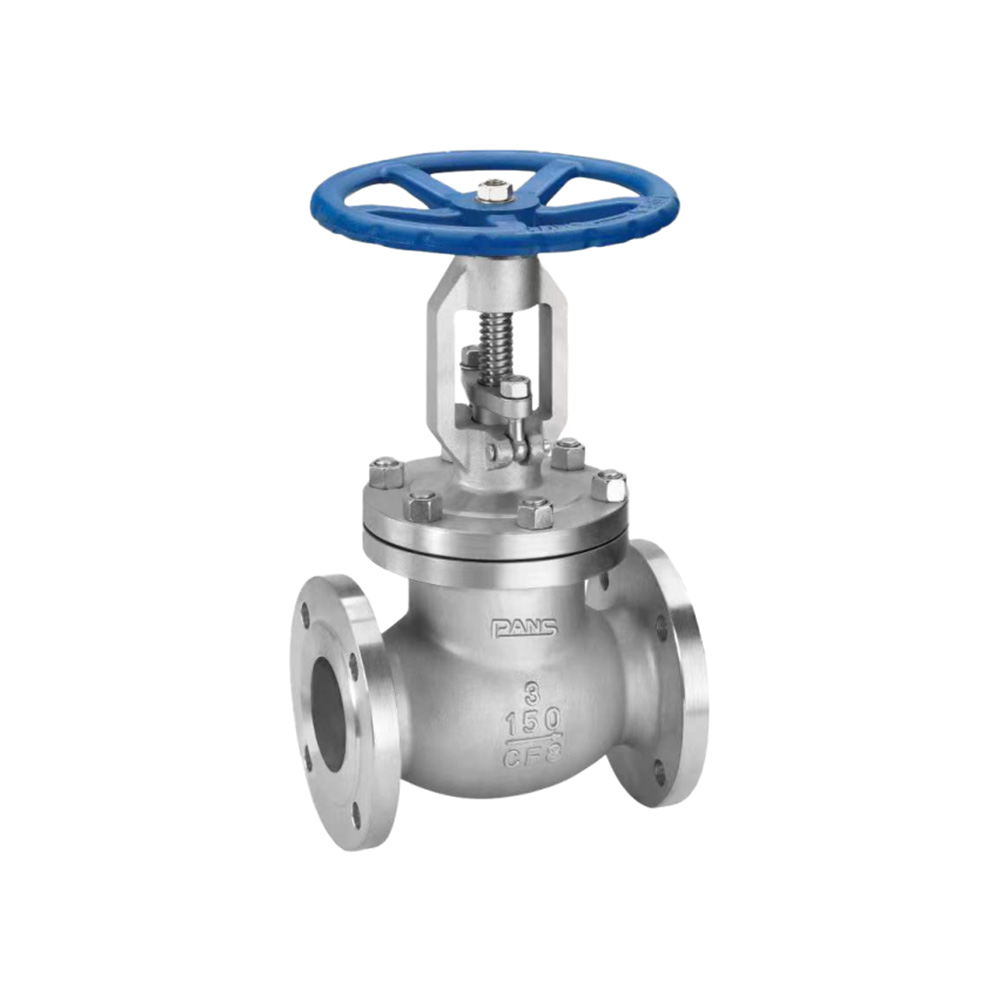
The public page does not publish model-specific Cv. Do not infer it from size or class; request the globe valve Cv curve for the exact model and trim. If the line stays fully open and pressure loss dominates, compare a lower-loss isolation design before fixing the type. Our globe valve vs plug valve comparison covers one alternative.
What Should a Globe Valve RFQ Include?
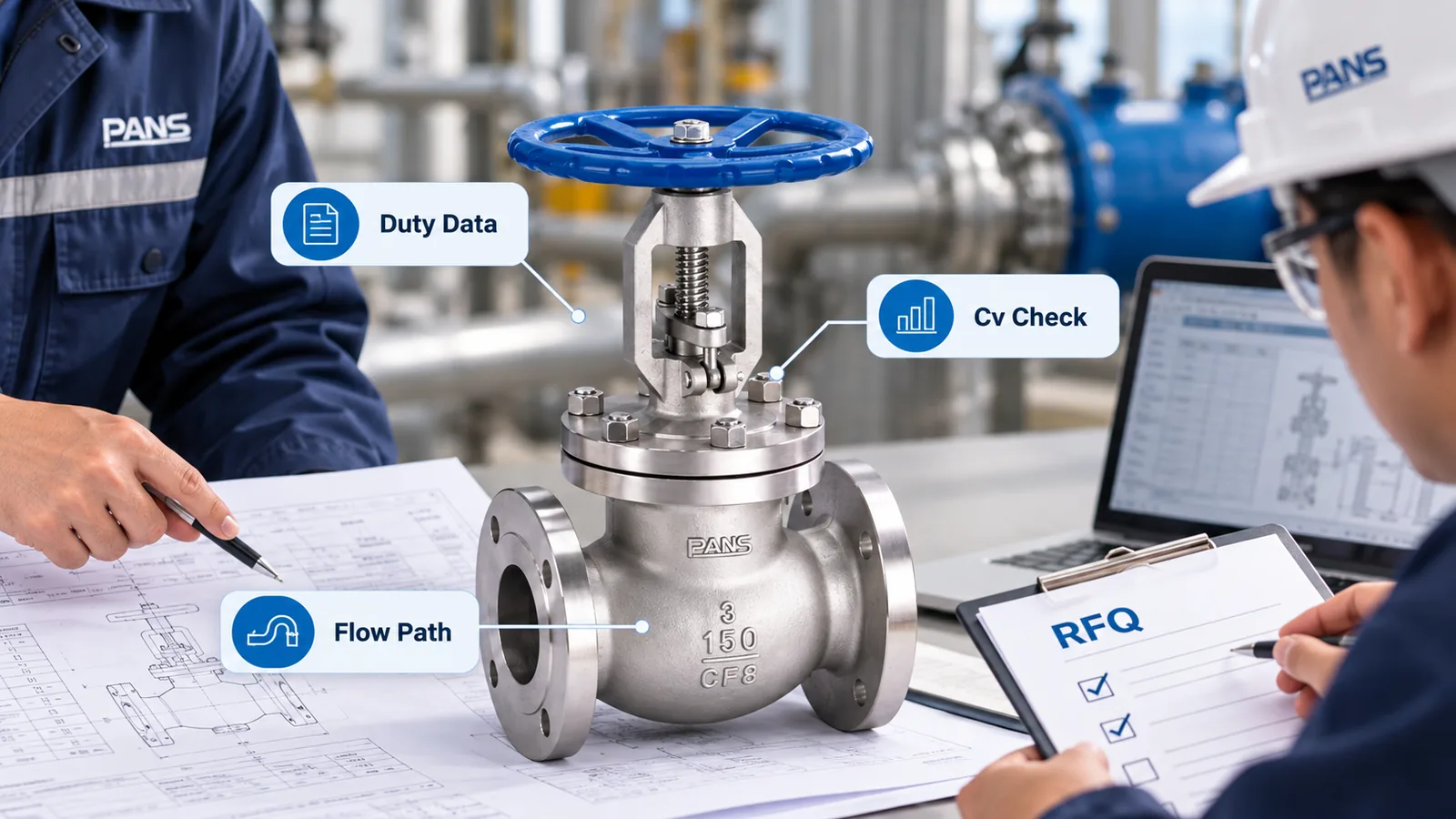
A quote can only be compared when suppliers size against the same duty. Include these fields:
| RFQ field | What to state |
|---|---|
| Fluid and temperature | Composition, phase, density, viscosity, vapour pressure and operating range |
| Flow | Minimum, normal and maximum flow, with units |
| Давление | Design and operating pressure, plus allowable globe valve pressure drop |
| Cv and travel | Required globe valve Cv at normal and maximum flow, and intended travel |
| Valve | Size, class, body pattern, materials and trim |
| Связи | Flange or weld standard, facing and face-to-face dimension |
| Installation and operation | Orientation, flow direction, manual or actuator |
| Документация | Drawing, Cv curve, certificates and test report scope |
Ask the supplier to show the calculation basis. A single line such as “Cv 40” is not enough without units, travel and fluid assumptions. If the duty is cavitating or close to vapour pressure, say so and ask for the cavitation check.
Часто задаваемые вопросы
1. Is globe valve pressure drop higher than gate valve pressure drop?
Usually, for the same size and fully open position, because the globe flow path turns more and passes a narrower seat area. Compare actual Cv and size, not a fixed percentage.
2. Does a higher Cv always mean a better globe valve?
No. Higher Cv means more capacity at a given loss, but an oversized valve may control poorly near its seat. Match Cv to normal and maximum flow.
3. Can I use a liquid Cv formula for steam?
No. Steam is compressible and may approach choked flow. Use a steam sizing method with pressure, temperature, superheat and critical-flow checks.
4. What is the difference between Cv and Kv?
Both express capacity. Cv uses US gallons per minute and psi; Kv uses cubic metres per hour and bar. Confirm the unit before comparing quotes.
Size for the Duty, Not the Catalogue Label
Globe valve pressure drop depends on more than nominal size. Check Cv at the intended travel, compare the globe valve flow path, and calculate at minimum, normal and maximum flow. Then put the fluid data and allowable loss into the RFQ.
Contact PANS with the duty data to confirm the available cast globe valve configuration, trim and test scope before you approve the order.
Поиск
Категории
Теги
Продукт
- Шаровой кран
- Плавающий шаровой клапан
- Полностью сварной шаровой кран
- Цапфовый шаровой клапан
- Дроссельный клапан
- Двунаправленный дисковый затвор с цельнометаллическим седлом
- Высокопроизводительный поворотный клапан-бабочка
- Трехэксцентриковый металлический поворотный затвор с жестким уплотнением
- Обратный клапан
- Литой подъемный обратный клапан
- Литой обратный клапан
- Обратный клапан вафельного типа
- DIN-клапан
- Проходной клапан с сильфонным уплотнением по стандарту DIN
- Шаровой клапан DIN
- Задвижка с выдвижным штоком DIN
- Поворотный обратный клапан DIN
- Кузница Клапан
- Кованый обратный клапан
- Кованый плавающий шаровой клапан
- Кованая задвижка
- Кованый шаровой клапан
- Задвижка
- Задвижка с сильфонным уплотнением
- Плоская задвижка
- Клиновая задвижка
- Шаровой вентиль
- Литой шаровой клапан
- Пробковый клапан
- Эксцентриситетный пробковый клапан
- Пробковый клапан с перевернутым балансом давления и смазкой
- Орбитальный пробковый клапан
- Пробковый клапан рукавного типа
- Шламовый клапан
- Шламовый клапан
- сетчатый фильтр


