The Buyer’s Guide to Lift Check Valves for Low-Flow Lines
Быстрый ответ
A lift check valve suits low-flow and vertical-line duty only when its opening differential, seat stability, and flow direction match the exact model. Size for the lowest continuous flow, not the line size alone. Check allowable pressure drop, reverse differential, media, and mounting position. Confirm orientation from the model drawing and the manufacturer’s instructions before ordering. The catalog type is only a starting point; the trim and installation decide whether the valve works.
What Makes Lift Check Valve Selection Different?
Lift check valves stop reverse flow without manual action, and they fit where a swing disc is impractical. The real question is not which type is best. It is whether a given lift design will open at your flow, stay stable, and close before backflow reaches the pump. Those answers come from the model, the trim, and the installation.
Why Does Lift Check Valve Selection Start With Flow Direction?
Flow direction decides whether the disc lifts cleanly or drags against its guide. In a lift check valve, the body passage, guide, and seat are arranged around one intended direction. Reversing the line does not reverse the valve.
Start with the drawing, not the body arrow. Confirm the inlet and outlet ports, disc travel, cover orientation, and the access the installation needs. Resolve any conflict between drawing and piping layout before ordering.
How Does a Lift Check Valve Open and Close?
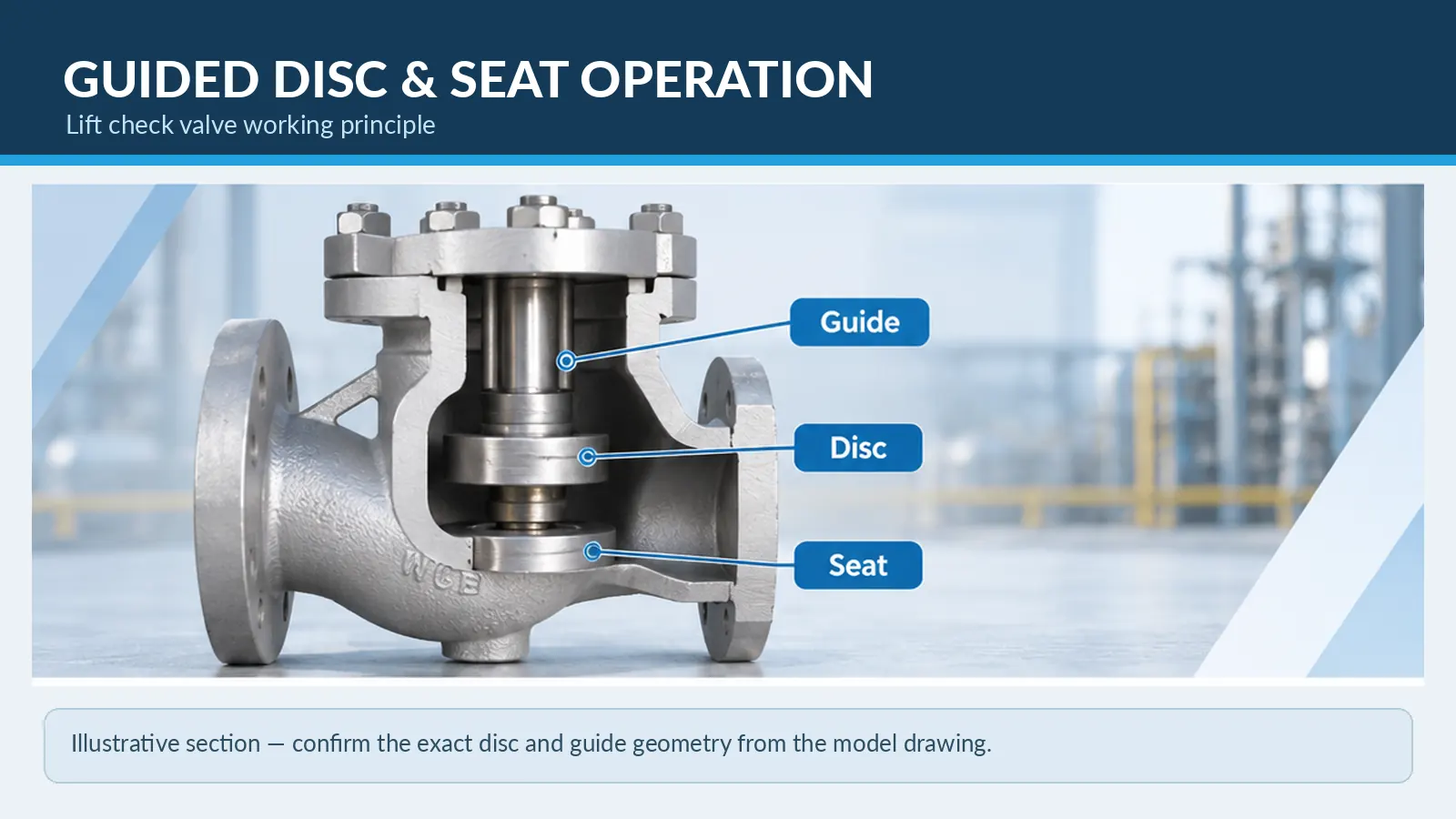
Forward flow lifts a guided disc off the seat. The guide keeps it aligned so it reseats on the same sealing surface. When flow falls below the closing force, the disc returns and blocks reverse flow.
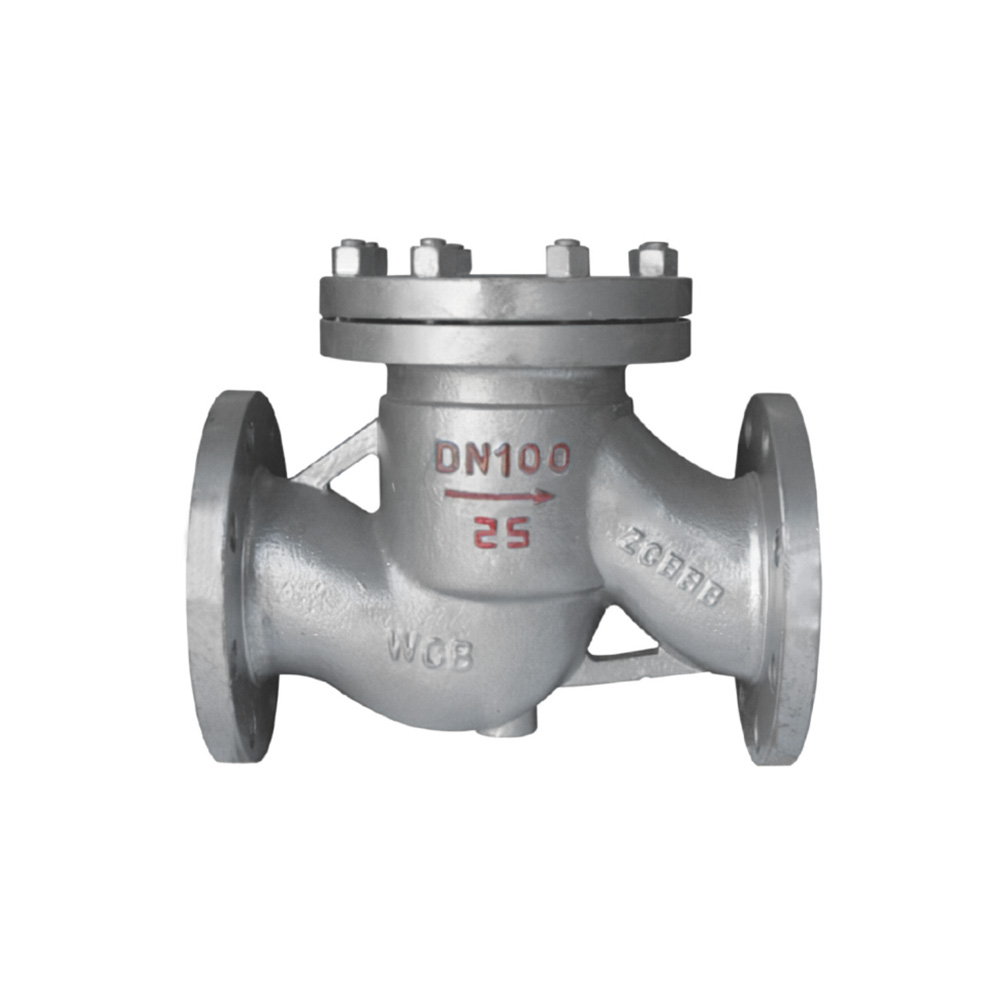
The published PANS cast lift check valve page lists a bolted bonnet, a guided lift or piston disc, renewable seat rings, and a cobalt-alloy welded sealing surface. Those features support maintenance and wear resistance, but they do not set the opening flow. Spring, trim, seat geometry, and fluid decide when the disc leaves the seat.
Closing takes time. The disc must travel back and displace fluid. Clean liquid service usually closes quickly; compressible or viscous media change the behavior and raise the risk of slam or chatter.
Which Way Should a Lift Check Valve Be Installed?
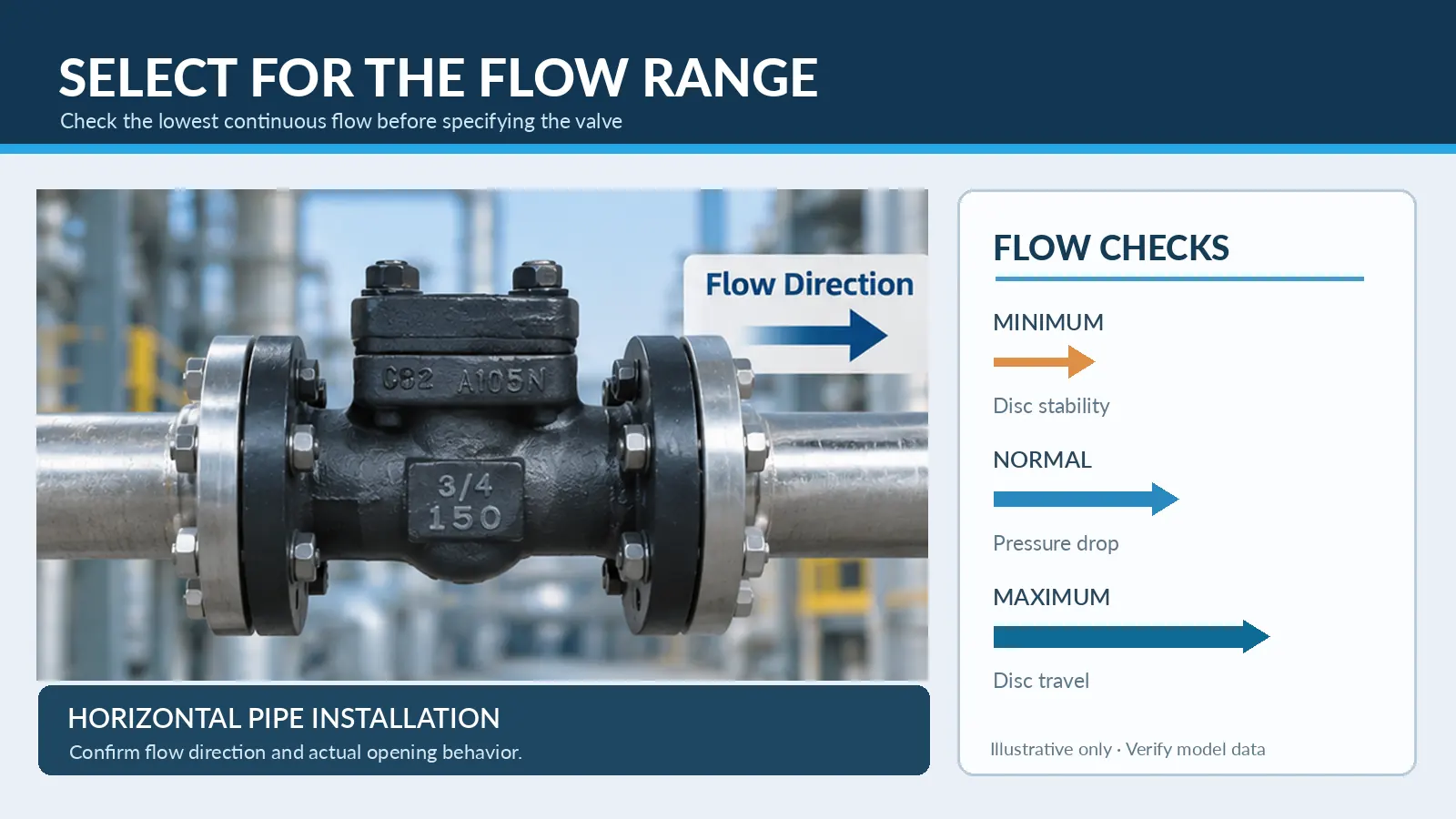
Flow must enter the inlet port and leave through the outlet. Beyond that, follow the model drawing and the manufacturer’s instructions. Do not assume a valve sold for horizontal service behaves the same when rotated.
Can a Lift Check Valve Be Installed Vertically?
Sometimes, but not by default. Gravity then helps or opposes the opening and closing forces, depending on whether flow runs up or down. A spring-assisted design may tolerate an orientation that a non-spring design cannot.
The published PANS cast lift check valve page specifies horizontal service. That applies to that model, not to every lift check valve. For a vertical lift check valve request, send the intended flow direction with the RFQ and ask for confirmation against the drawing.
What Happens at Low Flow?
At low flow, the disc may hover just off the seat: open enough to pass flow, but not enough to be stable. The result can be flutter, seat wear, and noise. Below that, the disc may not lift at all, and the valve acts like a closed pipe until upstream pressure rises.
Is There a Minimum Flow for a Lift Check Valve?
Every lift design has an opening differential below which the disc will not leave the seat, plus a range above it where the disc is unstable. Those values depend on spring, disc weight, seat area, fluid density and viscosity, and test method. No catalog number applies across sizes and services.
Size for the lowest continuous flow, then confirm the same valve can pass the maximum without excessive pressure drop or disc travel. If turndown is wide, a single lift check may not cover the range. Discuss a different trim or valve type rather than accepting a compromise.
How Much Pressure Drop Should You Allow?
Pressure drop is real energy loss. On pump discharge it adds to the head the pump must produce; on a gravity line it reduces the driving head. Set the allowable drop at design flow, not at a nominal rating.
Use the published flow coefficient or pressure-drop curve for the exact size and trim. If it is unavailable, ask for the test basis. A generic claim of low pressure drop is not a selection input.
Check reverse differential too. The valve must close against the backpressure the system can produce and survive the load. On pump discharge that includes shutoff head and surge; on parallel pumps it includes the differential when one pump runs and another is idle.
How Does a Lift Check Valve Compare With Swing and Wafer Types?
А литой обратный клапан uses a hinged disc that swings out of the flow path. The open area is generally larger than that of a guided lift design of similar size, but it needs more space and depends on flow momentum and gravity to close. It suits larger horizontal lines where space allows.
А wafer-type check valve is a compact dual-plate design with two spring-loaded plates, installed between flanges. It saves space where a full-body valve will not fit. Its low-flow behavior and reverse-flow response differ from a lift design.
A lift check valve is guided, so it reseats on a defined path, and it can be built for high pressure classes. Its disc needs a clean passage, and its behavior depends heavily on the flow range. The check valve product family page shows the range; selection still depends on the data above.
What Data Should an RFQ Include?
| Item | What to state |
|---|---|
| Medium and phase | Fluid, composition, solids content, and whether the flow is liquid, gas, or two-phase. |
| Flow range | Minimum, normal, and maximum flow, with units, and whether the minimum is continuous or intermittent. |
| Допустимое падение давления | The drop you can accept at design flow, and the basis for it. |
| Класс давления | Design pressure and the required class. |
| Температура | Design and operating temperature, including excursions. |
| Line size and ends | Nominal size, schedule, and the connection standard or end type. |
| Orientation | Horizontal or vertical line, required flow direction, and available installation space. |
| Access and monitoring | Whether you need position indication, limit switches, or other monitoring. |
| Reverse condition | Backpressure, reverse differential, and how often the valve must close. |
The more of these you can state, the less the supplier has to assume.
Часто задаваемые вопросы
1. Can a lift check valve be repaired without removing the body from the line?
On bolted-cover designs, the cover can usually be removed for seat and disc inspection with the body in the line, once the line is isolated and drained. Confirm the procedure and spare parts for the specific model.
2. Does a lift check valve need a bypass?
A bypass is a system decision, not a valve requirement. It may be needed for draining, pump minimum recirculation, or trapped pressure. The valve itself does not require one.
3. Can a lift check valve handle media with solids?
It depends on the solids, seat design, and flow. A guided disc and narrow seat area can be sensitive to debris that would pass a swing check. State solids content and particle size in the RFQ.
4. How is a lift check valve tested?
Testing is usually set by the purchase standard, such as API 598 for seat and shell tests, with medium and acceptance criteria agreed in the order. The published PANS forged check valve options reference API 602 and API 598; the cast lift page references API 598 and API 6D.
Заключение
Lift check valve selection comes down to four checks: the flow direction and mounting position on the drawing, the lowest flow the disc must pass, the allowable pressure drop at design flow, and the reverse differential it must close against. Get those right and the valve type follows.
For a cast body, start with the PANS cast lift check valve range. For smaller forged lines, review the forged check valve options. Neither page replaces a drawing review for your line.
Share your valve specification with PANS to request a quotation.
Поиск
Категории
Теги
Продукт
- Шаровой кран
- Плавающий шаровой клапан
- Полностью сварной шаровой кран
- Цапфовый шаровой клапан
- Дроссельный клапан
- Двунаправленный дисковый затвор с цельнометаллическим седлом
- Высокопроизводительный поворотный клапан-бабочка
- Трехэксцентриковый металлический поворотный затвор с жестким уплотнением
- Обратный клапан
- Литой подъемный обратный клапан
- Литой обратный клапан
- Обратный клапан вафельного типа
- DIN-клапан
- Проходной клапан с сильфонным уплотнением по стандарту DIN
- Шаровой клапан DIN
- Задвижка с выдвижным штоком DIN
- Поворотный обратный клапан DIN
- Кузница Клапан
- Кованый обратный клапан
- Кованый плавающий шаровой клапан
- Кованая задвижка
- Кованый шаровой клапан
- Задвижка
- Задвижка с сильфонным уплотнением
- Плоская задвижка
- Клиновая задвижка
- Шаровой вентиль
- Литой шаровой клапан
- Пробковый клапан
- Эксцентриситетный пробковый клапан
- Пробковый клапан с перевернутым балансом давления и смазкой
- Орбитальный пробковый клапан
- Пробковый клапан рукавного типа
- Шламовый клапан
- Шламовый клапан
- сетчатый фильтр


