Full Bore vs Reduced Bore Ball Valve: Which to Choose?
Respuesta rápida
For many ball-valve projects, full bore is the safer starting point when the line must pass a pig, keep pressure loss low, or stay close to the pipe bore. Reduced bore can be the better choice for compact isolation duty when a smaller passage is acceptable and the allowed pressure drop is confirmed. The decision depends on flow, pig requirements, valve geometry and installed cost. PANS supplies full-port floating and trunnion ball valves, plus fully welded ball valves listed for pipeline and heating duties.
The bore affects more than the hole through the ball. It changes pressure loss, cleaning access, valve mass, actuator demand and the data needed for a comparable quotation.
What Is the Difference Between Full Bore and Reduced Bore?
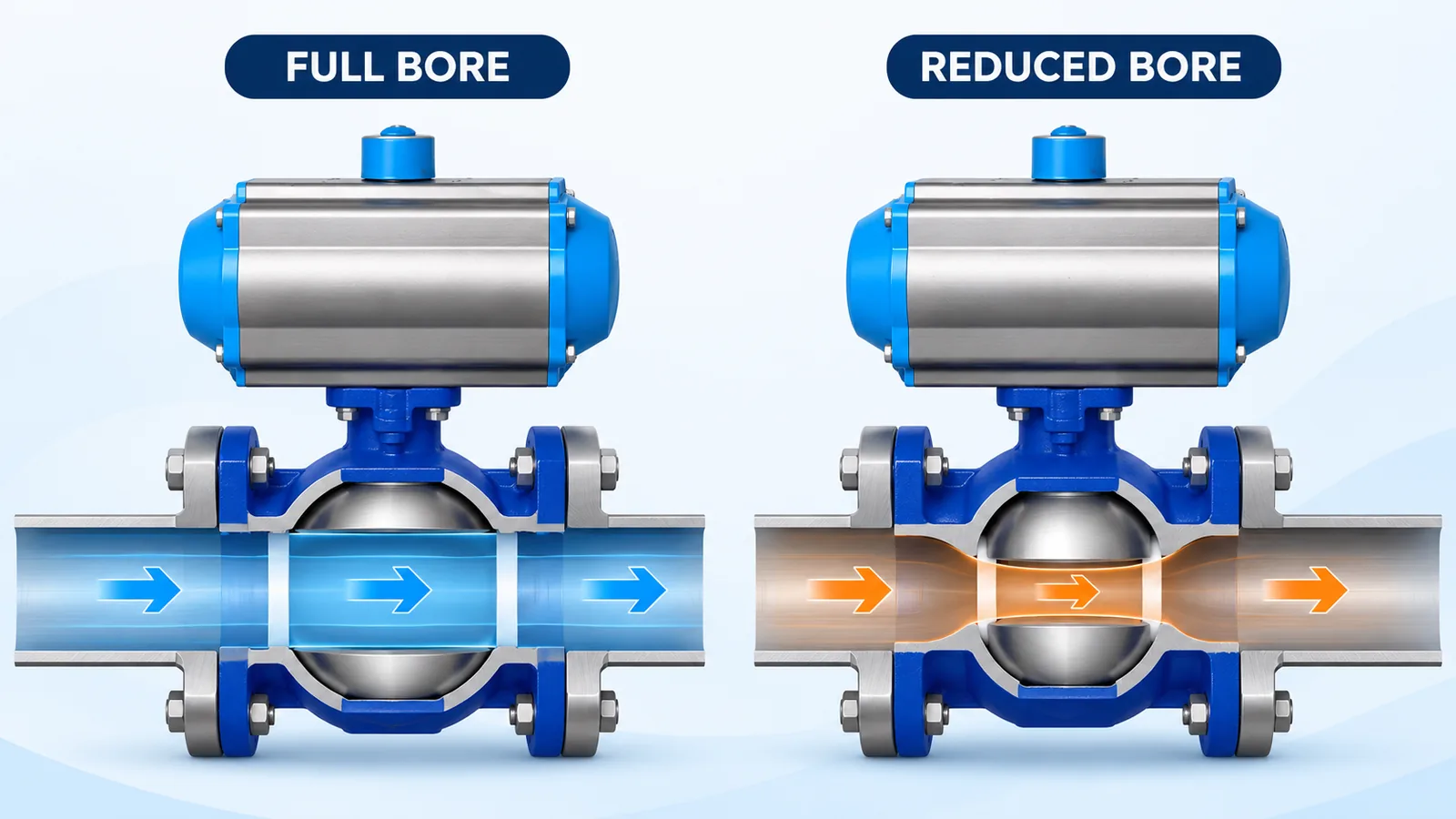
A full bore ball valve, often called a full port ball valve, has a flow passage intended to approximate the internal diameter of the connected pipe. A reduced bore ball valve, or reduced port ball valve, has a smaller passage through the ball and body. The reduction may be one size or more, depending on the design.
Full bore and full port are often used interchangeably, but the terms are not a measurement. DN and NPS are nominal designations, not the actual bore. Ask for the valve drawing, measured bore and any liner or weld detail before treating a valve as a match for the line.
These terms describe ball valves. A full-port plug valve is a different product with different geometry and selection checks. Do not use a ball-valve bore label to specify a plug valve.
El PANS ball valve collection lists the available families, but the bore still needs confirmation on the exact model drawing.
How Does Bore Choice Affect Pressure Drop and Energy?
At the same flow rate, a smaller passage raises velocity through the valve. Higher velocity usually means a larger irreversible pressure loss, which can raise pumping or compression energy use. A full bore design usually has lower ball valve pressure drop, but the difference depends on the valve’s actual bore, surface finish, seat geometry, fittings and operating flow.
Published Cv can help compare designs, but only when the basis is the same. Do not take a Cv value from one size or trim and apply it to another. If the line has a tight allowed pressure drop, give the normal and maximum flow rates and the permitted drop in the enquiry.
Reduced bore is not automatically inefficient. In a short, low-flow isolation branch with spare pressure margin, its higher loss may be acceptable. The check is whether the installed line can absorb that loss at every operating case, including startup and upset.
Does Bore Type Decide Whether a Pipeline Can Be Piggable?
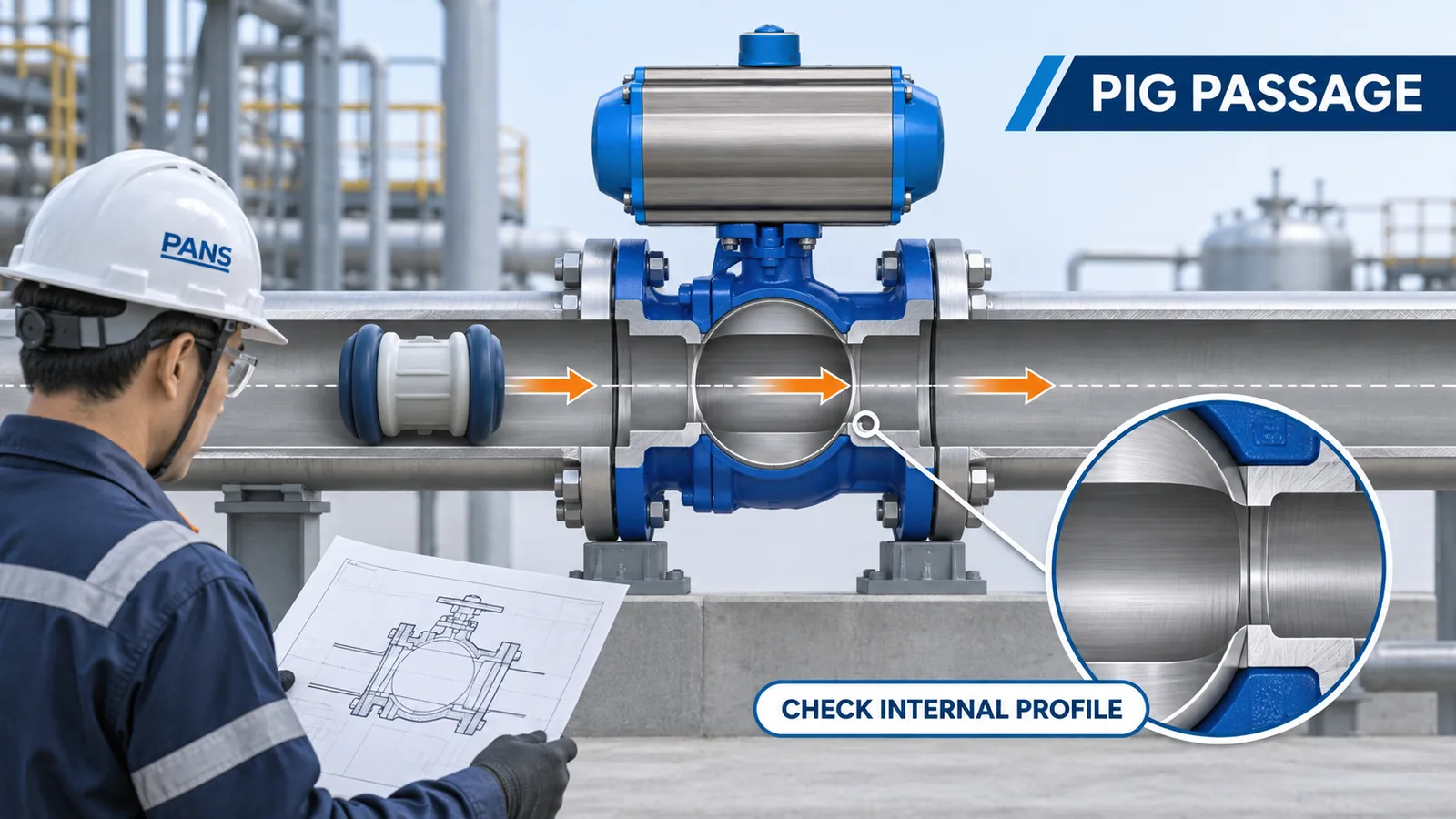
A piggable pipeline ball valve must allow the intended pig to pass without damage, blockage or loss of inspection data. Full bore is often specified because the passage is intended to stay close to line ID and can present a more continuous internal profile. That alone is not proof of pig passage.
The result depends on pipeline design, pig type and condition, valve geometry, seat and cavity details, internal steps, orientation and project requirements. Some reduced-bore valves may suit certain tools or cleaning duties if the pig and valve are compatible, but this must be confirmed from drawings and the pig specification. Never assume that every reduced-bore valve is unsuitable, or that every full-bore valve is piggable.
Ask for a passage drawing and state the pig type, minimum pass diameter, length, gauging plate and launch or receive method. The Válvulas de bola totalmente soldadas PANS are listed for transmission, distribution and heating supply duties; confirm the bore and internal geometry for the exact model.
What Do Weight, Torque, Space and Installed Cost Change?
Full bore valves usually need a larger ball and body to provide the larger passage. That can increase mass, face-to-face or end-to-end dimensions, installation space and lifting needs. The larger ball and seat area can also raise operating torque, although seat design, pressure, temperature and actuator choice can change the result.
Reduced bore designs are often more compact and lighter for the same nominal size, and their purchase price can be lower. Lower purchase price is not the same as lower installed cost. Add actuator size, supports, space, pressure loss and energy use over the operating life.
Torque must be quoted for the actual valve and worst expected differential pressure, not inferred from bore type. A full-port body may need a larger actuator, while a reduced-port body may still need high torque if its seat or pressure class demands it.
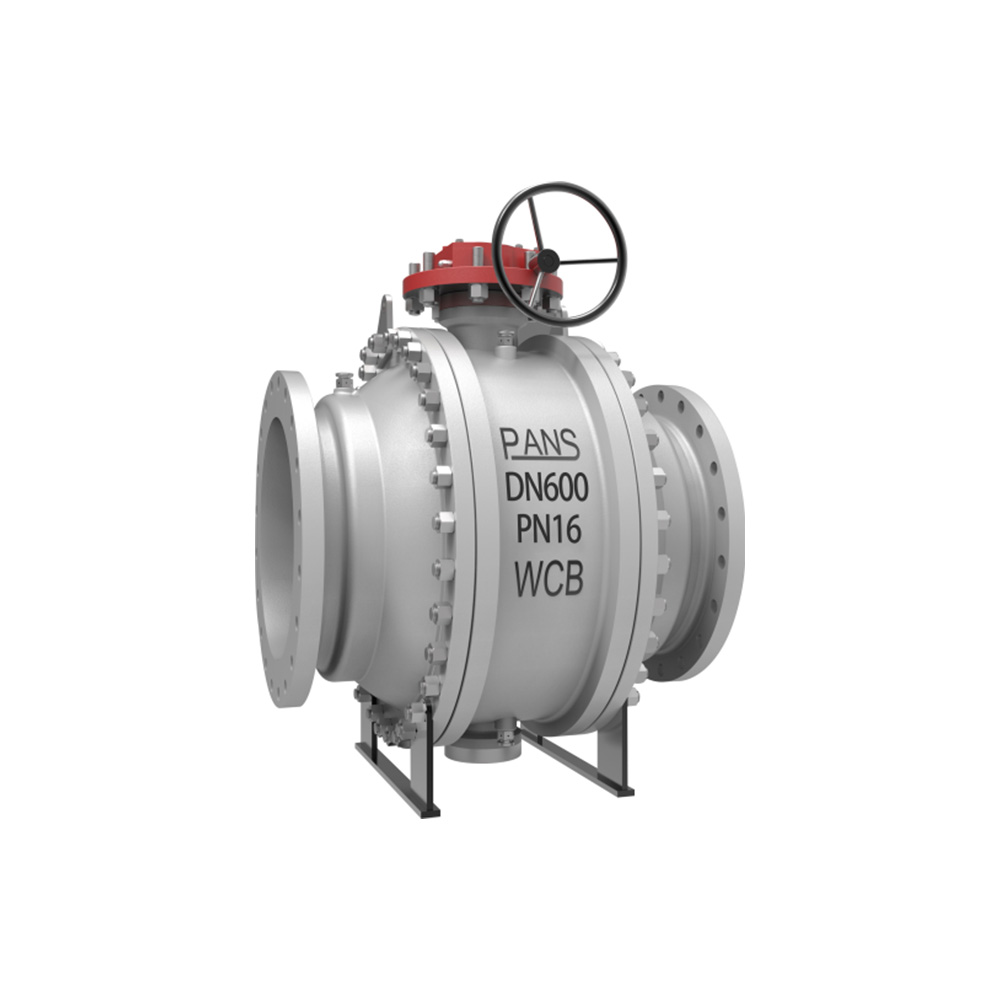
El PANS floating ball valve range (full port) covers split-body, bolted-connection designs with a floating ball, blowout-resistant stem and ISO 5211 mounting pad. The PANS trunnion-mounted ball valves support the ball on trunnions and are listed in full port; confirm the size, class, seat and torque for the duty. The floating versus trunnion ball valve designs explain how body support changes seat load and actuator demand.
Which Application Fits: Pipeline Service or Process Isolation?
Pipeline transmission and distribution often favor full bore, especially where pigging, low pressure loss or a close match to line ID matters. Process isolation often favors reduced bore when flow is moderate, space is tight and the allowed pressure drop leaves room for the restriction. These are starting points, not rules. Check the duty, not the label.
| Project condition | Better starting point | Main reason | Confirm before order |
|---|---|---|---|
| Pigging or inspection planned | A toda potencia | A continuous passage is easier to match to the pig | Pig specification, actual bore, internal steps and valve drawing |
| Tight allowed pressure drop or high flow | A toda potencia | Lower velocity and loss are usually easier to achieve | Flow cases, Cv basis and line ID |
| Compact isolation with spare pressure margin | Diámetro reducido | Smaller body and lower purchase cost can fit the space | Allowed pressure drop, actuator torque and connection dimensions |
| Replacement in an existing line | Match the existing envelope | Face-to-face, mass and actuator clearance may matter more than bore | Survey drawing, piping loads and actuator interface |
| Dirty or abrasive process | Either, subject to design | Bore does not solve wear; seat, ball and materials must suit the solids | Medium, particle size, velocity and maintenance plan |
| Pipeline with pigging and high pressure | Full-bore trunnion, or fully welded with bore confirmed | Supported or welded construction is often selected for larger, higher-pressure duty | Exact model, bore, class, pig passage and project standards |
What Should You Confirm Before Ordering?
Start with the medium and its composition, including solids content, particle size, hardness and any phase change. Then give the flow range and allowed pressure drop at normal, maximum and upset conditions. State the line size and the actual pipe internal diameter; do not rely on DN or NPS alone.
- Medium, concentration and solids content.
- Flow range and allowed pressure drop.
- Line size, schedule and actual internal diameter.
- Pigging requirement, pig type and minimum pass diameter.
- Pressure class and applicable design standard.
- Connection standard, flange facing or weld end.
- Manual or actuated operation, and control method.
- Actuator interface, power or air supply and fail-safe position.
- Face-to-face dimensions, installation orientation and documentation.
If two published specifications conflict, ask for the exact configuration in writing. The quotation should identify the bore, seat, body and actuator assumptions rather than relying on a family name.
Preguntas más frecuentes
1. Is full port the same as full bore?
Usually the terms are used that way for ball valves, but neither term proves the actual bore. Check the drawing and measured passage. A full-port plug valve is a different product and should be specified on its own terms.
2. Can I replace a reduced-bore valve with a full-bore valve without other changes?
Not automatically. The larger body may change face-to-face dimensions, mass, piping loads, clearance and actuator demand. Survey the line and confirm the new valve envelope and interface before ordering.
3. Does a reduced-bore ball valve always increase energy cost?
No. The extra loss depends on flow, actual bore and operating hours. In a low-flow branch with spare pressure margin, the effect may be small. Calculate it at normal and maximum flow rather than assuming from the bore label.
Choose the Bore That Meets the Line Duty
Full bore and reduced bore are not quality grades. Match the passage to flow, pigging, pressure loss, space and total installed cost, then confirm the exact valve geometry. The wrong assumption at RFQ stage can cost more than the difference in purchase price.
Share your valve specification with PANS to request a quotation.
Buscar
Categorías
Etiquetas
Producto
- Válvula de bola
- Válvula de bola flotante
- Válvula de bola completamente soldada
- Válvula de bola de muñón
- Válvula de mariposa
- Válvula de mariposa bidireccional con asiento totalmente metálico
- Válvula de mariposa de alto rendimiento
- Válvula de mariposa con sello rígido de metal y tres excéntricas
- La válvula de retención
- Válvula de retención de elevación fundida
- Válvula de retención oscilante fundida
- Válvula de retención tipo oblea
- Válvula DIN
- Válvula de globo sellada con fuelle DIN
- Válvula de globo DIN
- Válvula de compuerta de vástago ascendente DIN
- Válvula de retención oscilante DIN
- Válvula de forja
- Válvula de retención forjada
- Válvula de bola flotante forjada
- Válvula de compuerta forjada
- Válvula de globo forjada
- Válvula de compuerta
- Válvula de compuerta sellada con fuelle
- Válvula de compuerta plana
- Válvula de compuerta de cuña
- Válvula de globo
- Válvula de globo fundida
- Válvula de tapón
- Válvula de tapón de excentricidad
- Válvula de tapón lubricada con equilibrio de presión invertida
- Válvula de tapón orbital
- Válvula de tapón tipo manguito
- Válvula de lodo
- Válvula de lodo
- Colador


