Industrial Valve Standards Explained: API, ASME, ANSI, EN, ISO, MSS, DIN, JIS
Industrial valve standards establish the design, material, dimensional, testing, and pressure-temperature requirements that manufacturers and buyers use to specify, procure, and install valves safely across oil and gas, chemical, power, and water treatment industries. One of the most widely referenced design standards is ASME B16.34, covering flanged, threaded, and welding-end valves across all pressure classes. PANS Valve is ISO 9001 certified and manufactures to API, GB, BS, DIN, and JIS design standards, with CE and TÜV product certifications across ball, gate, globe, butterfly, check, and specialty valve product lines for global project supply.
Why Do Valve Standards Matter?
Three reasons drive compliance with valve standards api asme ansi and their international equivalents.
Safety is the primary driver. Standards establish minimum requirements that prevent pressure boundary failures, stem blowouts, and seat leakage under operating conditions. Interchangeability is the second. Standardized face-to-face dimensions, pressure classes, and end connections mean valves from different manufacturers fit the same pipeline without modification. Compliance is the third. Projects in regulated industries must specify valves meeting applicable codes. Non-compliant valves create liability exposure and can fail regulatory inspection before commissioning.
What Are the Main Standards Organizations?
Eight organizations produce the industrial valve standards that appear most frequently in global project specifications.
API covers oil and gas. ASME covers mechanical engineering and pressure equipment. ANSI coordinates US voluntary standards including the ASME B16 series. ISO provides internationally harmonized standards for global trade. EN standards cover the European Economic Area. MSS SP covers manufacturers’ standardization for valves and fittings. DIN valve standards originate from Germany and apply across European industrial procurement. JIS covers Japanese industrial standards for valves used in Asian and Pacific markets.
What Are the Key Design and Material Standards?
ASME B16.34 is the foundational design standard for flanged, threaded, and welding-end valves. It covers pressure-temperature ratings, materials, dimensions, tolerances, marking, and testing across all standard pressure classes from Class 150 to Class 2500.
API 600 covers cast or forged steel gate valves for petroleum refinery and processing service. API 602 covers compact steel gate, глобус, и обратные клапаны for sizes NPS 4 and smaller. API 603 covers corrosion-resistant bolted-bonnet gate valves. API 609 covers дроссельные клапаны including double-flanged, lug, wafer, and butt-welding-end designs for petroleum facilities. API 6D covers ball, check, gate, and plug valves for pipeline service with pressure ratings from Class 150 to 2500. These standards cover the majority of valve design requirements across oil and gas procurement globally.
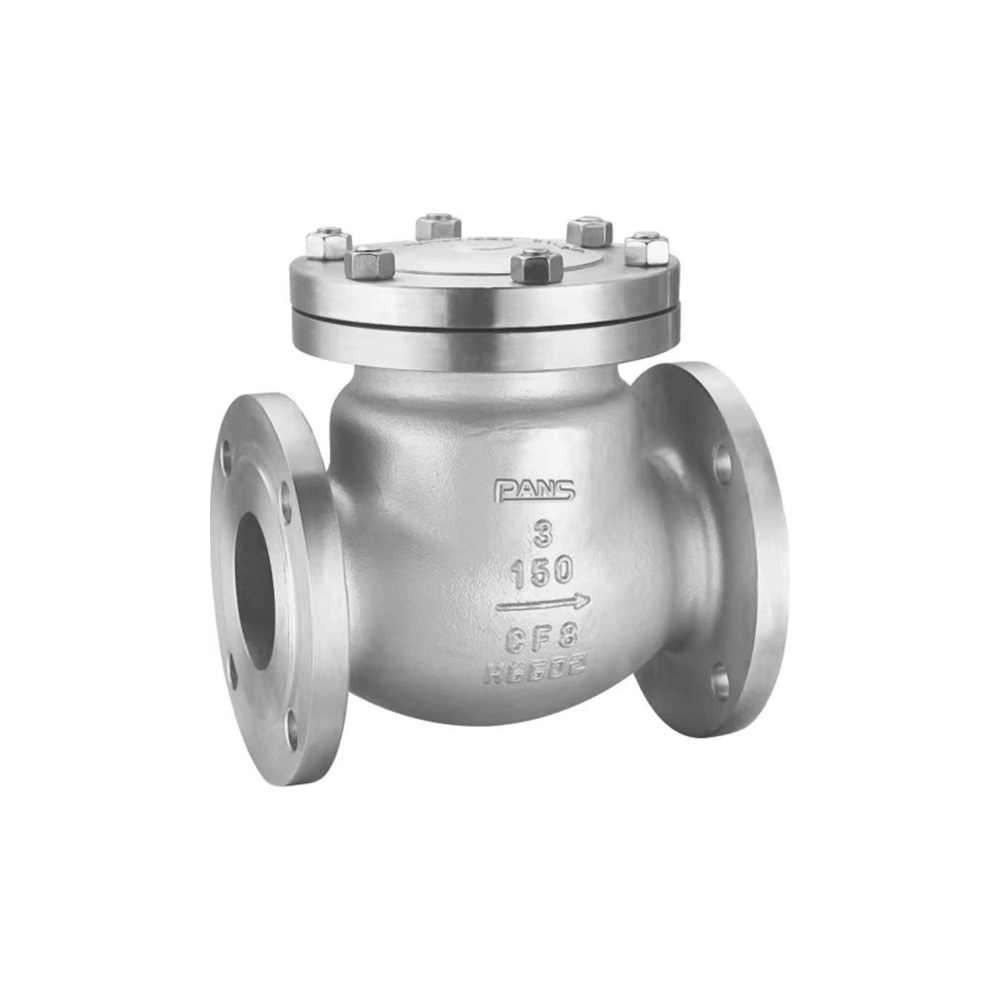
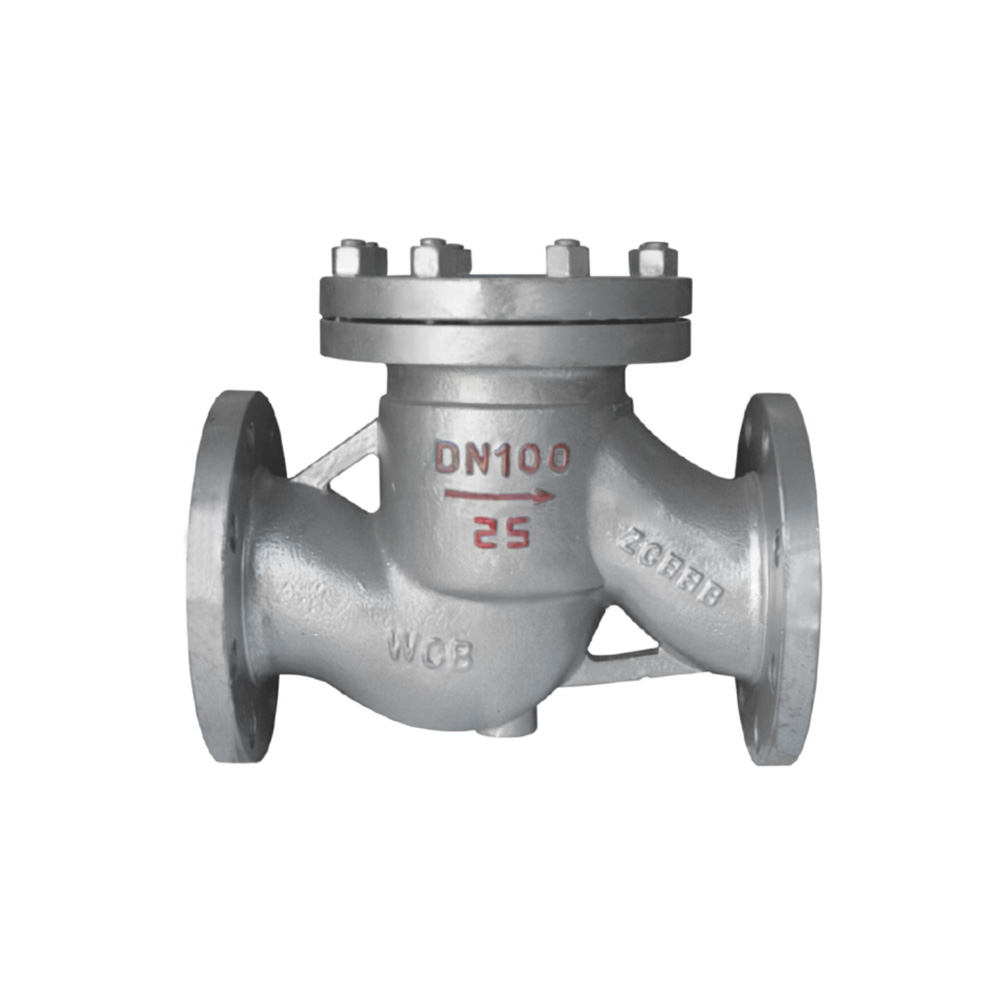
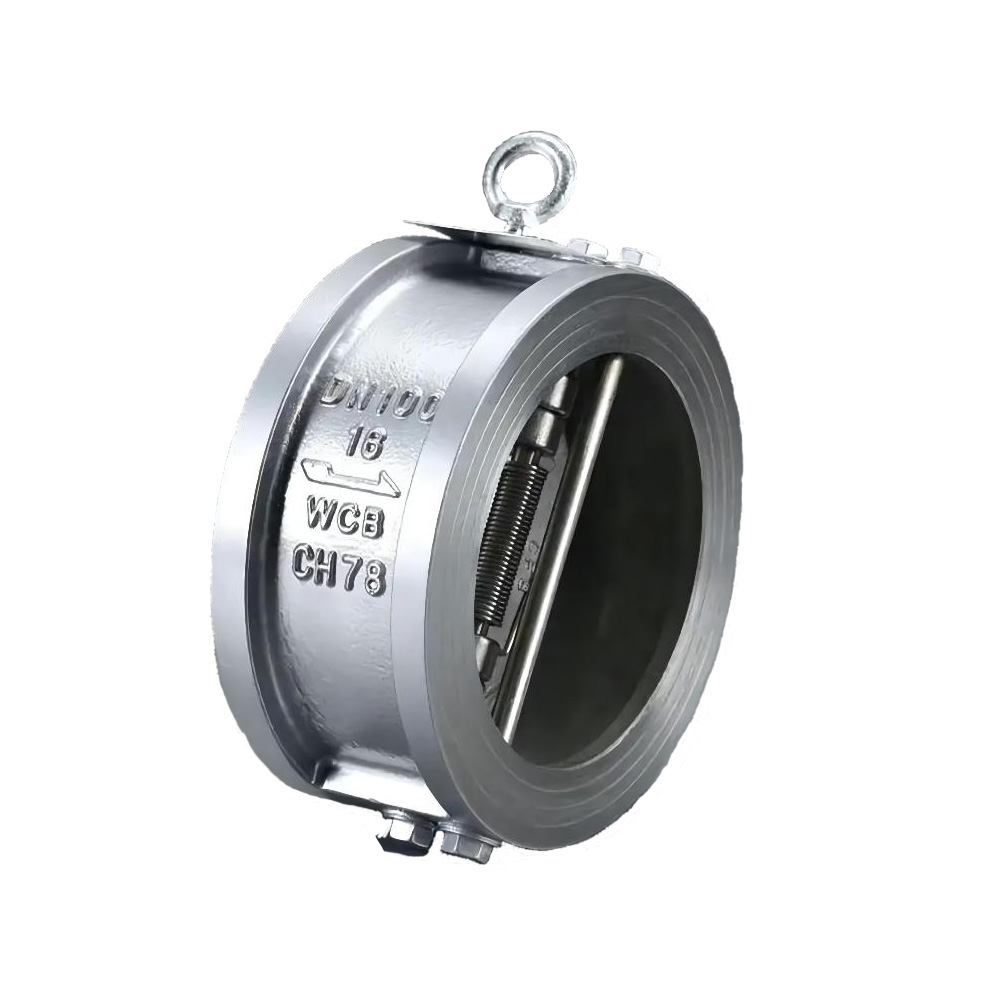
Ознакомьтесь с нашей серией высококачественных обратных клапанов.
What Are the Flange and Pressure-Temperature Standards?
ASME B16.5 covers pipe flanges and flanged fittings from NPS 1/2 through NPS 24. It establishes pressure-temperature ratings, materials, dimensions, and tolerances. ASME B16.47 extends coverage to large-diameter flanges from NPS 26 through NPS 60. Class designations of 150, 300, 600, 900, 1500, and 2500 define the maximum allowable working pressure at each temperature level.
The EN 1092 flange standard covers flanges for European market procurement using PN designations. PN designations and ANSI class designations are not directly interchangeable across all temperature ranges. Buyers specifying for European projects must confirm which flange standard applies. Mixing ANSI and EN flanges in the same piping system without verified dimensional compatibility creates leak risk at the joint.
What Are the Testing and Inspection Standards?
API 598 covers valve inspection and testing requirements including shell testing, backseat testing, and seat testing for gate, globe, plug, ball, check, and butterfly valves. It defines acceptable leakage rates by valve type and pressure class.
API 607 is the fire-safe test standard for quarter-turn valves with nonmetallic seats. API 6FA covers fire testing for valves used in pipeline service. Both verify that the valve maintains acceptable leakage performance during and after fire exposure. ISO 5208 provides international pressure testing requirements for industrial valves and is the basis for EN 12266-1 and China’s GB/T 13927, which are the equivalent references for non-API procurement in European and Asian markets.
How Do US, EU, and Asian Standards Compare?
The following table compares representative standards commonly referenced for similar valve procurement requirements. These standards are not necessarily direct equivalents, and the applicable requirements depend on the valve type, pressure rating, materials, end connections, service conditions, and project specifications.
| Procurement Requirement | US Standards | European Standards | Asian Standards (Examples) |
| General valve design and pressure-temperature ratings | ASME B16.34 | EN 12516 series | ГБ/Т 12224 |
| Задвижки | API 600, API 602, API 603 | EN 1984 | GB/T 12234 |
| Pipeline valves | API 6D | EN 13942, ISO 14313 | GB/T 19672 |
| Поворотные затворы | API 609 | EN 593 | JIS B 2032 |
| Flanges | ASME B16.5, ASME B16.47 | EN 1092-1 | JIS B 2220 |
| Valve pressure testing | API 598 | EN 12266-1 | GB/T 13927, JIS B 2003 |
| Fire-safe testing | API 607, API 6FA | EN ISO 10497 | ISO 10497 |
How Do You Read a Valve Specification or Data Sheet?
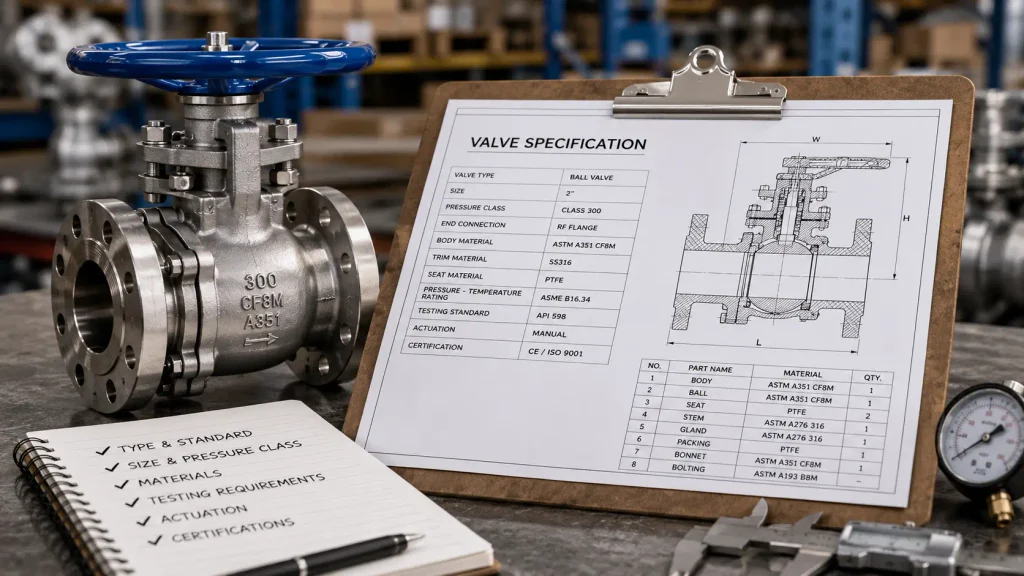
A valve data sheet communicates the complete technical requirements from buyer to manufacturer. Seven fields appear on every properly written valve specification.
Valve type and standard identify the valve design and applicable industrial valve standards governing its manufacture. Size and pressure class cover NPS or DN size plus ANSI class or PN rating. End connection type specifies flanged, butt-weld, socket weld, or threaded. Body and trim material specifies material grades for body, disc, seat, stem, and bolting.
Testing requirement references API 598, EN 12266-1, or project-specific test requirements. Actuation covers manual, pneumatic, electric, or hydraulic with a fail-safe position if applicable. Certification lists required third-party certificates such as CE, TUV, API monogram, or ATEX.
PANS Valve supplies complete material test reports, pressure test certificates, and applicable product certifications with every order. Contact PANS Valve for a project quotation covering DIN valve standards, JIS, API, ASME, and GB requirements from a single certified manufacturer.
Часто задаваемые вопросы
What are the major valve standards used in industry?
The most widely used are ASME B16.34 for valve design, API 6D for pipeline valves, API 600 and API 609 for gate and butterfly valves, API 598 for testing, EN 1092 for European flanges, and ISO 5208 for international pressure testing requirements.
What does ANSI mean in valve standards?
ANSI is the American National Standards Institute. It coordinates and approves standards developed by accredited organizations including ASME. Most valve dimensional and pressure class standards referenced as ANSI are formally ASME standards approved under the ANSI process.
What does ASME B16.34 cover?
ASME B16.34 covers flanged, threaded, and welding-end valves. It establishes pressure-temperature ratings, material requirements, dimensional tolerances, marking requirements, and testing procedures across all standard pressure classes from Class 150 through Class 2500.
What is API 609 used for?
API 609 covers butterfly valves for petroleum facility service including double-flanged, lug-type, wafer-type, and butt-welding-end designs. It specifies design requirements, pressure-temperature ratings, material requirements, face-to-face dimensions, and examination and testing procedures.
Поиск
Категории
Теги
Продукт
- Шаровой кран
- Плавающий шаровой клапан
- Полностью сварной шаровой кран
- Цапфовый шаровой клапан
- Дроссельный клапан
- Двунаправленный дисковый затвор с цельнометаллическим седлом
- Высокопроизводительный поворотный клапан-бабочка
- Трехэксцентриковый металлический поворотный затвор с жестким уплотнением
- Обратный клапан
- Литой подъемный обратный клапан
- Литой обратный клапан
- Обратный клапан вафельного типа
- DIN-клапан
- Проходной клапан с сильфонным уплотнением по стандарту DIN
- Шаровой клапан DIN
- Задвижка с выдвижным штоком DIN
- Поворотный обратный клапан DIN
- Кузница Клапан
- Кованый обратный клапан
- Кованый плавающий шаровой клапан
- Кованая задвижка
- Кованый шаровой клапан
- Задвижка
- Задвижка с сильфонным уплотнением
- Плоская задвижка
- Клиновая задвижка
- Шаровой вентиль
- Литой шаровой клапан
- Пробковый клапан
- Эксцентриситетный пробковый клапан
- Пробковый клапан с перевернутым балансом давления и смазкой
- Орбитальный пробковый клапан
- Пробковый клапан рукавного типа
- Шламовый клапан
- Шламовый клапан
- сетчатый фильтр


